Children Aging Out of Care Thrown into Society Unprepared
1 in 4 Children Are Basic Livelihood Security Recipients, Facing Economic Hardships
Long-term Support System Needed for Stable Independence
 Students arriving at school. The photo is not related to any specific expression in the article. Photo by Moon Honam munonam@
[Asia Economy reporters Han Seung-gon and Lee Joo-mi] Children aging out of care facilities at 18 years old are struggling to stand on their own. There are calls to establish a long-term support system to help them settle stably in society.
According to the Child Rights Protection Agency, 2,587 children aged out of care facilities in 2019. Approximately 2,500 "eighteen-year-old adults" enter society each year.
They receive up to 5 million KRW in self-reliance settlement funds and a monthly self-reliance allowance of 300,000 KRW for three years after aging out. Local governments also provide university entrance fees ranging from 1.5 million to 5 million KRW, and there are financial support measures such as the Child Development Support Account.
However, critics say the current support funds are insufficient for those who must enter society without securing stable employment or a proper footing. It is argued that the scope of financial support should be expanded to provide practical help for self-reliance.
One survey shows many children face economic difficulties after leaving facilities. According to the Ministry of Health and Welfare, from 2014 to 2019, 26.2% of children who left child care facilities and group homes were basic livelihood security recipients. This means one in four aged-out children is a basic livelihood security recipient.
In particular, the rate of basic livelihood security recipients among those in their first year after leaving care reaches 45%, and 13.3% of them remain recipients even after five years.
Children who must become independent immediately after graduating high school tend to choose employment over university. They give up university admission due to urgent livelihood needs. According to the Ministry of Health and Welfare, the university enrollment rate of aged-out children in 2019 was 43.6%.
Considering that the university enrollment rate for high school graduates in the same year was 70.4%, this is a significantly low figure. Children who enter the workforce immediately after graduation find it realistically difficult to secure quality jobs that require high academic credentials and many qualifications.
 Students maintaining social distancing in a line while going to school. The photo is not directly related to the article. Photo by Yonhap News.
In fact, according to the Child Rights Protection Agency, the number of aged-out youth working in service, simple labor, and skilled trades?jobs relatively less preferred by young people?(62%) is twice that of those working in management, professional, and clerical positions (32%).
Ultimately, even if employed, they cannot live comfortably financially. Unable to find good jobs, they must sustain their livelihood on low wages. The same survey shows that as of 2019, 43.2% of employed aged-out children earned less than 1.5 million KRW per month on average.
Considering that office workers within three years of employment spent an average of 1.52 million KRW per month in 2018, these children barely manage to get by compared to other young adults in similar social positions.
There are also opinions that, beyond financial support, a system tailored to each child's individual situation is needed to maximize the practicality of support for self-reliance. Since children live in facilities before becoming independent, they often lack knowledge about allowances, housing, and other issues.
For example, it is difficult to know how to plan and use received allowances or what aspects to focus on when finding a home unless they receive advice from those around them or seek information themselves.
According to the "2016 Survey on the Self-Reliance Status and Needs of Aged-Out Youth" published by the Ministry of Health and Welfare, the problems faced by aged-out youth after becoming independent include psychological burden (10.1%), lack of money management knowledge (7.7%), lack of employment information and skills (6.8%), and others (13.5%).
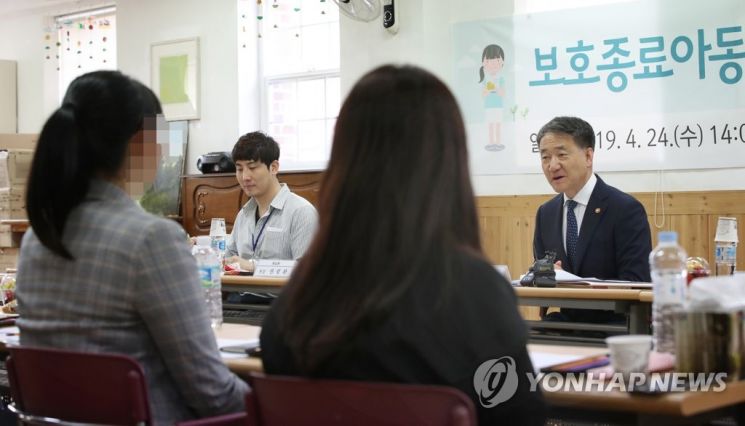 Former Minister of Health and Welfare Park Neung-hoo visited Hyesimwon in Yongsan-gu, Seoul, on the afternoon of April 24, 2019, and held a meeting with facility officials regarding independence allowances for children aging out of care.
 [Image source=Yonhap News]
One system that helps children facing such difficulties closely and supports their settlement is the Self-Reliance Support Specialist. These specialists systematically assist children in preparing for independence before leaving the facility and help them adapt stably to society within five years after aging out.
However, their numbers are woefully insufficient compared to the number of aged-out children, making practical help limited. According to the Child Rights Protection Agency, as of 2018, there were 262 self-reliance specialists. Considering children within five years after aging out plus those still in care, each specialist manages over 100 children.
Due to the absolute shortage in numbers, the quality of management inevitably declines. Although the system is designed to provide support, there are voices saying it lacks effectiveness.
Experts point out that the current support system is inadequate to help aged-out children settle in society. Professor Jeong Jong-hwa of the Department of Social Welfare at Samyook University said, "Aged-out children grew up living collectively in facilities, so they have difficulties living independently on their own," and suggested, "There is a need to increase the number of self-reliance specialists beyond the current level." He added, "Not only increasing the number of specialists but also utilizing tailored employment education support programs and job coaches (professionals who provide continuous assistance for the employment of people with disabilities) should be used to properly prepare for independence even before aging out."
© The Asia Business Daily(www.asiae.co.kr). All rights reserved.
!["The Woman Who Threw Herself into the Water Clutching a Stolen Dior Bag"...A Grotesque Success Story That Shakes the Korean Psyche [Slate]](https://cwcontent.asiae.co.kr/asiaresize/183/2026021902243444107_1771435474.jpg)


















