[Asia Economy Honam Reporting Headquarters Reporter Park Seon-gang] Gwangju Metropolitan City announced on the 4th that the area around 649 Gyerim-dong, Gwangju, has been selected as the target for the urban ‘Vulnerable Area Living Conditions Improvement Project’ contest hosted by the National Balanced Development Committee.
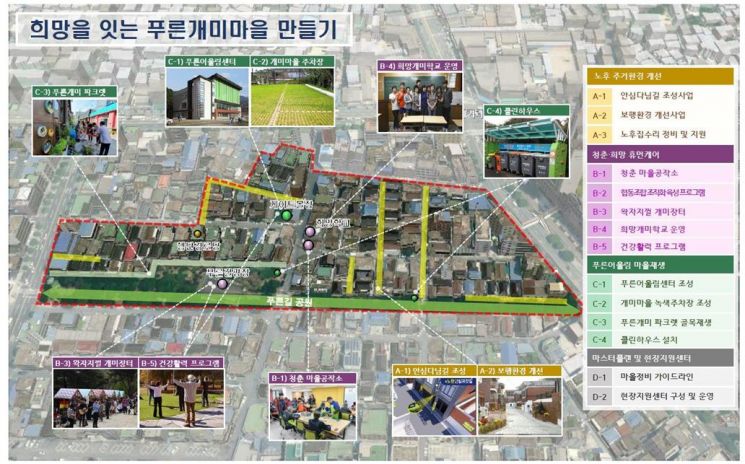
The area around 649 Gyerim-dong, Dong-gu, selected for this contest project, is a village located at the starting point of ‘Pureungil Park,’ a forest path within the abandoned railway site extending from Gwangju Station to Baegun Square. It had been a region marginalized by urbanization, suffering from slum conditions and many substandard houses, resulting in vulnerable residential living environments.
Following the selection, Gwangju City will invest a total of 4.9 billion KRW, including 3.5 billion KRW in national funds, by 2024 to carry out various projects such as installing parking lots within residential areas, renovating old slate roofs, improving pedestrian environments by installing streetlights and closed-circuit televisions (CCTV), and establishing a community center as a communication space for residents, which has been a long-standing wish of the local residents.
To secure the project selection, Gwangju City visited the National Balanced Development Committee and the Ministry of Land, Infrastructure and Transport to explain the area's vulnerabilities and incorporated various improvement measures into the project plan.
Moreover, by thoroughly preparing for the first written evaluation and attending the second on-site evaluation to actively explain the necessity of improving the vulnerable environment within the city, Gwangju achieved the distinction of being one of only two metropolitan cities, along with Busan, to be finally selected.
Lee Sang-bae, Director of the City Regeneration Bureau, said, “We expect this project to expand living infrastructure in areas densely populated by socially vulnerable groups, revitalize relatively underdeveloped areas by resolving safety issues such as aging buildings and disaster risks.”
© The Asia Business Daily(www.asiae.co.kr). All rights reserved.
![Clutching a Stolen Dior Bag, Saying "I Hate Being Poor but Real"... The Grotesque Con of a "Human Knockoff" [Slate]](https://cwcontent.asiae.co.kr/asiaresize/183/2026021902243444107_1771435474.jpg)











