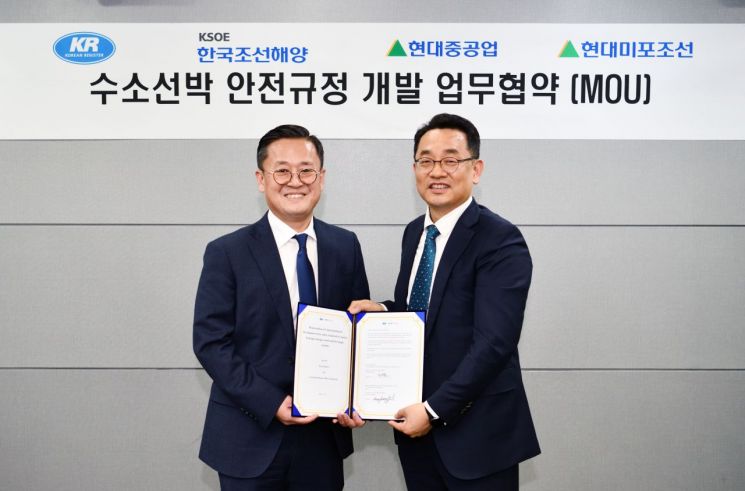
[Asia Economy Reporter Hwang Yoon-joo] Korea Shipbuilding & Offshore Engineering, a mid-tier holding company of Hyundai Heavy Industries Group, is partnering with Korean Register to develop the world's first international standards for hydrogen ships.
Korea Shipbuilding & Offshore Engineering recently signed a Memorandum of Understanding (MOU) with Korean Register at Bundang First Tower in Seongnam-si, Gyeonggi-do, to develop safety design regulations for hydrogen ships. Through this MOU, the two companies plan to jointly develop the world's first international standards for hydrogen ships and submit them to the International Maritime Organization (IMO) by 2022.
For ships to navigate the world's oceans, they must be built according to IMO ship regulations; however, there are currently no standards related to hydrogen ships. In particular, gas carriers must comply with regulations (IGC Code and IGF Code) covering the storage, operation, and emergency procedures for liquefied gases rather than general cargo, making the establishment of standards more complex.
Leveraging advanced technology, Korea Shipbuilding & Offshore Engineering will review conditions for the safe handling of hydrogen, including gas storage and fuel supply systems and cargo handling systems, together with Korean Register. Hyundai Heavy Industries and Hyundai Mipo Dockyard will also participate in the joint research, providing advice on detailed matters such as hull design and cargo hold arrangement based on their extensive experience in building gas carriers.
Since January, Korea Shipbuilding & Offshore Engineering has been participating in the 'Development of Safety Standards for Hydrogen Ships' project led by the Ministry of Oceans and Fisheries, taking the lead in establishing domestic and international technical standards.
Additionally, Korea Shipbuilding & Offshore Engineering obtained basic certification from Korean Register last October for the world's first commercially developed liquefied hydrogen carrier. Recently, it has partnered with Ulsan City and others to develop eco-friendly fuel cargo hold technologies for LNG, hydrogen, and other fuels, accelerating its hydrogen-related business.
A representative from Korea Shipbuilding & Offshore Engineering stated, "We will establish domestic and international technical standards for hydrogen carriers and hydrogen fuel-powered ships to advance the era of hydrogen ships. Furthermore, we will continuously secure alternative fuel technologies such as hydrogen and ammonia to lead the era of carbon-neutral ships."
According to the 'Hydrogen, Scaling Up' report released in 2017 by the Hydrogen Council, a global coalition of companies leading the hydrogen economy, the global hydrogen market is expected to grow to $2.5 trillion by 2050, accounting for 18% of total energy demand.
© The Asia Business Daily(www.asiae.co.kr). All rights reserved.

















