Ministry of Science and ICT Initiates System Construction
[Asia Economy Reporter Kim Bong-su] An intelligent research safety system that manages safety risk factors in real-time and systematically through artificial intelligence (AI) and the Internet of Things (IoT) is being launched to ensure the safety of universities, research institutions, and laboratories.
On the 4th, the Ministry of Science and ICT announced that it has established a system that provides customized safety information for laboratories by utilizing hazardous factor information such as chemicals, protective equipment, and research equipment within laboratories.
So far, the Ministry of Science and ICT has identified the safety management status through an annual ‘Laboratory Safety Management Survey’ for each institution, including universities, research institutions, and corporate research centers, and has provided necessary safety information to research sites. However, as research subjects and fields have become increasingly diverse, concerns have been raised about the rising possibility of laboratory safety accidents.
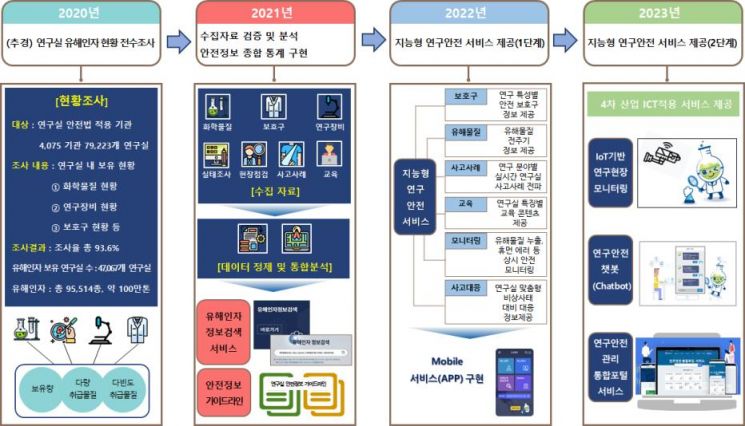
In response, last year, the Ministry of Science and ICT collected, for the first time in Korea, the status of hazardous factors held at the laboratory level to subdivide the safety management system by institution. They surveyed the status of over 95,000 types of hazardous factors handled in approximately 70,000 laboratories across 4,075 institutions (universities, research institutions, corporate research centers) nationwide.
The Ministry plans to first utilize this information, after verification and classification, to prevent laboratory accidents and respond quickly to incidents, and later build an intelligent research safety system that provides customized comprehensive safety information for each laboratory based on this data.
This year, researchers will be able to check the risks of hazardous factors through a mobile-based hazardous factor search service, and safety guidelines and other measures will be prepared for hazardous factors with a high probability of causing accidents. Starting next year, the mobile app will provide safety protective equipment and educational content tailored to the characteristics of each laboratory, as well as emergency response guidance for accidents occurring in domestic and international laboratories, and accident prevention information for laboratories in similar environments.
In particular, the goal is to build an intelligent research safety system that can manage issues such as hazardous substance leaks and human errors in laboratories in real-time by combining AI, IoT technologies, and more.
Kang Sang-wook, Director of the Future Talent Policy Bureau at the Ministry of Science and ICT, said, "We have included safety in the ‘4th Basic Plan for Fostering and Supporting Science and Technology Talent’ so that student researchers can focus on research in a safe environment, and we are doing our best, including signing a memorandum of understanding (MOU) with the Ministry of Education for university laboratory safety management," adding, "We will strive to discover and develop various safety information content by utilizing laboratory hazardous factor information so that researchers can receive safety management services anytime and anywhere."
© The Asia Business Daily(www.asiae.co.kr). All rights reserved.
![From Bar Hostess to Organ Seller to High Society... The Grotesque Con of a "Human Counterfeit" [Slate]](https://cwcontent.asiae.co.kr/asiaresize/183/2026021902243444107_1771435474.jpg)
















