Rapid Recovery Seen in Chinese Market
'Domestic Demand' in China Drives 'Hybrid Vehicle Sales Expansion' and Rising Japanese Market Share
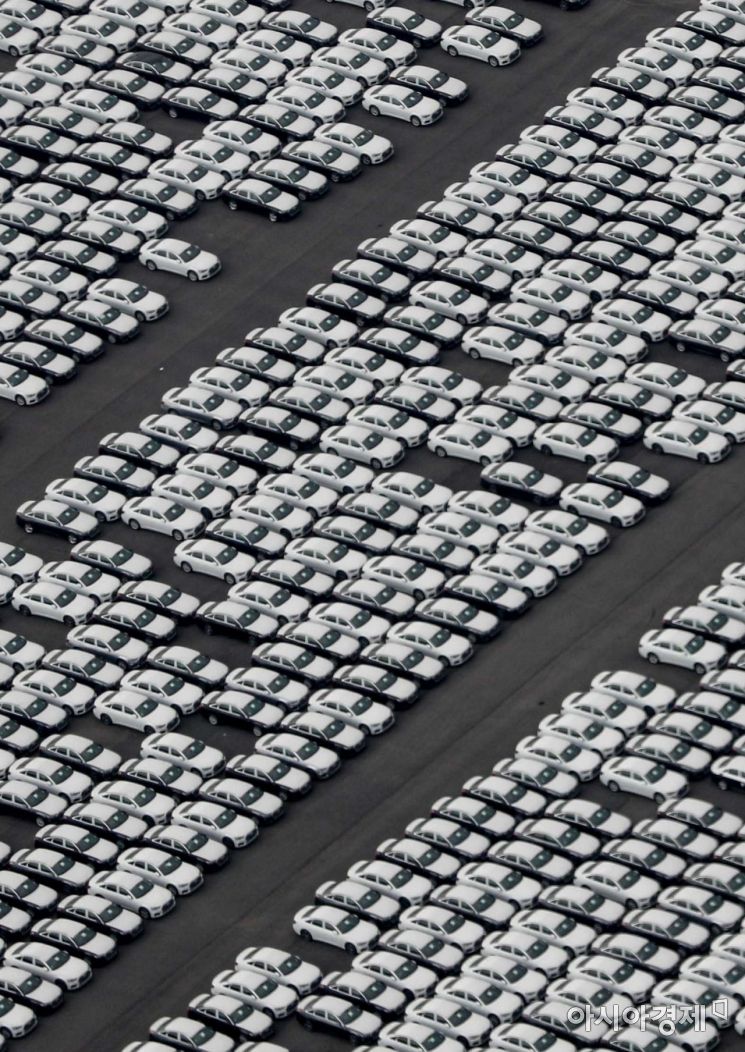 Imported cars are waiting to be shipped at Pyeongtaek Port, viewed from a Seoul Metropolitan Police Agency helicopter on the 10th, one day before the Lunar New Year holiday./Photo by Jinhyung Kang aymsdream@
[Asia Economy Reporter Yoo Je-hoon] Last year, while the market share of Korean brands in the global finished car market remained at the previous year's level, Chinese and Japanese automobile brands slightly increased their market shares. Following the COVID-19 pandemic, the rapid recovery of automobile demand in China in the second half of last year led to performance in the Chinese market driving the gap in market share.
According to the '2020 Overseas Major Automobile Market Sales and Policy Trends' report published on the 4th by the Korea Automobile Manufacturers Association (KAMA), which surveyed seven major countries worldwide, the global market shares of Korean, Chinese, and Japanese makers last year were 7.5%, 14.8%, and 25.8%, respectively. The market share of Korean makers remained the same as the previous year, while Chinese and Japanese makers' shares increased by 1.3 and 0.3 percentage points, respectively.
The differentiating factor between Korean and Chinese/Japanese makers was the Chinese market. Due to the impact of COVID-19 that struck last year, sales in major global markets decreased by 14.9% compared to the previous year, but the Chinese market showed a rapid recovery, reducing the decline to 6.1%, which was lower than other countries.
Korean makers increased their market shares in major markets such as the United States (0.6% increase), Europe (0.3%), and India (4.4%) by launching popular new models in high consumer preference segments like sport utility vehicles (SUVs) and minimizing production disruptions compared to competing countries. However, in the Chinese market, sales decreased by over 30%, resulting in a 15.9% drop compared to the previous year, limiting the maintenance of market share in major countries' automobile markets.
On the other hand, Chinese makers reduced their sales decline to 6.9% compared to the previous year, supported by strong domestic brand preference in their solid domestic market. Consequently, their market share showed the largest increase, rising from 13.5% in 2019 to 14.8% last year (an increase of 1.3 percentage points).
Japanese brands also saw a 14.0% decrease in total sales compared to the previous year, with a slight increase in market share from 25.5% to 25.8%. KAMA's analysis attributes this to strong performance in the U.S. market and increased sales centered on hybrid vehicles in the Chinese market (0.8% increase). In fact, last year, Japanese brands' hybrid vehicle sales in China increased by 27.3% compared to the previous year.
Meanwhile, American brands maintained their market share of 18.6% despite a 14.9% decrease compared to the previous year, supported by a recovery in the domestic market in the second half of the year and increased sales driven by premiumization and upsizing trends in the Chinese market. European brands performed relatively well in the Chinese market, focusing on premium brands, but their market share fell from 32.6% to 31.1% due to about a 40% decrease in domestic sales in the first half caused by COVID-19.
Meanwhile, in this situation, each country is not only expanding short-term support such as subsidies for electric vehicle purchases but also continuously announcing industrial restructuring plans to secure domestic competitiveness in future car core components such as batteries and semiconductors, making close monitoring necessary, according to KAMA.
Jung Man-ki, chairman of KAMA, stated, "This year's automobile demand will vary by market depending on the end of COVID-19, but for us, it is necessary to enhance production capacity and flexibility, such as flexible working hours, in preparation for a surge in demand."
Additionally, regarding each country's industrial restructuring strategies, Chairman Jung said, "In the long term, due to China's export controls on rare earths and dominance over battery raw material mines, our electric vehicle-focused industrial restructuring may increase China's influence over our industry. Therefore, efforts should be made to secure overseas mines for nickel, manganese, cobalt, etc., and diversify rare earth import sources from China to countries like Russia and Vietnam." He added, "In particular, the portfolio for producing eco-friendly vehicles should be expanded with various power sources such as hydrogen, eco-friendly internal combustion fuels, and bio-methane."
© The Asia Business Daily(www.asiae.co.kr). All rights reserved.

![Clutching a Stolen Dior Bag, Saying "I Hate Being Poor but Real"... The Grotesque Con of a "Human Knockoff" [Slate]](https://cwcontent.asiae.co.kr/asiaresize/183/2026021902243444107_1771435474.jpg)















