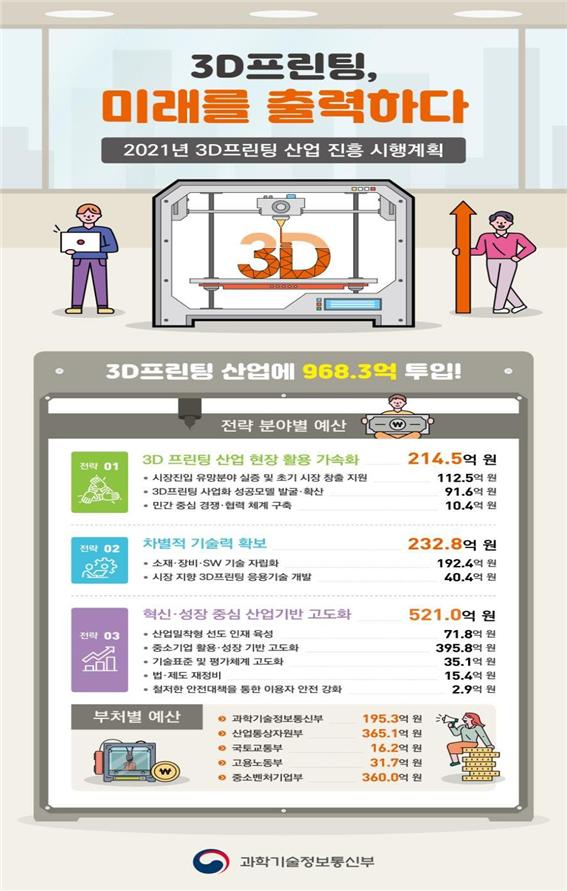
[Asia Economy Reporter Joesulgina] The government will invest 96.83 billion KRW this year to promote the 3D printing industry. Through on-site utilization, it plans not only to discover Korean-style success cases but also to achieve self-reliance in core materials, equipment, and software (SW) technologies.
The Ministry of Science and ICT and related ministries announced on the 4th the ‘2021 3D Printing Industry Promotion Implementation Plan.’ The plan focuses on creating market demand, securing technological competitiveness, expanding the industry, and strengthening institutional foundations, including ▲accelerating on-site utilization of the 3D printing industry (21.45 billion KRW), ▲securing differentiated technological capabilities (23.28 billion KRW), and ▲advancing an innovation- and growth-centered industrial base (52.1 billion KRW). This is the second-year implementation of the 2nd Basic Plan for 3D Printing Industry Promotion (2020?2022), with a total investment of 96.83 billion KRW for this year.
First, the government will discover Korean-style success cases to accelerate on-site utilization of the 3D printing industry. To apply industrially and create markets, it will expand the on-site demonstration base for industrial parts, develop 3D printing technologies for buildings, and establish test beds. It will also support clinical demonstrations for technology development aimed at commercializing medical devices.
Additionally, to discover successful commercialization models of 3D printing, the government plans to promote manufacturing innovation demonstration projects supporting the development of high value-added products and parts processes using 3D printing technology. It will conduct process development consulting for manufacturing innovation, support data-based process technologies, and promote technology activation projects across various industrial sectors. Support measures also include customized production for small business owners and SMEs, awareness improvement through conferences, publication of industry development survey reports, and operation of expert consultative bodies involving academia, industry, and research institutes.
The government will also accelerate efforts to secure technological capabilities. It will focus on self-reliance in core materials, equipment, and SW technologies, concentrating capabilities on fields with high potential demand and where technology preemption is essential. Development will be pursued from next-generation materials such as ultra-lightweight and functional materials to precision, large-scale, and customized equipment. It will also develop elemental and platform technologies for domestic production of core industrial SW. Alongside this, to develop market-oriented applied technologies, support will be provided for medical and bio-innovative technologies, lifestyle innovation-type high-quality and customized production technologies, and new industry applied technologies for manufacturing innovation.
The industrial base will also be advanced. Innovation and growth will be promoted through fostering specialized talent, upgrading infrastructure for manufacturing innovation and corporate growth, enhancing technology standards and evaluation systems, and improving laws, regulations, and safety. While operating university degree programs for convergence-type specialized talent, it will also foster master’s and doctoral-level personnel in new materials fields and cultivate practical talent through in-service training. A ‘3D Printing Convergence Technology Center’ will be established to provide one-stop services specialized for startups and support manufacturing innovation process development. Production and process support centers linked to regionally specialized industries will also be operated.
Furthermore, the government will lead international standardization activities for 3D printing, establish national technical standards, develop material quality evaluation standards, and create and disseminate SW quality reliability assurance guides. Plans also include operating and demonstrating joint manufacturing centers for medical devices, expanding evaluation-type qualification courses in the 3D printing field, and improving practical evaluations.
In addition, to strengthen the safety of 3D printing users through thorough safety measures, the government will establish cross-ministerial 3D printing usage safety measures and promote institutional improvements for systematizing and enhancing safety education for service providers.
Lee Seungwon, Director of Information and Communication Industry Policy at the Ministry of Science and ICT, stated, “In the era of digital transformation driven by the 4th Industrial Revolution and COVID-19, 3D printing technology can serve as a new growth engine and a starting point for innovation. We are strategically promoting demand discovery, talent cultivation, technology development, and infrastructure advancement. This year, we plan to focus on expanding the market through discovering manufacturing innovation demands for 3D printing, revitalizing startups related to 3D printing, and implementing measures to strengthen 3D printing usage safety.”
More detailed information about the 2021 implementation plan can be found on the websites of the Ministry of Science and ICT, related agencies, the dedicated agency Korea Information and Communication Industry Promotion Agency, and the 3D Imagination Portal (www.3dbank.or.kr).
© The Asia Business Daily(www.asiae.co.kr). All rights reserved.
![Clutching a Stolen Dior Bag, Saying "I Hate Being Poor but Real"... The Grotesque Con of a "Human Knockoff" [Slate]](https://cwcontent.asiae.co.kr/asiaresize/183/2026021902243444107_1771435474.jpg)
















