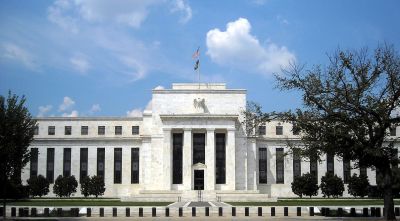
 United States Federal Reserve System
[Asia Economy Reporter Junho Hwang] Interest in the direction of monetary policies of various central banks, which will be held from the 11th to the 19th, has increased due to the rising trend of the US 10-year Treasury yield. The focus is on whether there will be changes in the policy directions of each central bank due to the distribution of COVID-19 vaccines and the recent rise in market interest rates and expected inflation.
The monetary policy meetings of major central banks will be held starting with the European Central Bank (ECB) on the 11th, followed by the US Federal Open Market Committee (FOMC) and the Bank of England (BOE) on the 18th, and the Bank of Japan (BOJ) on the 19th. Among these, the most attention is on the US FOMC, which has the greatest impact on the global currency market.
If statements aimed at stabilizing market interest rates come out at the FOMC, the stock market is likely to gain momentum. Since the COVID-19 pandemic, governments around the world have injected liquidity to revive the economy. The abundant liquidity flowed into risky assets such as stocks, revitalizing the stock markets in the US and South Korea. However, if the FOMC focuses more on economic recovery than market interest rates, the story changes. Currently, expectations for economic recovery due to abundant liquidity have raised concerns about rising expected inflation accompanied by price increases across commodities. In particular, vaccine supply and US economic stimulus measures could act as catalysts for price increases. The University of Michigan's expected inflation sentiment in the US for February recorded 3.3%, the highest level since August 2014.
Jaeun Najo, a researcher in asset allocation at Hana Financial Investment, explained, "It seems highly likely that the FOMC will seek to stabilize market interest rates," adding, "Despite improved economic forecasts, the situation still falls short of long-term goals, and inflationary pressures are temporary, so the current policy is likely to be maintained. There is also a possibility of additional measures such as Operation Twist, which reduces short-term bonds and increases long-term bond purchases, or yield curve control cards that can purchase long-term bonds unlimitedly at a certain level."
Do-eon Kim, a researcher at KB Securities, noted, "The FOMC may revise upward economic forecasts and make changes to the dot plot as early as this month," highlighting the change in perception of the Federal Reserve, the US central bank. Fed Chair Jerome Powell stated, "At the Jackson Hole meeting in August 2020, the future Fed policy goal is to achieve inclusive full employment and make policy decisions based on the shortfall from the full employment level." According to KB Securities, since 1980, the average time for the unemployment rate to recover after five recessions has been 102 months. Labor force participation rate and employment rate have not yet reached previous levels due to structural limitations since the 2000s.
© The Asia Business Daily(www.asiae.co.kr). All rights reserved.
!["The Woman Who Threw Herself into the Water Clutching a Stolen Dior Bag"...A Grotesque Success Story That Shakes the Korean Psyche [Slate]](https://cwcontent.asiae.co.kr/asiaresize/183/2026021902243444107_1771435474.jpg)















