Ministry of SMEs and Startups Requests Investigation into Fraud in 'Non-Face-to-Face Service Voucher' Program
Payment for Proxy Applications...Employment of Part-Timers May Constitute 'Fraud'
Strengthening Early Warning System for Fraud... "Strict Punishment with No Tolerance"
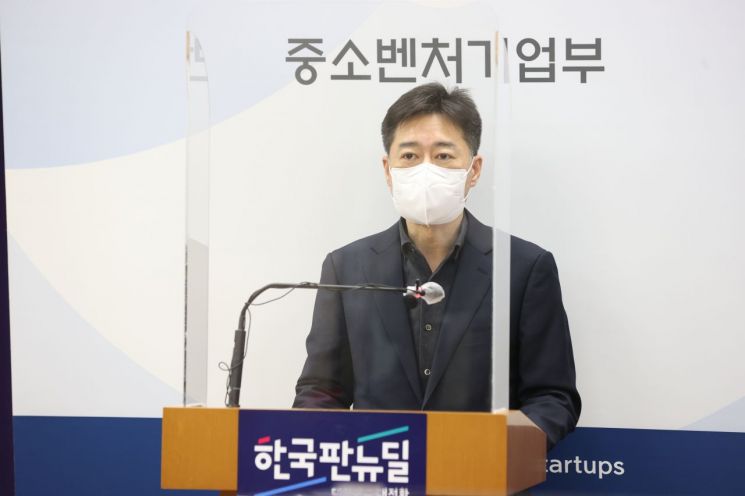 Park Yong-sun, Director of Venture Innovation Policy at the Ministry of SMEs and Startups, is giving a briefing on fraudulent activities related to the 'Non-face-to-face Service Voucher' project at the government Daejeon Government Complex on the 4th.
[Asia Economy Reporter Kim Bo-kyung] A company was caught enjoying government subsidy benefits by giving laptops worth 2 million KRW to businesses in exchange for purchasing its services. This is a rebate act exploiting loopholes in the 'Non-face-to-face Service Voucher' project implemented by the Ministry of SMEs and Startups since last year. The Ministry stated, "We will strictly punish without leniency" and "We will minimize fraudulent acts that cause budget waste in advance."
On the 4th, the Ministry of SMEs and Startups announced that it referred seven supplying companies suspected of fraudulent acts such as providing cash or in-kind benefits to demand companies to induce project applications through the Non-face-to-face Service Voucher project to the police for investigation. Investigations were also requested for two other cases suspected of specific fraudulent acts, although the supplying companies were not identified.
The Non-face-to-face Service Voucher project supports small and medium enterprises in adopting non-face-to-face services such as video conferencing and telecommuting by covering up to 90% of costs within a maximum limit of 4 million KRW. For example, if a service worth 4 million KRW is purchased, the demand company pays only 400,000 KRW, and the government supports 3.6 million KRW.
Last year, the Ministry selected 368 service supplying companies such as application providers and 80,000 demand companies to create a non-face-to-face work environment amid the COVID-19 pandemic, investing a budget of 288 billion KRW.
The Ministry detected illegal activities based on on-site investigations conducted by the 'Public-Private Joint Inspection Team' formed in November last year and reports received through the 'Fraud Report Center.'
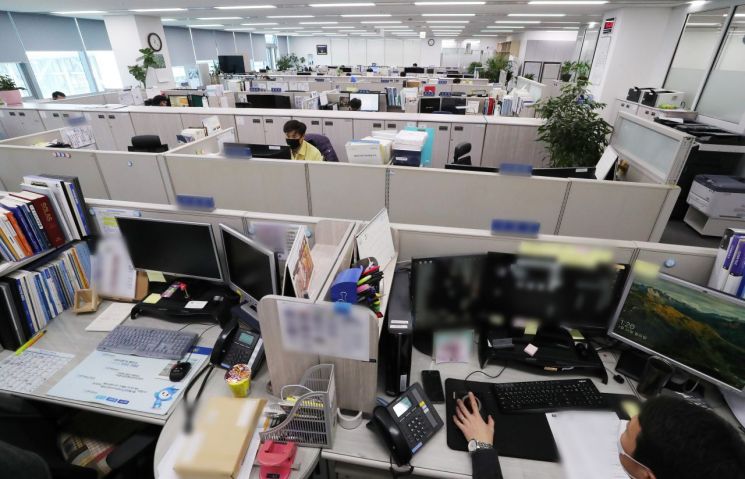
Supplying company A was caught providing laptops worth 2 million KRW to companies in exchange for purchasing its services. Although there were statements from demand companies who received the laptops and photographic evidence of the laptops, A denied the allegations. However, after receiving voluntary reports of fraudulent acts, 12 reports of receiving laptops from company A were submitted. The Ministry canceled A's selection and referred the case for investigation.
Supplying company B contracted with sales agencies and mobilized a merchant association to apply for the project and make payments on behalf of others. It was also found that 200,000 KRW per case was paid to merchants who applied for the project. Supplying company C is suspected of collusion with an association. The association guided its member companies on how to apply for the project and encouraged them to purchase C's services by promising an 800,000 KRW refund upon purchase.
Supplying company D was also caught hiring part-time workers to carry out organized proxy applications and paying a commission of 5,000 KRW per case. The Ministry views that the part-time workers arbitrarily writing service utilization plans for organized proxy applications not only violates the Subsidy Act but may also be subject to criminal charges of fraud under the Criminal Act.
The Ministry is preparing various measures to prevent fraudulent acts during this year's project implementation. To block proxy applications and payments in advance, a function was added to the platform to verify and block duplicate mobile phone numbers so that one individual can apply for only one company. Also, within the voucher support limit of 4 million KRW, the payment limit per supplying company was lowered to 2 million KRW to encourage purchasing services from two or more supplying companies.
In addition to analyzing the usage status after demand companies purchase service products, a monitoring group of about 100 citizens will be formed to directly experience and evaluate the services of supplying companies.
Park Yong-soon, Director of Venture Innovation Policy at the Ministry of SMEs and Startups, stated, "We plan to strengthen the platform's 'Fraud Early Warning' function to increase the possibility of early detection, and to strictly punish through thorough on-site investigations and zero tolerance policy."
© The Asia Business Daily(www.asiae.co.kr). All rights reserved.


















