100% Distribution of Eco-Friendly Buoys by 2025
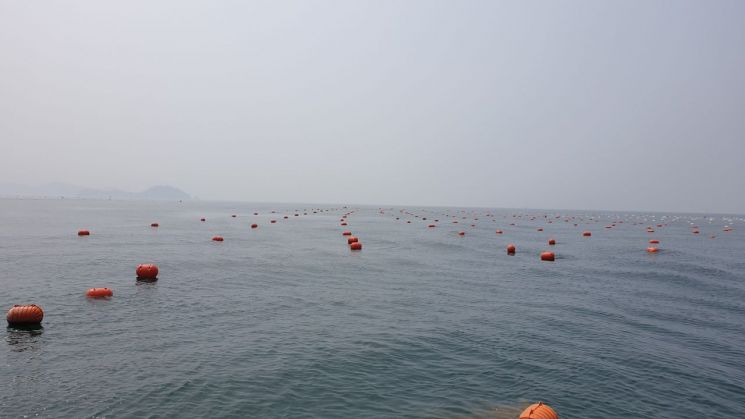
[Asia Economy Yeongnam Reporting Headquarters Reporter Park Saeyan] Gyeongsangnam-do held a council meeting at the oyster cooperative in Tongyeong on the 3rd to efficiently distribute eco-friendly buoys.
In Gyeongnam Province, 7.68 million buoys are used across 5,802 hectares of aquaculture farms for oysters, pearl mussels, sea squirts, and others, accounting for 70% of the national production volume.
So far, 900,000 eco-friendly buoys have been supplied, making the distribution rate 12% of the total buoy usage.
The province is aiming to replace 100% of aquaculture farm buoys with eco-friendly buoys by 2025 to reduce marine microplastics.
At the council meeting, various measures were discussed, including explanations on the progress of the eco-friendly buoy distribution project and institutionalizing the use of eco-friendly buoys.
In particular, the province sought ways to relieve the self-payment burden on fishermen purchasing eco-friendly buoys by eliminating the purchase contract fees charged by the National Federation of Fisheries Cooperatives and returning pricing authority to the fishermen.
Additionally, the province proposed to the Ministry of Oceans and Fisheries to improve related systems so that buoy manufacturers producing eco-friendly buoys can be exempted from recycling fees, enabling supply to fishermen at even lower prices.
Through this, it is expected that the 14% price reduction of eco-friendly buoys will reduce fishermen’s burden by approximately 3.8 billion KRW and buoy manufacturers’ annual burden by 1.1 billion KRW.
Furthermore, the province plans to promote pilot areas for 100% eco-friendly buoy distribution by 2023 in two locations: Jaranman in Goseong-gun and Geojeman in Geoje-si, covering 66,537 hectares.
In the future, aquaculture farms in these areas will pursue certification from the Aquaculture Stewardship Council (ASC) and Marine Stewardship Council (MSC), and work with large distribution companies to promote branding granted only to sustainable fisheries, aiming to establish a successful model through linked projects.
To this end, the province has finalized the formation of two working councils consisting of 30 members, including fishermen, fisheries cooperatives, academia, large distribution companies, and environmental organizations.
Going forward, through the 'Shared Gyeongnam Sea Forum' that gathers diverse opinions, the province plans to share values regarding safe seafood production bases and marine environment conservation.
Alongside this, the province plans to invest a total of 28.4 billion KRW next year in eight projects including marine waste collection and purchase of marine waste Styrofoam, installation of comprehensive preprocessing facilities for marine plastic resource recovery, and expansion of six marine waste collection centers and twelve Styrofoam collection centers.
© The Asia Business Daily(www.asiae.co.kr). All rights reserved.

















