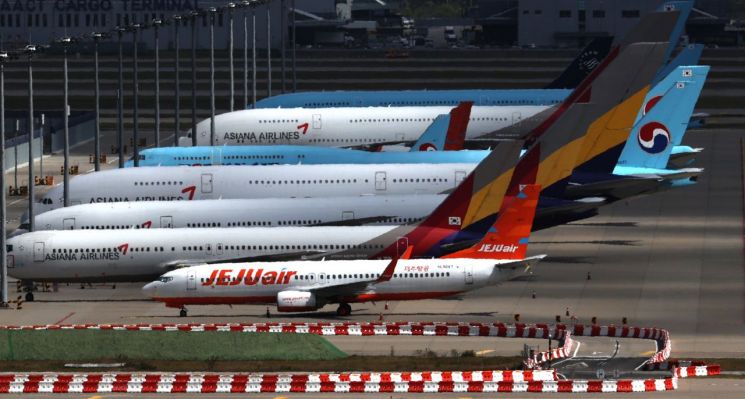
[Asia Economy Reporter Dongwoo Lee] As the government announced support measures for the aviation industry struggling due to the prolonged COVID-19 pandemic, the industry welcomed the announcement but emphasized that reasonable support measures considering fairness should follow.
On the 3rd, the Ministry of Land, Infrastructure and Transport announced the "Measures to Overcome the COVID-19 Crisis and Reboot the Aviation Industry" at the 31st Emergency Economic Central Countermeasures Headquarters meeting held at the Government Seoul Office.
The government plans to review policy financial support of about 200 billion KRW targeting major low-cost carriers (LCCs) such as Jeju Air, T'way Air, and Jin Air. It also intends to provide policy support to ensure the smooth completion of the merger and acquisition between Korean Air and Asiana Airlines.
The aviation industry mostly gave a positive evaluation to the plan to provide employment retention subsidies for up to 180 days if employment is maintained through paid leave this year as well, following last year. They also expect that the extension of reductions in airport facility usage fees, aircraft acquisition tax, and property tax will partially help management.
However, since the conditions for airlines to receive government support were not specifically stated on this day, the industry agreed that a reasonable plan reflecting fairness should be promptly established.
An aviation industry official said, "One disappointing point in this government announcement is that although support for LCCs was mentioned, there are no specific details," adding, "The plan to decide the amount of support funds through due diligence has been discussed since last year."
He continued, "In particular, since the amount of support is influenced by the debt ratio, companies that reduced their debt ended up receiving less support, resulting in reverse discrimination. It is necessary to partially supplement and apply these aspects in a fair manner."
The government has provided liquidity support of 267.7 billion KRW to Jeju Air, 40 billion KRW to Jin Air, 45 billion KRW to T'way Air, 138.8 billion KRW to Air Busan, and 30 billion KRW to Air Seoul since the COVID-19 outbreak.
New LCC Industry: "Conditions for Applying to the Period Industry Stabilization Fund Should Be Relaxed"
There is also criticism that support measures for the new LCC industry are insufficient. The new LCC industry did not receive government support last year because they did not meet the eligibility criteria for the government's Period Industry Stabilization Fund.
To apply for the Period Industry Stabilization Fund, conditions such as having 300 or more employees and borrowing of 500 billion KRW or more must be met. Among LCCs, only some like Jeju Air and Air Busan qualify, while new LCCs such as Fly Gangwon fall short of the criteria.
An official from the new LCC industry said, "We positively evaluate the government's implementation of regional air non-landing sightseeing flights, but direct government subsidies for securing liquidity, which is the most important, are urgently needed," adding, "It is necessary to relax the application conditions for new LCCs regarding the Stabilization Fund in this measure."
Additionally, the loan interest rate of the Period Industry Stabilization Fund was pointed out as a complaint because it is significantly higher than market rates. Overseas, loans with a 10-year maturity and an initial 5-year interest rate of about 1% per annum are provided as low-interest loans, whereas domestically, it is known to be 5-7% for a 3-year maturity.
© The Asia Business Daily(www.asiae.co.kr). All rights reserved.

















