[Asia Economy Reporter Lim Hye-seon] The European Union (EU) has raised non-tariff barriers on imported food products, putting domestic kimchi exports on high alert. With the EU set to implement new composite food regulations from next month to strengthen food safety, domestic export companies are on edge.
Production Factories Must Obtain EU Approval
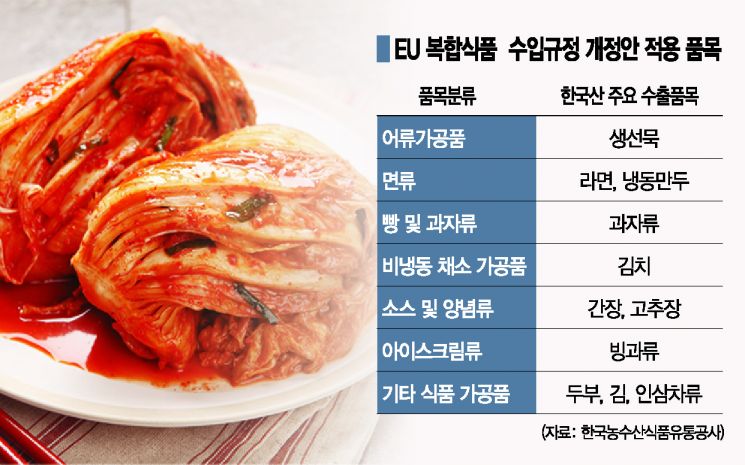
According to the Korea Agro-Fisheries & Food Trade Corporation (aT) on the 3rd, the EU will enforce strengthened import regulations on composite foods containing animal-derived ingredients starting from the 21st of next month. Composite foods refer to products mixed with animal-derived processed foods such as meat or animal by-products (bones, offal, fat), seafood, animal fats (milk), eggs, honey, and vegetable or plant-based foods. Applicable items include fish cakes, ramen, frozen dumplings, kimchi, soy sauce, gochujang, soups and broths, ice cream, tofu, and more.
The existing regulations classified and applied standards based on the content of animal-derived ingredients (50%). The new regulations require that production facilities manufacturing animal-derived processed products contained in composite foods must obtain EU approval without exception. Countries wishing to export composite foods must notify the EU of the source of raw materials before export and request to be listed in the approved country list. Certificates must also be submitted. “Non-refrigerated foods” and “meat-containing non-refrigerated foods” require official government certificates. These certificates must include the origin of animal raw materials, compliance with EU regulations, production facility details, and adherence to residue programs. “Non-refrigerated foods” only require a private certification issued by the importer, which must indicate information about the origin, composite food production facility, and animal raw material origin.
What About Kimchi and Ramen Exporters?
The EU currently prohibits imports of Korean meat and meat-processed products. Therefore, seafood is the only animal-derived raw material from Korea currently allowed for import. This is why Korean kimchi exports to Europe are facing a crisis. Salted fermented seafood (jeotgal) is classified as an animal-derived processed food. Jeotgal producers must obtain facility approval from the EU. According to the Ministry of Food and Drug Safety, last year’s kimchi exports to the EU amounted to $7.975 million (1,879 tons). Major exporters include Daesang, leading with the “Jongga Jip” brand, and CJ CheilJedang, operating the “Bibigo” brand. Most of the export volume is from Daesang. The issue is whether EU approval can be obtained by next month.
An industry insider said, “The new EU food safety regulations were announced at the end of last year, but obtaining EU approval takes 7 to 8 months. The government is cooperating as much as possible, but exports could become difficult starting next month.” They added, “Raw materials like jeotgal are mostly supplied from partner factories. Dozens of supplier factories must also obtain EU approval, which is not easy, so we are looking for alternatives.”
Meanwhile, soup powders used in seafood ramen are also regulated. Even if squid powder, which makes up about 4% of the soup powder, accounts for less than 0.5% of the total ramen weight, the factory producing the squid powder must obtain EU approval to export. Ramen companies such as Nongshim are working to have their partner factories that process soup ingredients obtain EU approval as soon as possible. For eggs and milk, domestic raw materials cannot be used, so they are pursuing EU approval under the condition of using imported raw materials.
High Growth Potential in the EU Market
The scale of food exports to the EU is minimal compared to Japan, the United States, and China. The reason companies focus on the EU market is its growth potential. As a market to plant the flag of “K-Food,” they are strategizing to meet the stringent EU regulations and prepare for the future.
Exports of agricultural and food products to the EU reached approximately $554 million last year, buoyed by favorable exports of kimchi, sauces, and ramen. Ramen exports increased by 48% compared to the previous year, reaching $57 million, driven by new product launches and the COVID-19 boom. European preference for kimchi is also rising. According to KOTRA, the volume of kimchi exported from Korea to Germany more than doubled despite COVID-19. Last year’s export value was $1.19 million. Fourteen countries imported over $1 million worth of kimchi from Korea, totaling $144 million in exports. This is the result of research showing immune-boosting benefits and the influence of K-pop.
In response, the government is actively stepping up. The Ministry of Oceans and Fisheries, Ministry of Food and Drug Safety, Korea Agro-Fisheries & Food Trade Corporation, CJ CheilJedang, Daesang, and Nongshim are holding discussions. Some criticize the government for a delayed response causing damage to companies. The government is reported to have held related briefings and meetings since the end of last year. A government official stated, “The Ministry of Oceans and Fisheries is registering domestic factories producing salted fermented seafood with the EU, and the Ministry of Food and Drug Safety is promptly issuing certificates. We believe there will be no problems with exports.”
© The Asia Business Daily(www.asiae.co.kr). All rights reserved.

















