Ssangyong Cement's 'Coal Phase-Out' Declaration, Increasing Environmental Focus and Changing Company Name
Seven Major Industry Leaders Jointly Declare Challenge for Carbon Neutrality in Cement Industry by 2050
Hanil Cement Launches Full-Scale Eco-Friendly Projects Including Renewable Energy
Emerging as Environmental Problem Solver Through Waste Recycling Since 2019
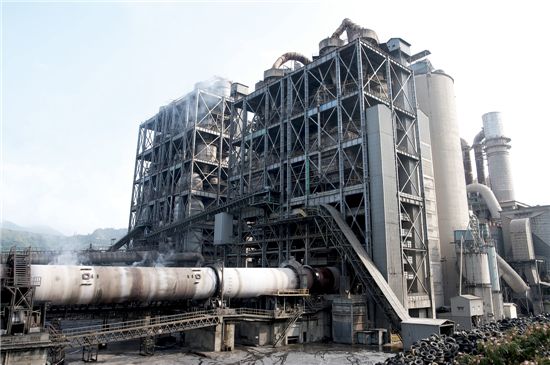 Kiln and preheating chamber of Ssangyong Cement Donghae Plant. The preheating system (NSP) is significantly reducing cement fuel costs.
 [Photo by Ssangyong Cement]
[Asia Economy Reporter Kim Jong-hwa] The cement industry is accelerating its steps to transform into an eco-friendly industry. Following Ssangyong Cement, the industry leader, declaring a 'coal phase-out' management policy, industry representatives have jointly declared 'carbon neutrality,' creating the formula 'cement = eco-friendly.'
On the 24th of last month, Ssangyong Cement announced it would change its company name to 'Ssangyong C&E.' Ssangyong E&C takes the first letters of Cement and Environment in English. By removing 'Cement' (Yanghoe), which means cement manufacturing, the company is determined to become an eco-friendly company by increasing the sales proportion of environmental industries to 50%.
To this end, Ssangyong Cement added environmental-related items to its business objectives at an extraordinary shareholders' meeting in December last year to enter the comprehensive environmental industry, and this year, it became the first in the domestic cement industry to declare 'coal phase-out management.' Instead of using bituminous coal as fuel for cement manufacturing, it plans to use waste plastics, reducing the current bituminous coal usage to half, 500,000 tons by 2025, and aims for zero usage by 2030.
Hanhil Cement also plans to specify the eco-friendly business contents, which were formally mentioned as waste recycling and renewable energy businesses, at the regular shareholders' meeting on the 25th of next month. This includes producing and utilizing electricity from steam generated by waste incineration. They will also appoint new outside directors to actively promote eco-friendly businesses.
The cement industry's transformation into an 'eco-friendly industry' became widely known during the removal process of the garbage mountain in Uiseong, Gyeongbuk, which had caused international embarrassment following a 2019 CNN report. The cement industry emerged as an environmental problem solver by safely processing 95,000 tons, accounting for 46% of the waste, as auxiliary fuel in cement plants.
In particular, with the expiration of the metropolitan landfill site usage in 2025 approaching and no alternative sites found, the Ministry of Environment and relevant local governments have shown interest in waste disposal methods in areas where cement plants are located, such as Donghae in Gangwon and Jecheon in Chungbuk, and are reportedly discussing disposal plans with the cement industry. Donghae City safely processes local household waste at Ssangyong Cement's Donghae plant, and Jecheon City in Chungbuk has resolved waste disposal issues by supplying and processing briquette ash and rural waste vinyl as auxiliary fuel with the cooperation of Asia Cement.
The cement industry's 'carbon neutrality declaration' is also noteworthy. On the 17th, Lee Hyun-jun, chairman of the Korea Cement Association, along with representatives of seven major cement companies, announced the '2050 Cement Industry Carbon Neutrality Challenge Joint Declaration' at the launch ceremony of the Cement Green New Deal Committee.
The joint declaration includes major action tasks for the cement industry, such as efforts to reduce carbon emissions through innovative technology development and production structure transformation, continuous discussion of joint tasks through the Cement Green New Deal Committee for public-private communication, discovering and improving government policy tasks, and strengthening future industrial competitiveness.
An industry official said, "The government transparently manages emissions below standards through TMS (automatic chimney measuring devices), so there is no need to worry about pollutant emissions from recycling resources," adding, "The production method using waste plastics will take root in the cement industry, and the cement industry will become an environmental problem solver."
© The Asia Business Daily(www.asiae.co.kr). All rights reserved.
!["The Woman Who Threw Herself into the Water Clutching a Stolen Dior Bag"...A Grotesque Success Story That Shakes the Korean Psyche [Slate]](https://cwcontent.asiae.co.kr/asiaresize/183/2026021902243444107_1771435474.jpg)















