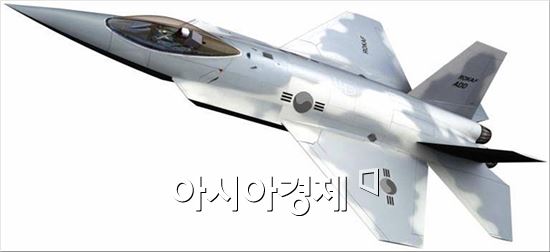
[Asia Economy Yang Nak-gyu, Military Specialist Reporter] The Korean Fighter eXperimental (KF-X) is facing a situation where it must carry out its missions without being equipped with air-to-ground missiles that attack ground targets. This is due to setbacks in the plan to develop air-to-ground missiles in line with the KF-X development phase.
According to the military on the 3rd, the air-to-ground missile development project, originally planned to be conducted by the Agency for Defense Development (ADD), has been transferred to private defense industry companies, causing delays in development time and other aspects. ADD had set a plan in 2019 to independently develop air-to-ground missiles domestically. The rationale was that domestic development would reduce costs compared to importing air-to-ground missiles and would symbolize an asymmetric weapon in Northeast Asia. ADD intended to develop the air-to-ground missile by 2028, when the KF-X Block-2 is developed, and equip it on the KF-X.
However, last year, the Defense Acquisition Program Administration (DAPA) transferred this project to defense companies, citing that "ADD should focus only on core technologies." The purpose was to specialize ADD's development capabilities and foster the defense industry. Following this change, DAPA, ADD, and defense companies held technical analysis meetings, which concluded that the development period for the air-to-ground missile would increase from the original 72 months to 90 months, and costs would rise from 190 billion KRW to 340 billion KRW. This is because defense companies require significant time and costs for new researcher recruitment and other factors.
As a result, the air-to-ground missile can only be equipped 1 year and 6 months after the KF-X Block-2 is developed. In other words, the KF-X will have to perform missions for 1 year and 6 months equipped only with the AGM-88B (HARM), an anti-radiation missile for suppressing air defense weapons.
Moreover, last year, DAPA also transferred the development of the Korean Vertical Launching System-II (KVLS-II) to be mounted on the Korean Destroyer eXperimental (KDDX), the upgrade of lightweight torpedo performance, and the development of the 130mm guided rocket-II to defense companies. Accordingly, the lightweight torpedo performance upgrade is expected to take an additional 3 years and cost 53.4 billion KRW. The development period for the 130mm guided rocket-II, to be mounted on high-speed vessels, is expected to increase by 1 year, with an additional cost of 59.6 billion KRW.
A military official said, "The transfer of development was inevitable to break away from the framework where ADD focuses on research and development and defense companies on manufacturing and mass production," adding, "We plan to provide policy support to help defense companies secure research and development capabilities."
© The Asia Business Daily(www.asiae.co.kr). All rights reserved.
!["The Woman Who Threw Herself into the Water Clutching a Stolen Dior Bag"...A Grotesque Success Story That Shakes the Korean Psyche [Slate]](https://cwcontent.asiae.co.kr/asiaresize/183/2026021902243444107_1771435474.jpg)















