Jongno-gu, Recruiting Applicants for "Mugyewon Traditional Wedding"... A Meaningful Opportunity to Experience the Beauty of Traditional Hanok and Indigenous Wedding Rituals... Pre-Applications Open for Traditional Weddings Scheduled in May and October, Spanning the First and Second Halves of the Year
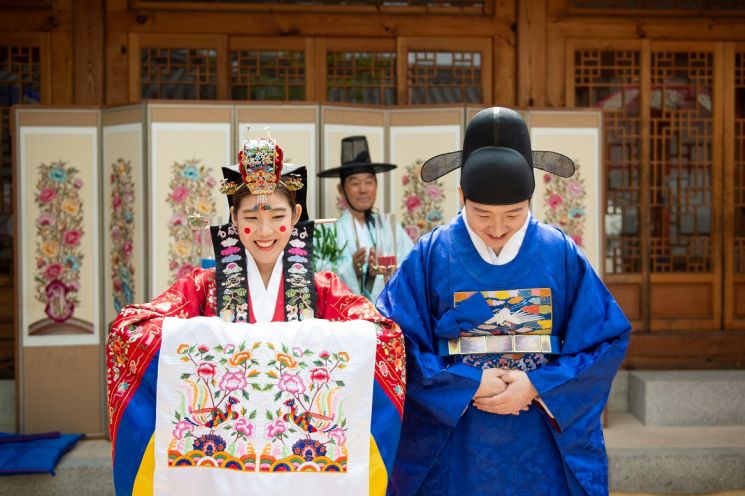
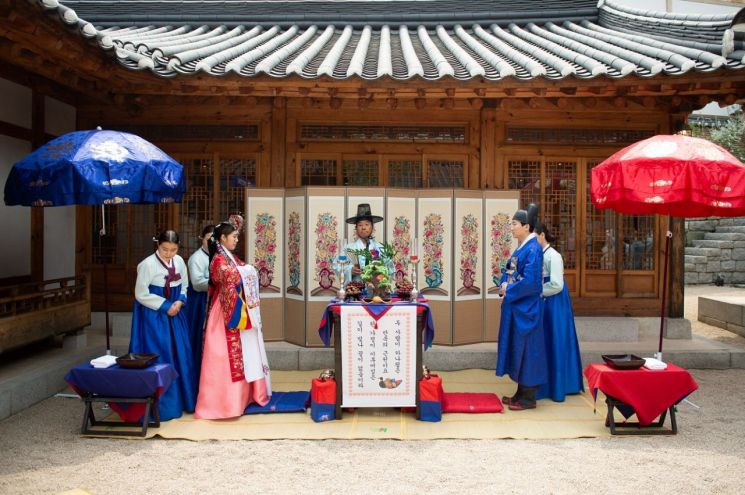
[Asia Economy Reporter Jongil Park] Jongno-gu (Mayor Kim Young-jong) offers a special opportunity to tie the knot by wearing 'Hanbok' instead of a dress and holding the traditional Korean wedding ceremony not in a wedding hall but in a 'Hanok' (traditional Korean house).
The district is recruiting applicants in advance for the 'Mugyewon Traditional Wedding,' where participants can experience the charm and sentiment of Korean culture, with wedding ceremonies scheduled throughout the first and second halves of the year.
Mugyewon, a traditional cultural space in Buam-dong opened in March 2014, is a place where visitors can experience Hanok amidst serene scenery and fully appreciate the beauty of Korean culture.
Jongno-gu held a total of three traditional wedding ceremonies here in April and October last year, receiving high praise from the bride and groom as well as the guests.
This year, they plan to hold traditional weddings embodying the Samseo Spirit (three vows taken during the wedding) in May and October, spanning the first and second halves of the year, by recruiting applicants.
The entire Mugyewon space, from the elegant main quarters (Anchae) to the guest quarters (Sarangchae), the servant quarters (Haengnangchae), the inner courtyard, and the backyard, will be extensively used, making it a meaningful time to pray for the prosperity of the family.
For traditional wedding necessities such as folding screens, the initial ceremonial table setting, receptions, photography, and makeup, applicants can use the Jongno Cultural Foundation’s partner companies.
The ceremony lasts about 30 minutes and proceeds in the following order: the groom and bride’s marriage vow and parental respect ceremony (Seobumorye), the groom’s pledge to fulfill spousal duties and the presentation of a goose symbolizing love (Jeonanrye), the mutual bowing of the bride and groom (Gyobaerye), the vow and oath to heaven (Seocheonjirye), the pledge to share life’s joys and sorrows as husband and wife (Sebaeurye), and the groom and bride sharing wine from a gourd (Geunbaerye).
For more detailed information on how to apply, schedules, and costs for the traditional wedding, inquiries can be made through ‘Joeunnal,’ a partner company of the Jongno Cultural Foundation.
Meanwhile, Mugyewon, where the ceremony is held, was built by Jongno-gu using building materials from the former Ojinam, the first Seoul-registered restaurant located in Ikseon-dong. The gate, roof tiles, rafters, and pillars were constructed using these materials.
To understand Mugyewon, one must also know its root, Ojinam. Ojinam was the home of the late Joseon Dynasty painter Lee Byeong-jik and, in the early 1910s, was a representative commercial urban Hanok with rarity and high preservation value. It is also a historic site where the July 4th North-South Joint Statement, which led the Cold War regime on the Korean Peninsula toward dialogue, was produced.
Additionally, the Mugyewon site is historically significant as it resembles the Peach Blossom Spring dreamed of by Prince Anpyeong. It is said that the painter An Gyeon painted the Dream Journey to the Peach Blossom Land (Mongyudowondo) in three days here, and the prince built a pavilion, composed poetry, and practiced archery at this site.
Mayor Kim Young-jong said, “This will be an opportunity to reflect on the true meaning of our traditional wedding in a tranquil Hanok and for the bride, groom, and guests to create precious memories.” He added, “We will continue to develop diverse programs for citizens by utilizing the rich historical and cultural resources that Jongno possesses.”
© The Asia Business Daily(www.asiae.co.kr). All rights reserved.


















