Analysis of February Figures for 5 Major Banks
"As Credit Loans Became More Difficult, Savings Flowed into Investment Amounts"
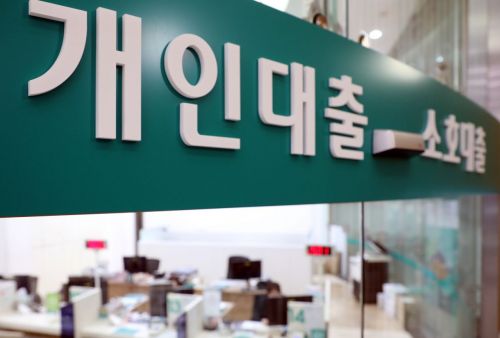
[Asia Economy Reporters Kiho Sung, Wondara] The outstanding balance of unsecured loans in the market, which had been rapidly increasing since the beginning of the new year, showed signs of slowing down last month by decreasing nearly 60 billion KRW. This is analyzed to be due to financial authorities' policy to tighten household loans, leading banks to raise loan interest rates and lower loan limits. Along with this, regular savings deposits also showed a simultaneous decrease. On the other hand, deposits turned to an increasing trend in February.
According to the banking sector on the 2nd, the outstanding balance of unsecured loans at the five major banks (Kookmin, Shinhan, Hana, Woori, Nonghyup) was 135.1843 trillion KRW in February, a 0.04% (55.6 billion KRW) decrease compared to the previous month (135.2400 trillion KRW). This is the first decrease in two months since a 0.03% drop in December. Regular savings deposits also decreased simultaneously. Regular savings deposits, which were 40.6488 trillion KRW in January, decreased by 4.093 trillion KRW to 36.5555 trillion KRW in February.
A banking sector official said, "As unsecured loans became more difficult, unsecured loans decreased, but regular savings deposits also declined together," adding, "It seems that as unsecured loans became harder to obtain, savings flowed into investment amounts."
The rise in loan interest rates due to the increase in market interest rates is also estimated to have had an impact. The interest rate on unsecured loans, which was 1.99?3.51% at the end of July last year, jumped to 2.59?3.65% as of the end of February.
Meanwhile, deposits, which had been stagnant, turned to an increasing trend in February. The outstanding balance of fixed deposits at the five major banks was 630.3472 trillion KRW as of February, up 0.55% (4.5136 trillion KRW) from the previous month (626.8940 trillion KRW). This marks an increase after four months. In January, fixed deposits decreased by 5.5136 trillion KRW compared to December last year (632.4076 trillion KRW).
Household loans increased by 3.7967 trillion KRW to 678.1705 trillion KRW compared to the previous month (674.3738 trillion KRW). Although the total amount of household loans increased, the growth rate compared to the previous month decreased. In January, household loans increased by 4.2199 trillion KRW compared to December last year (670.1539 trillion KRW).
A banking sector official commented on the increase in fixed deposits, saying, "As the stock market boom subsides, market funds that are observing the situation are flocking to banks," and added, "Since fixed deposits have no risk of principal loss, there is sufficient demand to temporarily deposit funds."
The balance of demand deposits increased by 5.04% compared to the previous month to 605.0828 trillion KRW, and MMDA (Money Market Deposit Accounts) increased by 4.89% to 113.4378 trillion KRW. It is analyzed that there is nothing unusual as demand deposits and MMDA tend to decrease in December and January due to the demand for year-end bonuses and other funds, then increase again in February, repeating this pattern.
© The Asia Business Daily(www.asiae.co.kr). All rights reserved.
![Clutching a Stolen Dior Bag, Saying "I Hate Being Poor but Real"... The Grotesque Con of a "Human Knockoff" [Slate]](https://cwcontent.asiae.co.kr/asiaresize/183/2026021902243444107_1771435474.jpg)











