KIST Discovers High-Efficiency Flexible Thermoelectric Device
[Asia Economy Reporter Kim Bong-su] A technology that generates electricity using body heat to power various wearable electronic devices such as smart bands without charging has been developed.
On the 2nd, the Korea Institute of Science and Technology (KIST) announced that the research team at the Complex Materials Technology Research Institute of the Jeonbuk Branch, led by Jin-Sang Kim, developed a high-efficiency flexible thermoelectric device that can semi-permanently generate electricity using body heat. The developed device was made by producing a flexible silicone compound material (PDMS) in a sponge form to secure heat insulation capability, and by using this as a framework, they succeeded in dramatically improving the device’s performance.
Thermoelectric devices generate electricity by utilizing the temperature difference between the two ends of the device. They are used as eco-friendly energy generators that produce electricity from heat such as car engine heat or waste heat from power plants. Conversely, when electricity is supplied, one side of the device cools down while the other side heats up, which is used in temperature control systems such as small refrigerators, car cooling seats, and semiconductor devices.
Generally used thermoelectric devices have rigid ceramic substrates supporting the thermoelectric semiconductors, making them difficult to apply on curved surfaces. However, flexible thermoelectric devices use flexible polymer materials that wrap around the thermoelectric semiconductors without ceramic substrates, allowing them to be easily bent. When attached to the human body, they can semi-permanently generate electricity and can also be used as portable air conditioners, attracting attention in the field of body-attached electronic devices. However, the polymer materials used as flexible substrates have high thermal conductivity and cannot block heat at both ends of the material, resulting in a critical problem of underperforming compared to commercial thermoelectric devices with rigid substrates.
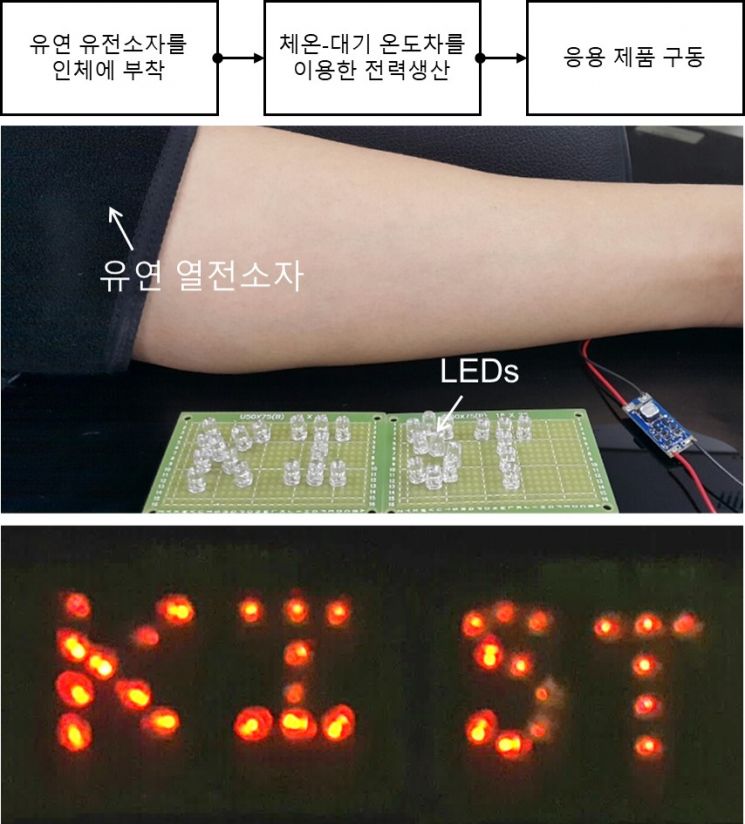
The KIST research team poured liquid silicone compound over sugar cubes, solidified it, and then dissolved the sugar in water to create a sponge-like polymer material. As a result, the original sugar locations turned into tiny air bubbles, increasing heat insulation capability by more than 50% compared to existing materials, effectively blocking heat transfer. Using this substrate as the framework supporting the thermoelectric device, they developed a flexible thermoelectric device that is flexible yet does not lose performance. The flexible thermoelectric device developed by the research team showed performance more than 20% superior to existing flexible thermoelectric devices and is at the same level as currently commercialized devices. The research team succeeded in lighting an LED using body heat with the developed flexible device.
Jin-Sang Kim, director of the Jeonbuk Branch of KIST, said, "Through a cheap and simple process of pouring a solution over sugar cubes and solidifying it, we raised the efficiency of flexible thermoelectric devices to the level of commercial thermoelectric devices," and added, "Using a sufficient amount of thermoelectric devices, it will be fully possible to operate smart bands using only body heat." The research results will be published in the March issue of the international journal 'Nano Energy.'
© The Asia Business Daily(www.asiae.co.kr). All rights reserved.

















