Growing Expectations for Global 'Vaccine Passport' Discussions
Airfare and Accommodation Commerce Companies Also Busy
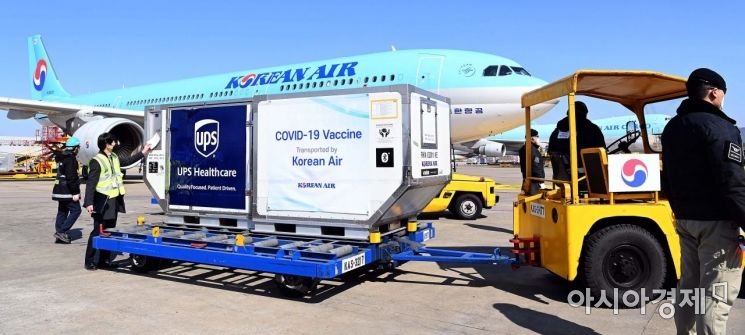 On the 26th of last month, the initial batch of Pfizer vaccines secured through the international vaccine supply organization 'COVAX facility' was unloaded from a Korean Air cargo plane at the Incheon International Airport cargo terminal on Yeongjongdo Island and transported.
 The total quantity received that day was enough for 58,500 people, and these vaccines are scheduled to be delivered directly to five central and regional vaccination centers without passing through the logistics center in Pyeongtaek, Gyeonggi Province.
Pfizer vaccinations will begin the following day, on the 27th, at the Central Vaccination Center set up at the National Medical Center in Jung-gu, Seoul.
Yeongjongdo = Photo by Airport Photographers Group
[Asia Economy Reporter Donghyun Choi] With the start of COVID-19 vaccination in South Korea, expectations for overseas travel are growing. Travel agencies have begun developing products tailored to changing travel patterns, and social commerce companies are pre-purchasing travel products in preparation for the ‘post-COVID’ era.
Following news of domestic vaccine distribution, commerce companies selling airline tickets and accommodation vouchers are accelerating their efforts. Interpark Tour recorded sales of 1.4 billion KRW by selling overseas resort accommodation vouchers for 55 minutes on TV home shopping on the 21st of last month. TMON saw a 650% increase in domestic airline ticket sales for tickets departing this month compared to reservations sold the previous month during the period from the 1st to the 20th of last month. Tickets departing in April increased by 744%, and tickets departing in May surged by an astonishing 1308%.
The high interest in travel is spreading further amid ongoing global discussions about the ‘vaccine passport.’ A vaccine passport is a kind of certificate proving that one has received the COVID-19 vaccine. The European Union (EU) is recently accelerating the introduction of vaccine passports. The International Air Transport Association (IATA) and Chinese airlines are also actively promoting the adoption of vaccine passports to resume travel.
Domestic quarantine authorities have not yet discussed the introduction of vaccine passports but have suggested that related systems could be established as vaccination expands.
‘Rapid Polymerase Chain Reaction (PCR) tests’ are also a factor driving travel demand. In particular, rapid PCR tests are expected to be mainly used by people who have not yet been vaccinated. Hwang Hee, Minister of Culture, Sports and Tourism, is currently consulting with quarantine authorities on introducing rapid PCR testing methods for travelers. Additionally, discussions are underway on applying a ‘travel bubble’ that allows free travel through mutual agreements between countries with established quarantine systems.
In the future, overseas travel is likely to be dominated by small groups such as families and acquaintances rather than large-scale group tours. This is because it will take considerable time for the world to achieve complete immunity to COVID-19, and there is uncertainty about when new or variant viruses might emerge again.
Hana Tour, which is attempting to transform into an online-based ‘travel tech’ company, is developing small-scale private travel products in line with this trend. Recently partnering with mobility startup Move is part of this strategy. Move provides private vehicle and driver services in Southeast Asian regions such as Vietnam and Thailand. Hana Tour has also recently normalized its partner (agency) airline consultation services, which had been operated on a limited basis until now.
A Hana Tour representative said, "We plan to introduce products linked with the Move platform, such as driving guided tours, unguided local tours, and AI and big data-based travel products," adding, "Most products on the online platform Hana Hub will be small-group private planned trips."
Traditional offline package tours are not expected to disappear completely. If the pent-up desire for travel consumption is released all at once, it could lead to ‘revenge consumption.’ Therefore, if demand surges and prices soar, affordable package products may regain attention.
Modetour plans to focus on differentiating existing offline package products rather than launching new businesses amid the current uncertain situation. A Modetour representative said, "Only after the market stabilizes and existing package businesses are reorganized will it be possible to establish new sales lines," adding, "In the current situation, unless a company is global, the success of online travel agencies (OTA) cannot be guaranteed."
© The Asia Business Daily(www.asiae.co.kr). All rights reserved.

















