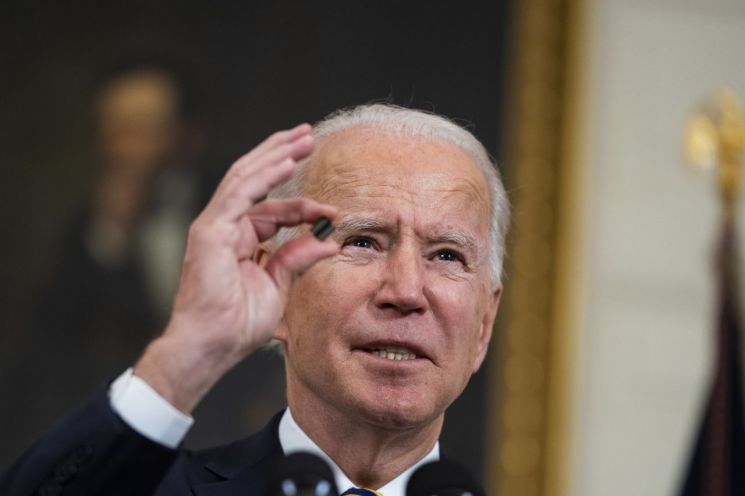
 U.S. President Joe Biden is holding a semiconductor chip and mentioning the purpose of the executive order on building a semiconductor supply chain before signing the order at the White House on the 24th of last month (local time).
 [Washington EPA=Yonhap News] Photo by EPA
[Asia Economy Reporter Kim Heung-soon] U.S. President Joe Biden recently ordered a review of the supply chains for key items that have revealed structural problems in supply, such as semiconductor chips, large-capacity batteries for electric vehicles, rare earth elements, and pharmaceuticals, complicating the calculations for related domestic companies. Opinions are divided on whether the Biden administration’s efforts to strengthen U.S. competitiveness in these items will work to their advantage or become a negative factor. In particular, semiconductor companies, whose export ratio abroad reaches 95%, are now in a situation where they must carefully weigh the pros and cons.
On the 1st, an industry insider said, "Globally, the semiconductor supply shortage issue has emerged as a hot topic, and due to forecasts that this situation may prolong, component prices have already rebounded," adding, "If the U.S. encourages local investment or strengthens supply chains by enhancing cooperation with allied countries, demand could increase in some way, which would be advantageous for semiconductor companies."
Active Investment Attraction... Will Voices of Korean Companies Entering the U.S. Gain Strength?
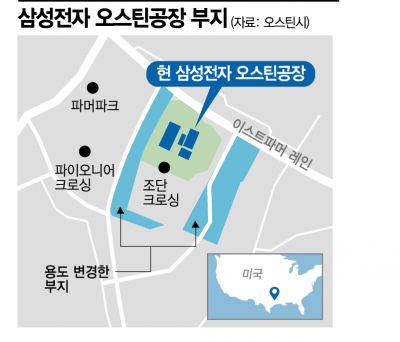
There is a possibility that Samsung Electronics’ moves to expand semiconductor factories and invest locally in the U.S. will gain momentum. Samsung Electronics has built trust by operating a semiconductor factory in Austin, Texas since 1998, and based on this, it is scouting suitable candidate sites to expand its factories within the U.S. Several state governments, including New York, have already sent love calls to Samsung Electronics.
In fact, Samsung Electronics is understood to have submitted a letter of intent to invest to the Texas state government and local governments near Austin in January. The plan is to invest a total of $17 billion (approximately 19 trillion KRW) to add foundry facilities near the currently operating Austin foundry (contract manufacturing) plant.
Among the 107-page proposal, there is a specific request to reduce taxes by $805.47 million (approximately 907 billion KRW) over 20 years. In return, the investment blueprint projects that Austin will gain an economic effect of $8.643 billion (approximately 10.37 trillion KRW) and expects 2,973 direct and indirect jobs. Additionally, Samsung pressured that "if the 20-year tax reduction condition is not resolved, other regions such as New York or Arizona will be considered as candidates." This includes the option of building a factory in Korea as well.
Need to Consider Relations with China, Which Has High Dependence on Korean Semiconductor Exports
On the other hand, there are also forecasts that the Biden administration’s policy could deal a blow to domestic semiconductor companies. This is because it could develop in a direction to check China, which plays a major role in the semiconductor industry. According to the Korea International Trade Association, Korea’s semiconductor export amount over the past year from January last year was about $107.9 billion (approximately 119 trillion KRW), with China accounting for the largest share at about $43.3 billion (approximately 48 trillion KRW). In May last year, China’s share of total exports was 46.4%, nearly half. Samsung Electronics and SK Hynix are known to have China accounting for half of their semiconductor export amounts. Samsung Electronics operates a semiconductor factory in Xi’an, China, and SK Hynix operates one in Wuxi.
An industry insider said, "China’s IT companies have rapidly grown, creating enormous semiconductor demand, and its influence is significant as it affects the global economy, so it is a market that domestic companies cannot give up," adding, "Currently, since the U.S. future plans have not been concretized, the industry is in a difficult situation where it cannot act decisively." He further added, "While continuously expanding investment and exchanges with the U.S., companies must carefully balance so as not to lose the Chinese market."
Meanwhile, earlier on the 24th of last month (local time), President Biden signed an executive order at the White House to conduct a 100-day review of the supply chains for four core items: semiconductor chips, large-capacity batteries for electric vehicles, rare earth elements, and pharmaceuticals, emphasizing especially the semiconductor supply issue. He stressed the necessity of semiconductor production within the U.S., expressed intentions to cooperate with allied semiconductor companies, and announced plans to promote legislation for semiconductor funding support.
© The Asia Business Daily(www.asiae.co.kr). All rights reserved.













