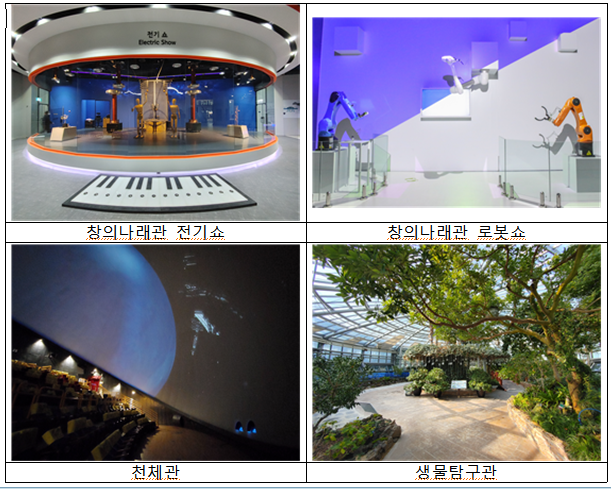
[Asia Economy Reporter Kim Bong-su] The National Science Museum announced on the 1st that it will additionally open the Changui Narae Hall, the Celestial Hall, and the Biological Exploration Hall following the easing of restrictions on public facility operations.
Previously, as a preemptive response to the resurgence of COVID-19, the museum temporarily closed the Changui Narae Hall, Celestial Hall, and Kkumatti Experience Hall, where indoor crowding or physical contact between visitors was expected. Until now, the museum had partially opened only the Science and Technology Hall (three sessions of 400 people each), the Natural History and Anthropology Hall (three sessions of 140 people each), and the Future Hall (two sessions of 200 people each).
The Changui Narae Hall offers new exhibits including an Electric Show, Robot Show, Laser Show, and Drone Show, which can be experienced along with a show-and-talk style commentary program. It operates by online advance reservation, with three sessions per day and only 30 people allowed per session. Especially in the new Electric Show, visitors can experience wireless power transmission, helical discharge ladder, tingling static electricity, how to survive lightning, lightning piano performance, and a fantastic Tesla music concert. In the Robot Show, visitors can enjoy robot media fusion performances, bottle standing challenges, drawing quizzes, and basketball free throw competitions together with robots.
At the Celestial Hall, videos titled "Earth, Moon, Sun" and "We are stars" are screened by session, and through the "Stars Seen During the Day" program, visitors can learn about the stars and constellations visible in the night sky of that day. It allows 50 people per session, three sessions per day, and operates by online advance reservation. Each session offers different programs, consisting of two video screenings and one constellation commentary session.
The Biological Exploration Hall has newly arranged the Cactus Hall and Subtropical Hall during the closure period, presenting them to visitors for the first time, and outdoors, visitors can enjoy various spring flowers and wildflowers. Entry is allowed after temperature checks and signing the visitor log, with four sessions per day and 50 people per session. On the first floor Subtropical Hall, visitors can see endangered species such as Solipran, Pachoi-ilyeop, endemic plants like Seommaebaltopnamu, Jeju Gosarisam, and high-altitude native plants such as Shiromi and Manbyeongcho. On the second floor Cactus Hall, visitors can see an 80-year-old Kumho cactus that has branched into multiple individuals, over 3-meter-tall Muryunju cactus, Daebongyong cactus, and various succulents. For more details, please visit the National Science Museum website.
© The Asia Business Daily(www.asiae.co.kr). All rights reserved.
!["The Woman Who Threw Herself into the Water Clutching a Stolen Dior Bag"...A Grotesque Success Story That Shakes the Korean Psyche [Slate]](https://cwcontent.asiae.co.kr/asiaresize/183/2026021902243444107_1771435474.jpg)
















