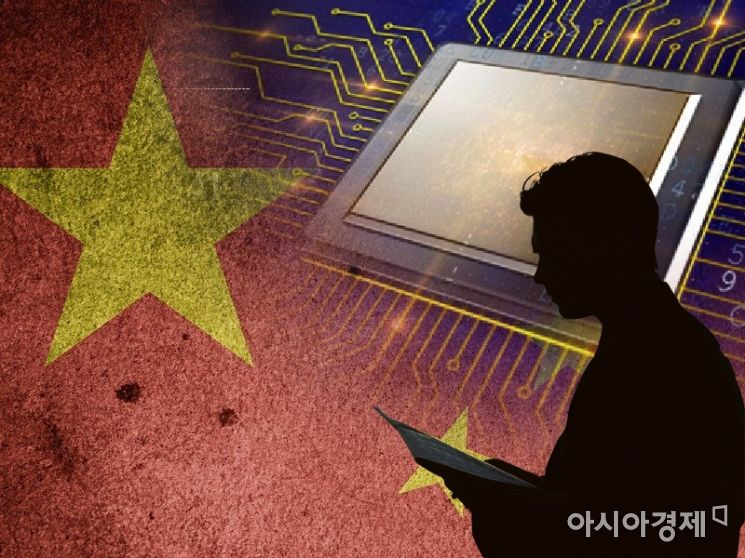
[Asia Economy Reporter Choi Eun-young] China's semiconductor project, which ambitiously announced a large-scale investment plan worth 20 trillion won aiming for 'semiconductor self-reliance,' is now undergoing liquidation with a disappointing outcome.
On the 28th, according to Chinese economic media Caixin and Hong Kong's South China Morning Post (SCMP), Wuhan Hongxin Semiconductor Manufacturing (HSMC) recently asked all 240 employees to resign. The reason given was that there are no plans to restart the company.
The company was established in Wuhan in 2017 with the goal of producing system semiconductors using cutting-edge 7-nanometer (nm) or smaller advanced process technology.
The total funds invested or to be invested in this company, designated as a major project by Wuhan city, amount to 128 billion yuan (approximately 22 trillion won).
In particular, the company attracted attention in the semiconductor industry by recruiting Jiang Shangyi (蔣尙義), the top engineer of Taiwan's TSMC, the world's number one foundry (semiconductor contract manufacturing) company, as its CEO.
However, the business began to drift due to financial difficulties from the early stages. Eventually, creditors seized the land, making recovery virtually impossible, and CEO Jiang Shangyi described his short tenure at HSMC as a "nightmare" before moving to China's largest foundry company SMIC (中芯國際, Zhongxin Guoji).
Although the Wuhan city government directly acquired the company last year, raising hopes for a possible revival, the recent dismissal notice has increased the likelihood of proceeding with liquidation.
SCMP pointed out, "This project failure is the most recent example of China's ambition to achieve semiconductor self-reliance being thwarted."
Some say that although China is striving to solve its biggest weakness?external dependence on semiconductors?it is not easy to realize the dream of 'semiconductor self-reliance.'
China has shown remarkable progress in various advanced technology fields such as 5th generation mobile communication (5G), cloud, artificial intelligence (AI), autonomous driving, and unmanned aerial vehicles, but it lags far behind other advanced countries in the semiconductor sector.
Until now, China has depended on the United States for semiconductor supply, but due to the US-China trade conflict, Chinese information and communication companies have faced increasing difficulties in procuring parts.
Meanwhile, China's semiconductor import value last year increased by 14.6% from the previous year to 350 billion dollars. This accounts for more than 13% of China's total imports last year.
© The Asia Business Daily(www.asiae.co.kr). All rights reserved.

















