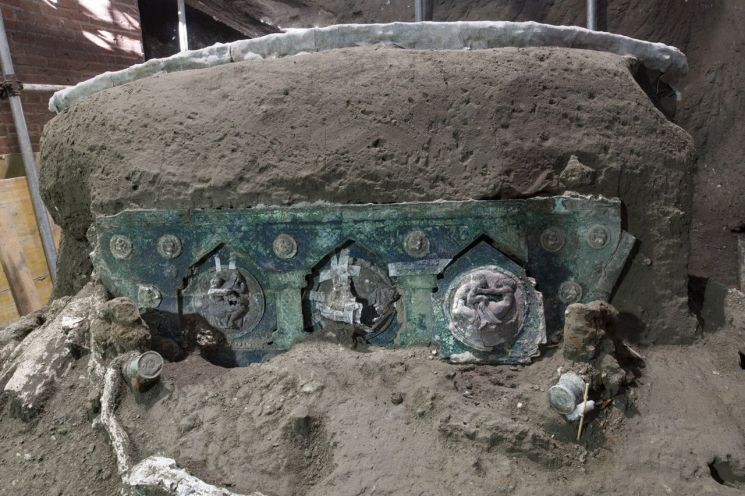
 A representative from the park where the carriage was excavated stated that the carved decorations on the side of the carriage are in relatively good condition, describing it as a "very special excavation."
 [Image source=EPA Yonhap News]
[Asia Economy Reporter Choi Eun-young] A chariot used during the ancient Roman era has been uncovered in Pompeii, Italy. The chariot, complete with decorations and wheels, was excavated in an intact form, earning high archaeological value.
On the 27th (local time), the Pompeii Archaeological Park announced in a press release, "A four-wheeled chariot used during events such as weddings or parades was excavated from an ancient villa in Civita Giuliana."
According to the press release, the chariot discovered this time was found in an excellent state of preservation, and no chariot has been found in such a well-preserved condition until now. The park officials expressed astonishment, stating, "Considering the preservation state, nothing comparable has been found in Italy so far."
The discovered chariot measures approximately 90 cm in width and 140 cm in length, and was found with all four wheels attached. The main body is made of iron, and at the rear, there is an eye-shaped decoration made of copper and tin. The park officials estimated that this ornament represents Cupid, the god of love from Greco-Roman mythology.
Additionally, the bronze and tin decorations on the side of the chariot were almost undamaged, and traces of ropes and floral decorations used on the chariot were clearly visible.
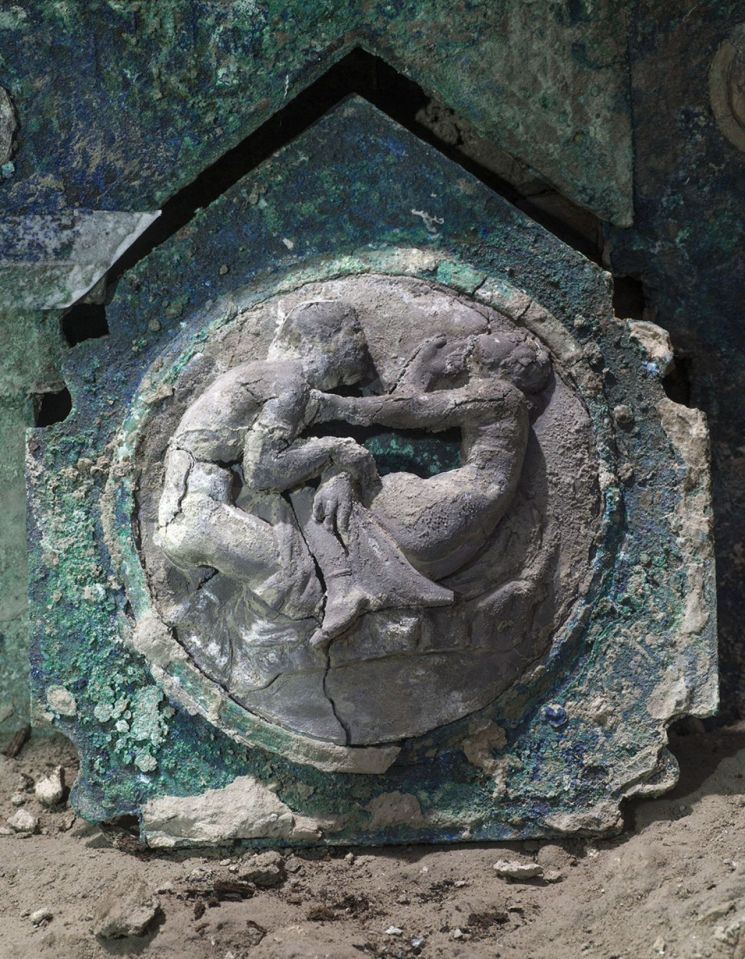
The park officials stated, "While transport chariots have been excavated before, this is the first time a chariot used for ceremonies has been found," adding, "It appears to have been used in parade processions. Given the Cupid decoration at the rear, the chariot was likely used by a woman and may have been used to transport a bride to her new home during a wedding."
Meanwhile, Civita Giuliana, where the chariot was found, is a city located north of the ancient Pompeii city walls in Italy. In late 2018, remains of three horses and horse tack were also discovered here, leading to the assumption that it was a stable of an ancient noble residence.
Archaeologists began excavation work at this villa in 2017. Especially since several underground tunnels were discovered in the area, raising concerns about looting, the excavation work was expedited.
Pompeii, the most prosperous city of the Roman Empire, was instantly reduced to ruins by the eruption of Mount Vesuvius in AD 79. Systematic excavation began after relics were unearthed during 1st-century waterway construction. Excavation work has since progressed enough to vaguely reconstruct the city's past layout. In 1997, Pompeii was recognized for its archaeological value and was designated a UNESCO World Heritage site.
© The Asia Business Daily(www.asiae.co.kr). All rights reserved.


















