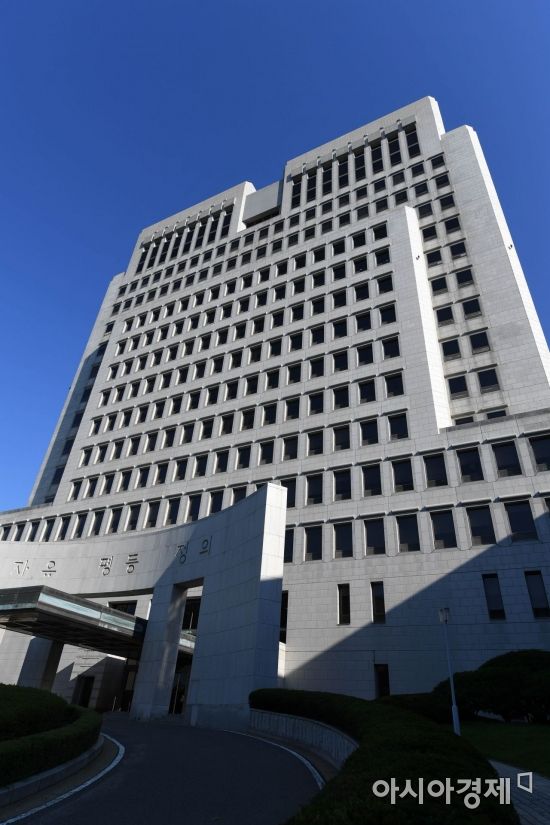
 Supreme Court in Seocho-dong, Seoul. Photo by Honam Moon munonam@
[Asia Economy Reporter Kim Daehyun] The Supreme Court has ruled that the 'statute of limitations for surcharge disposition' on violations before the 2012 amendment of the Fair Trade Act must follow the amended standards. This means that if the law was changed to extend the statute of limitations period while the statute of limitations for the violation had not yet been completed, the amended law should be applied.
On the 28th, the Supreme Court's 3rd Division (Presiding Justice Lee Dongwon) overturned the lower court's ruling that had ruled in favor of Hanjin Information & Communications in the appeal lawsuit against the Fair Trade Commission's corrective order and surcharge payment order cancellation, and sent the case back to the Seoul High Court.
Hanjin Information & Communications was fined 620 million won by the Fair Trade Commission in 2018 for colluding with other companies three times regarding the prospective successful bidder and bid prices in a bid ordered by the National Geographic Information Institute.
However, Hanjin Information & Communications argued that the surcharges should not be imposed for the first and second violations, which ended in 2010 and 2011 respectively. Before the 2012 amendment, the Fair Trade Act stipulated the statute of limitations for surcharge disposition as '5 years from the end date of the violation,' so based on this, the statute of limitations had already been completed.
On the other hand, the Fair Trade Commission countered that the statute of limitations for surcharge disposition under the amended law could be applied to the first and second violations. The amended law stipulates the statute of limitations as '5 years from the start date of the investigation into the violation' or '7 years from the end date of the violation if the Fair Trade Commission did not start an investigation.'
The Seoul High Court ruled in favor of the plaintiff. The court at the time pointed out, "The Fair Trade Commission first conducted an on-site investigation into Hanjin Information & Communications' violations in 2016," and stated, "This is the point when the statute of limitations for the first and second violations was completed." It then ordered the cancellation of 460 million won of the imposed surcharge.
However, the Supreme Court sided with the Fair Trade Commission. The court stated, "Applying the amended standards even if the violation ended before the amendment of the statute of limitations does not violate the constitutional principle of non-retroactivity of laws," and remanded the case. Even if the 5-year statute of limitations stipulated in the old law had passed by the time the Fair Trade Commission's initial investigation began after the enforcement of the current law, the current law takes effect immediately upon enforcement, so applying the current law is correct.
© The Asia Business Daily(www.asiae.co.kr). All rights reserved.
















