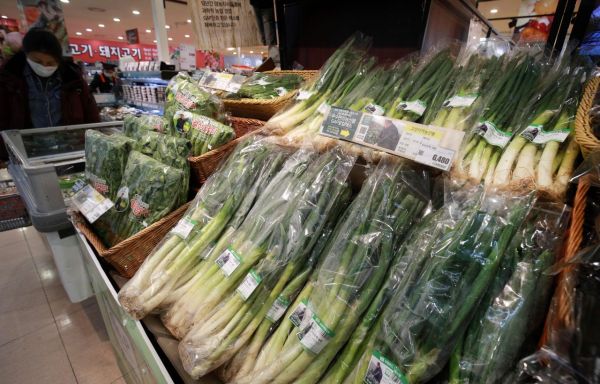
[Asia Economy Reporter Jo In-kyung] Agricultural product prices, which usually stabilize after the Lunar New Year holiday, have continued to rise until the end of February this year. As the price of a carton of eggs and a bunch of daepa (green onions) each exceeded 7,000 won, soaring to more than two to three times the average price, the government has taken measures to expand supply and stabilize demand to ease the burden on low-income households' food expenses.
Endlessly Rising Prices Due to Poor Crop Conditions
According to the Korea Agro-Fisheries & Food Trade Corporation (aT) on the 28th, the average consumer price of 1 kg of daepa (product) at major supermarkets and traditional markets nationwide reached 7,232 won, marking an all-time high. This is a 42.1% increase from 5,089 won a month ago and a 238.7% rise compared to 2,135 won around the same time last year.
The price of a bunch of daepa at Hanaro Mart Yangjae branch in Seoul is 6,600 won, more than double the 3,180 won on January 22 and more than five times the 1,250 won at the end of February last year.
The sharp increase in daepa prices is due to a significant reduction in production caused by consecutive cold waves and heavy snowfall last winter.
Daepa prices rose to around 4,500 won in early November last year but dropped to the 3,200 won range in early December. Since the beginning of this year, prices have again exceeded 4,000 won and continued to rise, soaring to 6,400 won on the 10th of this month, just before the Lunar New Year holiday. The upward trend continued after the holiday, with prices reaching 6,544 won on the 15th, 6,672 won on the 22nd, and 7,205 won on the 25th.
Similarly, onion prices, which also suffered from poor crop conditions last year, rose from 3,174 won per 1 kg (product) a month ago to 3,455 won currently, an 8.9% increase. Compared to 1,958 won a year ago, this is a 76.5% rise.
Egg prices, hit hard by highly pathogenic avian influenza (AI), are also still soaring. According to the Livestock Products Quality Evaluation Institute, the average price of a carton of eggs (30 special eggs) was 7,666 won as of the 26th, up 14.1% from 6,718 won a month ago. This is more than double the average egg price of 3,015 won in February last year.
The egg price was 7,481 won just before the Lunar New Year holiday this month and surged to 7,821 won on the 15th, right after the holiday. Although AI outbreaks are expected to subside as the weather warms, a significant number of laying hens have already been culled, making it difficult for egg supply to stabilize for more than six months.
Increasing Egg Imports and Advancing Onion Shipments
On the 26th, the government held a meeting with related agencies to stabilize prices of major agricultural and livestock products and processed foods and decided to prepare tailored response strategies for early price and supply stabilization of these products.
For eggs, in addition to the planned import of 44 million eggs by the end of February, an additional 20 million eggs will be imported in March, and discount events for agricultural and livestock products at large supermarkets and other retail stores will continue.
For onions, to expand private supply volumes, the government will encourage early shipment of stored onions and early-maturing onions scheduled for shipment at the end of March. Regarding daepa, it is expected that prices will stabilize when some of the shipments delayed by the cold wave are released in March.
© The Asia Business Daily(www.asiae.co.kr). All rights reserved.

















