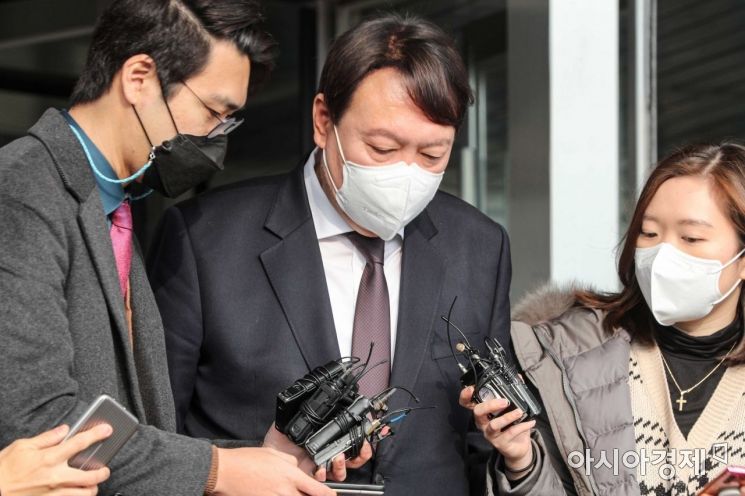
 Prosecutor General Yoon Seok-yeol is leaving the Ministry of Justice building after meeting with Park Beom-gye, Minister of Justice, who is about to take office, at the Government Complex Gwacheon in Gyeonggi on the 1st. / Gwacheon - Photo by Kang Jin-hyung aymsdream@
[Asia Economy Reporter Choi Seok-jin] Amid growing internal opposition within the prosecution to the ruling party's push to establish the Serious Crime Investigation Agency (SCIA), Prosecutor General Yoon Seok-yeol is expected to officially announce his stance on the matter soon, drawing attention to the manner and content of his statement.
The ruling party argues that to restore public trust in the criminal justice system, the prosecution's 'investigative authority' and 'prosecutorial authority' should be separated. However, many prosecutors perceive this as effectively a 'dismantling of the prosecution.'
Nonetheless, with Prosecutor General Yoon's term nearing its end and key positions in the Ministry of Justice, the Supreme Prosecutors' Office, and frontline prosecution offices occupied by prosecutors trusted by the current administration, it is difficult for prosecutors to voice a unified opposition. This deepens Yoon's dilemma.
Proposal to Abolish the Prosecutors' Office and Establish 'Investigation Agency' and 'Prosecution Agency'... Prosecutors Disappear from Investigations
According to the National Assembly's legislative information system on the 28th, the Democratic Party of Korea submitted the "Act on the Establishment and Operation of the Serious Crime Investigation Agency" (SCIA Establishment Act) on the 8th, led by Representative Hwang Un-ha.
Previously, amendments to the Prosecutors' Office Act significantly curtailed prosecutors' investigative authority to six major crimes designated by presidential decree?corruption, economic crimes, public official crimes, election crimes, defense industry crimes, and large-scale disasters?as well as crimes committed by police officers. All other crimes were transferred to the police for investigation.
However, the newly proposed law aims to transfer even the investigative authority over these six major crimes, which remain with the prosecution, to the newly established Investigation Agency.
Prior to this, the ruling party had already submitted the "Prosecution Agency Act" and the "Prosecutors' Office Act Abolition Act" at the end of last year. The SCIA Establishment Act is premised on the passage of these two bills in the National Assembly.
The Prosecution Agency Act limits prosecutors' duties to filing and maintaining indictments, requesting proper application of laws to courts, directing and supervising trial execution, and other matters within their authority under other laws. In other words, it completely removes prosecutors' investigative authority, restricting them to prosecution and maintenance of indictments.
Additionally, the Prosecution Agency is divided into the High Prosecution Agency and Regional Prosecution Agencies, with the Prosecutor General serving as the head of the High Prosecution Agency. It also explicitly states that the Prosecutor General will be treated as a vice-ministerial level official.
Ultimately, this abolishes prosecutors' investigative authority, eliminates the current Supreme Prosecutors' Office equivalent organization, and demotes the Prosecutor General?currently accorded ministerial-level status?to vice-ministerial level. Given that the current Deputy Prosecutor General and High Prosecutors are treated as vice-ministerial officials, downgrading the Prosecutor General to the same level appears to be an intentional move to weaken the prosecution and the Prosecutor General's power.
During the intensified conflict with former Minister of Justice Choo Mi-ae over her exercise of investigative command authority last year, Prosecutor General Yoon sparked controversy by stating at the Supreme Prosecutors' Office's National Assembly audit, "The Prosecutor General is not a subordinate of the Minister."
Finally, the "Prosecutors' Office Act Abolition Act" aims to abolish the Prosecutors' Office Act, thereby removing the legal basis for the establishment of the Prosecutors' Office and prosecutors' investigative authority, contingent upon the passage of the Prosecution Agency Act in the National Assembly.
If these three bills pass sequentially and are implemented as envisioned by the ruling party, the investigation of the six major crimes assigned to prosecutors after the adjustment of investigative authority between the police and prosecution will be handled by investigators of the newly established Investigation Agency. Prosecutors will be responsible for prosecution and maintaining indictments at the Prosecution Agency, prosecuting suspects investigated by the police, Investigation Agency, or the High-ranking Officials' Crime Investigation Agency (HOCI), and participating in trials.
The Prosecution Agency Act also prohibits prosecutors from being dispatched to other agencies, except when appointed as special prosecutors, special assistant prosecutors, or special investigators. However, prosecutors' constitutional authority to request warrants remains intact.
In conclusion, prosecutors will no longer conduct investigations but will instead decide on prosecution based on investigation records and participate in trials. This represents a complete overhaul of the current system, where most prosecutors handle both investigation and prosecution, and prosecutors in trial divisions maintain indictments.
"This is Going Too Far" · "Separation of Investigation and Prosecution Lacks Effectiveness" ... Prosecutors Express Dissatisfaction and Concerns
Since the enforcement of the amended Criminal Procedure Act and Prosecutors' Office Act this year, which transferred much of the prosecution's investigative authority to the police and abolished prosecutors' supervisory authority over police investigations maintained since 1954, there has been no collective protest from prosecutors.
This is largely because public criticism of the prosecution's past investigative misconduct was intense, and as prosecutorial reform was a priority in President Moon Jae-in's administration, opposing the adjustment of investigative authority or the introduction of the HOCI could be perceived as organizational selfishness or resistance to reform.
However, the current bills proposed by the ruling party?the Prosecutors' Office Act Abolition Act, the Prosecution Agency Act, and the SCIA Establishment Act?do not aim to reform the prosecution system while maintaining its existence. Instead, they seek to abolish the Prosecutors' Office entirely and fundamentally change the criminal justice framework by preventing prosecutors from performing their core investigative duties, making it difficult for prosecutors to accept.
A senior prosecutor (A) from the Seoul Central District Prosecutors' Office expressed, "Isn't this going too far? When investigating the state affairs manipulation and judicial manipulation cases, those who praised the prosecution for doing well have now turned their attitude because the prosecution is investigating their own side, trying to weaken the prosecution's power, and now they want to abolish the entire organization. Is this really reform?"
There are also voices arguing that preventing specialized prosecutors from conducting investigations or the idea of separating investigation and prosecution itself is abnormal.
Prosecutor B said, "Chief prosecutors with over 20 years of investigative experience, deputy chief prosecutors and senior prosecutors who have focused solely on investigations for nearly 20 years are the top experts in investigations. Ignoring their long practical experience and expertise and assigning them only prosecution and trial duties, while selecting investigators with lawyer qualifications or over five years of investigative experience to handle complex serious crimes, is beyond my understanding."
B added, "Since the Securities Crime Joint Investigation Unit at the Seoul Southern District Prosecutors' Office was abolished, the number of judicial actions against financial crimes has significantly decreased. Ultimately, those applauding behind the scenes will be the criminals."
Another prosecution official (C) pointed out, "Investigation is not an end in itself but a means to collect evidence and testimonies to prove criminal charges and secure guilty verdicts in trials. It is not easy for prosecutors at the Prosecution Agency, who have no involvement in investigations, to maintain indictments based solely on investigation records that can be tens of thousands of pages long."
C continued, "Currently, important cases involve the investigating prosecutor directly participating in trials. Maintaining indictments based on investigation records from prosecutors within the same office is entirely different from maintaining indictments based on investigations conducted by a completely separate agency," expressing concern.
"Concerns Over Reduced Crime Response Capability" · "Do Not Distort Overseas Cases" ... Real-name Posts Appear on Prosecution Internal Network
As the ruling party's push to establish the Investigation Agency gains momentum, prosecutors have begun posting real-name messages on the internal network expressing concerns.
◆ Park Cheol-wan, Head of Andong Branch of Daegu District Prosecutors' Office: "Hold a Nationwide Prosecutors' Meeting to Gather Opinions" = On the 26th, Park Cheol-wan, head of the Andong branch of the Daegu District Prosecutors' Office, posted an article titled "Watching the Attempt to Establish the Serious Crime Investigation Agency and Prosecution Agency" on the prosecution's internal network.
He wrote, "A few months ago, when Representative Hwang Un-ha and several other lawmakers mentioned the establishment of the Serious Crime Investigation Agency and Prosecution Agency, I dismissed it as an idea beyond the common sense and imagination of a few lawmakers with deep-rooted animosity toward the prosecution and paid little attention."
He continued, "However, recently, I heard through the media that their proposal might be adopted as the ruling party's official stance. Yesterday, I received an official letter from the Supreme Prosecutors' Office requesting opinions on the bill, and I found it hard to even force a smile."
He explained, "I had resolved to remain silent until something changes, but if I stay silent now, I might truly become a straw man, so I decided to make an exception and speak out."
Park shared content he posted on the Andong branch's internal network on the 17th, before reviewing the detailed SCIA Establishment Act.
In that post, he stated, "The ruling party drastically revises the Criminal Procedure Act and Prosecutors' Office Act, which form the foundation of criminal justice, to significantly reduce the prosecution's authority. However, they left prosecutors' authority to initiate investigations for some serious crimes because removing it would mean losing the prosecution's know-how and capabilities in investigating important crimes, which could cause serious gaps in crime response."
He added, "The reality and awareness underlying these opinions have not changed much, and although prosecutors in each country are granted authority according to their circumstances, the ruling party is pushing to establish a new investigative agency based on the superficial argument that 'to protect citizens' human rights, the prosecution should only exercise prosecutorial authority.' This is incomprehensible."
Park warned, "To avoid gaps in crime response during the establishment of such an investigative agency, experts in this field must move from the prosecution to the new agency, and the prosecution must secure conditions that allowed it to build expertise and investigative achievements (such as prosecutors' job security and warrant request authority enabling swift searches). However, my humble prediction is that these conditions will not be met for several years. If my prediction is correct, establishing the Investigation Agency will cause a significant gap in crime response capability."
He also criticized, "I do not know whether the ruling party views the prosecution's pursuit of efficiency under the Prosecutor General as mere human rights oppression or as a threat to themselves, but pushing institutional changes hastily like lightning strikes is truly inappropriate."
Park suggested, "If the ruling party insists on proceeding despite these criticisms, at least they should anonymously survey current and former prosecutors with expertise in investigating serious crimes about their willingness to join or leave the new investigative agency."
Finally, he emphasized, "Whether to establish the Serious Crime Investigation Agency and Prosecution Agency is a crucial matter directly related to maintaining a normal criminal justice system, and all prosecutors would agree. On this issue, a nationwide prosecutors' meeting should be held to gather opinions, not just a regular prosecutors' meeting."
At the end of his post, Park noted, "I have been reviewing the bill since this afternoon. Reading the reasons for the proposal, I understand the proposers' perception of the prosecution system and reality. I have written my thoughts in detail," providing a thorough rebuttal to the bill's stated rationale.
He particularly refuted the proposal's claim that "to guarantee objectivity and fairness in investigation and prosecution, prosecutors should not be forced to play dual roles as parties and public interest representatives in trials but should be institutionally separated to provide mutual checks and balances."
Park argued, "Deciding on prosecution solely based on investigation records may ensure procedural objectivity and fairness, but it is more likely to fail in reaching decisions that reflect substantive truth compared to when the investigating prosecutor decides. Incorporating information obtained during investigations into prosecution decisions can lead to decisions aligned with substantive truth."
◆ Gu Seung-mo, International Cooperation Officer at the Supreme Prosecutors' Office, Refutes Using Cases from the US, UK, Germany, and Japan = A rebuttal post addressing the ruling party's claim that "separation of investigation and prosecution is a global trend" was also posted.
Gu Seung-mo, International Cooperation Officer at the Supreme Prosecutors' Office, wrote on the internal network the previous day under the title "Investigation of Serious Crimes by Prosecutors in Major Countries," stating, "Recently, discussions on abolishing prosecutors' investigative authority and limiting them to prosecution and maintenance of indictments have been underway, citing the claim that 'separation of investigation and prosecution is a global trend.' While examining foreign systems is desirable when improving our system, there are many cases where only parts of foreign systems are cited without considering the whole system or practical aspects, leading to distorted interpretations."
Gu introduced the investigative systems of major countries such as the US, UK, Germany, and Japan.
He explained, "In the US, federal prosecutors have the authority to initiate investigations on major federal cases and conduct investigations closely with federal investigators from the start. State and local prosecutors also often have their own investigative personnel for major cases."
He added, "The UK's Serious Fraud Office (SFO) integrates investigation and prosecution within one agency for complex economic crimes, bribery, and corruption cases, requiring cooperation between prosecutors and investigators from the outset, unlike ordinary cases."
Gu noted, "In civil law countries like Germany, prosecutors act as the lead investigators with authority to initiate, direct, and conclude investigations, conducting investigations through judicial police officers. Specialized prosecutors in major prosecution offices handle important corruption and economic crimes from the investigation stage, directing police and taking responsibility for investigation, prosecution, and maintenance of indictments."
He also mentioned, "Neighboring Japan has special investigation divisions where prosecutors directly investigate corruption, corporate crimes, tax evasion, and financial crimes. The Japanese Ministry of Justice website states that prosecutors' independent investigations into corruption and corporate crimes are crucial for uncovering and arresting major crimes hidden in political and economic darkness, contributing to the nation's sound development."
At the end of his post, Gu emphasized, "As you well know, investigation is not the goal itself but a means to legally obtain evidence of criminal facts to secure guilty verdicts through trials. In complex serious crime investigations, failing to consider prosecution from the investigation stage makes it naturally difficult to obtain guilty verdicts."
He stressed, "Therefore, major countries strive to integrate investigation and prosecution functions organically for serious crimes."
This contradicts the ruling party's claim of a global trend.
Finally, Gu urged, "When fundamentally revising the national criminal justice system, I hope that critical discussions are not hastily decided based on inaccurate facts."
◆ Prosecutor Cha Ho-dong: "Separation of Investigation and Prosecution Is Not a Global Trend" Based on UN Office on Drugs and Crime Data = On the same day, Cha Ho-dong, prosecutor of the Women and Children Crime Investigation Division at Daegu District Prosecutors' Office, posted an article titled "Separation of Investigation and Prosecution Is Not a Global Trend."
He began by stating, "When the contradictory concept of 'separation of investigation and prosecution' first appeared, it was dismissed as a claim by those unfamiliar with the legal system. However, recently, misinformation suggesting that prosecutors in foreign countries only prosecute and are separated from investigations has been spread as if it were true."
Cha questioned, "Is it being perceived that only investigations initiated directly by prosecutors are 'investigations,' and the process of collecting evidence for prosecution is not? This is highly questionable. But first, we need to verify whether this is actually the case globally and whether it is a trend."
He introduced materials from international organizations, including the 2014 Criminal Justice Handbook published by the United Nations Office on Drugs and Crime (UNODC) and resolutions adopted at the UN's 8th Congress on Crime Prevention and Criminal Justice.
The materials state that "With the emergence of new crimes and sophisticated, complex crimes, and the specialization and complexity of legal provisions, even countries without prior cooperation between police and prosecution have increased prosecutorial involvement and cooperation in police investigations."
They also note, "Legal systems worldwide vary widely, from those where prosecutors do not intervene in investigations to those with extensive involvement. Regardless of this spectrum, there is a strong tendency for prosecutors to be involved in investigations from the early stages, especially in complex cases such as fraud and corruption."
The proposal to separate investigation and prosecution was first mentioned by then Minister of Justice Choo Mi-ae at a press conference in February last year, sparking controversy.
At that time, Minister Choo stated, "Because prosecutors' direct investigation and prosecution of important cases may compromise neutrality and objectivity, internal control mechanisms are necessary. We will consider institutional improvements to separate the subjects of investigation and prosecution within the prosecution."
The prosecution largely responded that this was a statement by someone unfamiliar with investigative realities. Prosecutor General Yoon also indirectly opposed the proposal during a private meeting with prosecutors and staff from Busan High Prosecutors' Office and District Prosecutors' Office, stating that "important cases should have the investigating prosecutor directly maintain indictments" and "it is natural for the investigating prosecutor to decide on prosecution."
At the time, Shim Jae-chul, then floor leader of the Liberty Korea Party, criticized the proposal, saying, "Separation of investigation and prosecution is not practiced anywhere in the world and is a clear violation of current law," calling Minister Choo a "pseudo-legal professional."
Minister Choo has recently continued to urge the swift passage of the SCIA Establishment Act through her Facebook posts.
"Calls for 'Speed Control' Buried by Hardliners... Prosecutor General Yoon Contemplating How and How Strongly to Express His Position"
Amid the confusion caused by the adjustment of investigative authority between the police and prosecution and the establishment of the HOCI, concerns have arisen within the Blue House and ruling party that establishing another investigative agency will cause greater confusion and reduce the nation's crime response capability.
Five-term senior lawmaker Lee Sang-min of the Democratic Party, former chair of the National Assembly's Legislation and Judiciary Committee, publicly opposed the ruling party's push to establish the SCIA on the 25th via his Facebook.
He stated, "It is inappropriate to establish the SCIA separately at this time. If established, investigative agencies will proliferate into the SCIA, HOCI, police, prosecution, and other special investigative agencies, excessively burdening and pressuring citizens and businesses."
He added, "Anti-corruption investigative capabilities may decline, and relationships among investigative agencies will become complicated and chaotic. What we should do first is to carefully manage the proper settlement of the HOCI and the adjustment of investigative authority between the police and prosecution."
Recently, through remarks by Minister of Justice Park Beom-gye, it was reported that President Moon also expressed concerns about the ruling party's hasty push to establish the SCIA and urged 'speed control.' However, Minister Park later downplayed this, saying it was "during the appointment ceremony" and that "the President did not use the term 'speed control,'" causing some confusion.
It remains unclear what President Moon's exact stance is on the SCIA establishment or the extent of opposition within the ruling party, but current trends suggest that under the leadership of hardliners within the ruling party, the bill is likely to be put to a vote in the National Assembly during Prosecutor General Yoon's term.
The Supreme Prosecutors' Office recently sent official letters to frontline prosecution offices requesting opinions on the SCIA Establishment Act at the Ministry of Justice's request.
Once opinions from each prosecution office are collected, it is widely expected that Prosecutor General Yoon will express his position in some manner.
In the past, when collective voices from prosecutors were necessary?such as during the initial push to abolish the Supreme Prosecutors' Office's Special Investigation Division in 2004 (under Prosecutor General Song Kwang-soo) or when the investigative authority adjustment bill was amended in the National Assembly's Judiciary Committee in 2011 (under Prosecutor General Kim Jun-gyu)?the Prosecutor General or senior prosecutors supporting him, or frontline chief prosecutors, expressed protest by collectively offering to resign.
However, the current situation is quite different.
Although most prosecutors oppose the establishment of the SCIA, it is uncertain how many are willing to take the lead in voicing opposition despite potential personnel disadvantages to protect the organization.
Even among senior prosecutors at the Supreme Prosecutors' Office, those who fully support Prosecutor General Yoon are outnumbered by those appointed during former Minister Choo's tenure and the current administration, many of whom are likely eyeing their next positions.
Among prosecutors recognized for their abilities during the previous administration and once considered 'front-runners' among their Judicial Research and Training Institute peers but sidelined after the regime change, many are reluctant to engage in politically sensitive issues, adopting an attitude of "do as you please."
The content of opinions collected from frontline prosecution offices and the extent to which opposition to the SCIA spreads through internal networks will likely influence how and to what degree Prosecutor General Yoon expresses his stance.
The strongest option available to Prosecutor General Yoon would be to resign in protest.
However, even if Yoon resigns, there is no guarantee that the ruling party's hardliners will slow their legislative push. Moreover, with ongoing investigations into powerful figures in cases such as the Wolseong Nuclear Power Plant, Kim Hak-eui's illegal overseas departure, and the Ulsan mayoral election interference, giving up the remaining five months of his term is a difficult decision, deepening Yoon's dilemma.
© The Asia Business Daily(www.asiae.co.kr). All rights reserved.

















