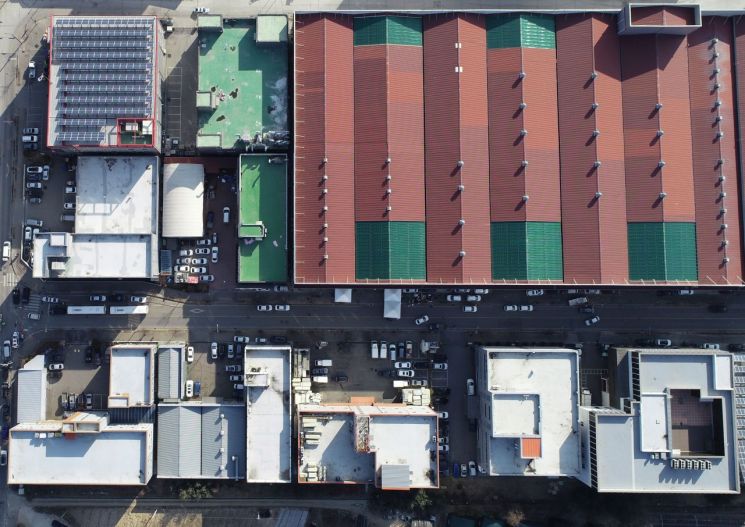
 A recent COVID-19 cluster infection occurred at a plastic manufacturing factory in Jingwan Industrial Complex, Jingun-eup, Namyangju-si, Gyeonggi Province.
 [Image source=Yonhap News]
[Asia Economy Reporter Kim Heung-soon] Due to the impact of COVID-19 cluster infections mainly occurring in manufacturing factories and workplaces, the number of confirmed foreign COVID-19 cases in South Korea has more than doubled in the past month compared to before the Seollal holiday.
According to the Central Disease Control Headquarters (CDCH) on the 27th, the cumulative number of foreign COVID-19 confirmed cases since January this year reached 1,747, accounting for 6.6% of the total domestic cases during the same period. In particular, foreign confirmed cases have continuously increased over the past month (January 24 to February 26), rising 2.7 times compared to before the Seollal holiday.
By region, the cases were distributed as follows: Gyeonggi Province (47.1%), Seoul (28%), Chungnam (6.5%), and Incheon (5.4%). There were a total of 13 cluster infection cases related to foreigners (648 people), among which the infection rate among foreigners was 61.4% (398 people). By industry, manufacturing accounted for 5 cases (272 people), including the 'plastic factory in Namyangju, Gyeonggi Province,' meat processing companies had 2 cases (8 people), sales industry 2 cases (27 people), and others 4 cases (91 people).
According to the CDCH, among the total 71 cluster infection cases in the recent two weeks (February 12 to 25), 19 cases (633 confirmed patients) occurred in workplaces. The health authorities announced that to prevent workplace infections and minimize further transmission, they will cooperate with the Ministry of Employment and Labor, the Ministry of Justice, and local governments to establish and implement customized surveillance strategies by region, age group, and nationality.
Specifically, they plan to strengthen surveillance while improving testing accessibility by conducting mass testing of confirmed patients' living facilities, using multilingual epidemiological investigation forms and guidance documents to enhance information accessibility, and utilizing proactive and anonymous testing for foreign students and workers.
© The Asia Business Daily(www.asiae.co.kr). All rights reserved.

















