Kona Recall Cost 1 Trillion Won... Stock Price Falters Amid US Interest Rate Hike Impact
Hyundai Mobis Stock Returns to Early January Levels
EV Market Still 'Clear'... "Kona Recall Removes Uncertainty"
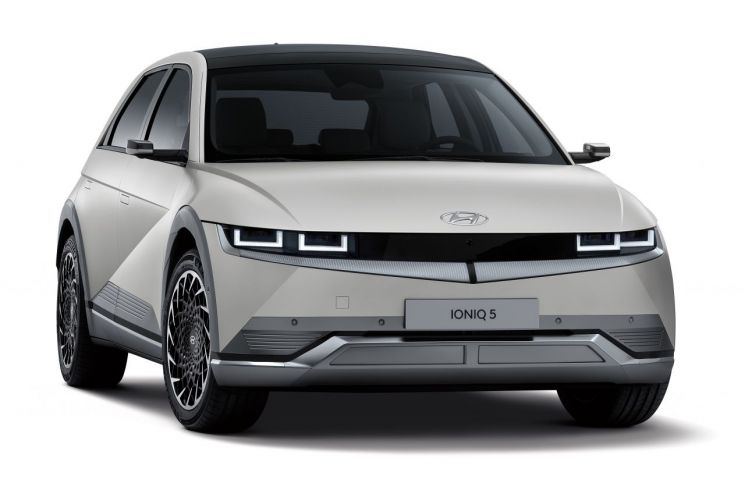
[Asia Economy Reporter Minwoo Lee] The confirmation of a 1 trillion won-scale electric vehicle recall has become a negative factor for Hyundai Motor and its affiliates' stock prices. This has dampened the mood just after unveiling the next-generation electric vehicle Ioniq 5. However, it is interpreted as a one-time cost and rather an opportunity to reduce uncertainty in the early stages.
According to the Korea Exchange on the 27th, Hyundai Motor's stock price closed at 237,000 won on the 26th, down 3.27% from the previous day. Recently, rapid fluctuations have been repeated, gradually forming a downward curve. On the 24th, it fell 3.89% from the previous day to 235,000 won. The next day, it rose 4.26% to 245,000 won but then dropped back to the 230,000 won range. Considering the KOSPI's fluctuations of -2.45% on the 24th, 3.50% on the 25th, and -2.80% on the 26th, the volatility appears even greater. During this period, Hyundai Mobis's stock price also fluctuated. It closed at 325,000 won on the 23rd but dropped to 303,000 won the previous day. Hyundai Mobis's stock price falling to the 300,000 won level is the first time since the beginning of the year on the 7th of last month.
It is analyzed that the impact of the Kona recall combined with the sharp rise in the US 10-year Treasury yield caused the overall stock market to freeze. Earlier, on the 24th, Hyundai Motor decided to replace all batteries in 81,701 units of Kona electric vehicles (EV), Ioniq, and electric buses Elec City. This is because 15 fire incidents occurred domestically in Kona EVs equipped with LG Energy Solution batteries, a subsidiary of LG Chem, since May 2018. Although a large-scale recall was conducted last October, problems reoccurred. Recently, fires also occurred in electric buses Elec City equipped with the same battery.
The bad news broke just one day after Hyundai Motor announced the new car Ioniq 5, the first model of the electric vehicle platform 'E-GMP,' which Hyundai has marked as its future growth engine. Previously, Hyundai Motor simultaneously unveiled the Ioniq 5 worldwide via YouTube on the 23rd. It is regarded as the starting point of the 'future mobility' envisioned by Hyundai Motor Group Chairman Chung Euisun and embodies Hyundai's next-generation electric vehicle technology.
Subsequently, on the 25th (local time), the US 10-year Treasury yield surged to 1.5%, negatively affecting the entire market. At one point during the day, it even exceeded 1.6%. This level is similar to mid-February last year, before the full spread of COVID-19. Consequently, the three major US stock indices?the Dow Jones Industrial Average (-1.75%), S&P 500 (-2.45%), and Nasdaq (-3.52%)?all declined. The KOSPI and KOSDAQ also fell by -2.80% and -2.38%, respectively.
Despite this, the outlook for the electric vehicle industry remains bright, and there is analysis that upward momentum remains for the future. In particular, the Kona recall is interpreted as an opportunity to reduce uncertainty ahead of the Ioniq 5's European launch next month. Kim Dongha, a researcher at Hanwha Investment & Securities, said, "Quality issues are inevitable in the early stages of electric vehicle transition, so proactive protective measures are important. The preemptive response for customer safety despite low fire occurrence probability and financial burden is positive for strengthening the electric vehicle brand." He added, "Frequent quality costs are negative, but since the recall cost will be reflected in last year's fourth-quarter earnings, the impact on stock prices is limited."
© The Asia Business Daily(www.asiae.co.kr). All rights reserved.

















