Rising Prices and Economic Recovery Expectations Push US Treasury Yields Higher
10-Year Korean Treasury Bond Yield Also Threatens 2%
Won-Dollar Exchange Rate Surges 12.7 Won at Opening... Largest Increase in 11 Months Compared to Previous Close
Risk Asset Preference Drops Sharply... KOSPI Index Threatened Below 3000
Bank of Korea Announces Plans to Purchase 5 to 7 Trillion Won in Treasury Bonds in First Half of the Year
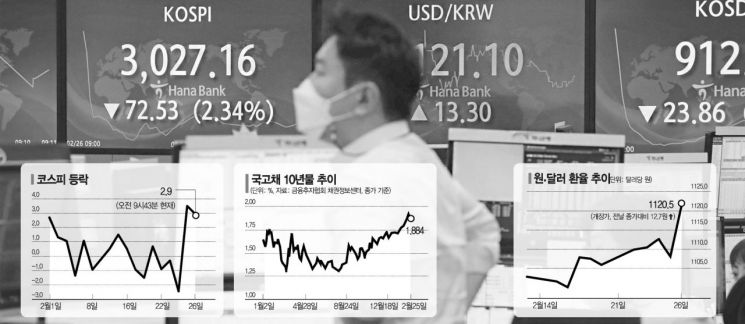
[Asia Economy Reporters Eunbyeol Kim, Minwoo Lee] As US Treasury yields soar, preference for risk assets is rapidly declining. The won-dollar exchange rate rose about 13 won in early trading, and the KOSPI index is once again at risk of falling below the 3000 mark. The virtual asset Bitcoin is also plummeting. Judging that market volatility is unusual, the Bank of Korea announced its treasury bond purchase plan earlier than expected. Experts say that while market volatility triggered by treasury yields will not last long, the market could be shaken whenever doubts arise about inflation, given that the US Federal Reserve (Fed) has stated it will tolerate inflation but not pursue monetary tightening.
On the 26th, in the Seoul foreign exchange market, the won-dollar exchange rate opened at 1120.5 won per dollar, up 12.7 won from the previous day's closing price. It has since maintained a level in the 1120 won range. The surge in US Treasury yields overnight caused a stronger dollar, and risk asset preference among investors sharply contracted, pushing up the won-dollar exchange rate. The gap up at opening compared to the previous close was the largest since March 23 last year (18.5 won). March 23 last year was a day when the KOSPI index broke below 1500, causing significant market turmoil. Although the exchange rate level itself is not high, having reached 1123.81 won earlier this month, considering the time difference between Korea and the US, this indicates that the impact of US market interest rates and the dollar index on the domestic market was particularly significant this time.
Exchange Rate Surges Over 12 Won
The reason for the sharp rise in the won-dollar exchange rate is that investors have formed expectations of rising inflation and economic recovery. On the back of inflation expectations, the US Treasury yield surged to 1.614% intraday the previous day, and as of 10:34 AM today, the 10-year Korean Treasury bond yield also reached 1.966%. It was trading in the high 1.8% range just the day before, so this represents an 8 basis point (1bp=0.01 percentage point) increase in one day. The market had initially viewed the 2% level on the 10-year Treasury bond yield as a critical threshold.
When inflation expectations rise and bond yields increase, funds typically flow out of the stock market. When inflation is expected to rise, bond prices fall (bond yields rise), reducing the attractiveness of interest-paying products because the real interest rate, adjusted for inflation, decreases. Existing bondholders suffer losses due to price drops, but new investors are more inclined to buy bonds. As stock investors move to the bond market, stock prices naturally fall. Additionally, rising bond yields increase interest burdens on companies with existing loans, reducing the attractiveness of stock investments in those companies.
Therefore, the KOSPI index, which surged over 100 points the previous day, is at risk of falling below 3000 again within two days. Foreign and institutional investors are selling off, increasing the decline. The domestic stock market has experienced fluctuations of around 2% to mid-2% for three consecutive trading days. During this period, the KOSPI fluctuated sharply between 2094 and 3099. As of 9:55 AM today, the KOSPI stood at 3013.04, down 2.80% (86.65 points) from the previous day. After opening slightly lower at 3089.49, the index rapidly widened its losses. Around 9:35 AM, it fell to 3005.02, nearly breaking below the 3000 level. Selling pressure from foreign and institutional investors pulled the index down. They net sold 589.2 billion won and 765 billion won worth of stocks, respectively. Although individual investors net bought 1.3462 trillion won worth, they could not prevent the index's decline. The KOSDAQ also fell 2.75% (25.60 points) to 910.61 at the same time. It also opened slightly lower but quickly widened its losses, dropping to 906.73 around 9:36 AM. The KOSDAQ market is also experiencing coordinated selling by foreign and institutional investors.
Bank of Korea Expands Treasury Bond Purchases: "Plan to Buy 5 to 7 Trillion Won in First Half"
As the market suddenly shook, the Bank of Korea announced plans to simply purchase 5 to 7 trillion won worth of treasury bonds in the first half of this year. In September last year, it had announced plans to purchase 5 trillion won by the end of last year, but this time it expanded the range to 5 to 7 trillion won, showing a stronger commitment to treasury bond purchases. A Bank of Korea official explained, "Given the recent increase in market interest rate volatility and the expected significant increase in treasury bond issuance due to supplementary budget formulation, we disclosed the purchase scale proactively." The Bank of Korea plans to announce the purchase date, scale, and bond types on business days before the auction, considering future market conditions. It will purchase through competitive bidding using multiple interest rate methods targeting institutions eligible for simple securities trading. The official emphasized, "In addition to expanding simple purchases, we will also take additional measures to stabilize the market if necessary, such as during rapid market interest rate fluctuations." Reporters Eunbyeol Kim and Minwoo Lee silverstar@
© The Asia Business Daily(www.asiae.co.kr). All rights reserved.
![Clutching a Stolen Dior Bag, Saying "I Hate Being Poor but Real"... The Grotesque Con of a "Human Knockoff" [Slate]](https://cwcontent.asiae.co.kr/asiaresize/183/2026021902243444107_1771435474.jpg)
















