10-Year Bond Yield Surges to 1.6% Amid Inflation Concerns
Highest in 1 Year... Rises 0.34%P in 2 Weeks
KOSPI Falls Over 2%... Exchange Rate Up 12.7 Won
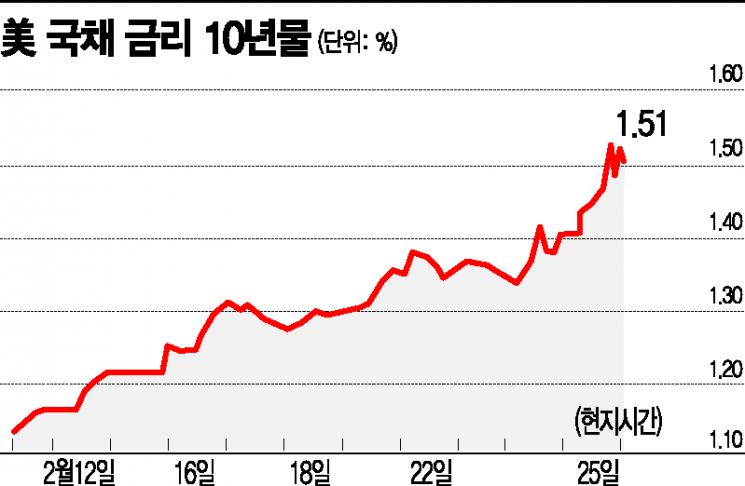
[Asia Economy New York=Special Correspondent Baek Jong-min, Reporters Kim Eun-byeol, Lee Min-woo] The sharp rise in U.S. Treasury yields has shaken global financial markets. As the U.S. 10-year Treasury yield surpassed 1.6% intraday, Asian stock markets including South Korea's have been volatile following the New York Stock Exchange.
On the 25th (local time), U.S. Treasury yields surged to 1.61% intraday due to inflation concerns. This is the highest level in a year since February last year. Based on the closing yield of 1.518% that day, the U.S. 10-year Treasury yield has jumped 0.34 percentage points over the past two weeks. This reflects widespread market fears that the U.S. economic recovery will prompt an accelerated rate hike. ▶Related article on page 4
The surge in U.S. Treasury yields, which serve as a benchmark for investment products worldwide, poured cold water on the stock markets. On that day, the Nasdaq index, which is highly sensitive to rising yields, plunged 3.52% in New York. The Dow Jones Industrial Average also fell 1.75%, and the S&P 500 dropped 2.45%. As inflation concerns pushed Treasury yields higher, fears spread that the Federal Reserve (Fed) might raise rates earlier than expected, turning bonds and stocks into sell-off targets.
The shockwave from the surge in U.S. Treasury yields hit the Korean market directly. On the 26th, both the KOSPI and KOSDAQ indices showed declines of over 2% from the start of trading. The KOSPI, which opened at 3,089.49, down 10.20 points (0.33%) from the previous day, quickly widened its losses and fell to 3,007.68 within 20 minutes of the opening. The KOSDAQ index at one point dropped more than 3%, falling to the 906 level. Except for Kakao, which is benefiting from a stock split effect, major market cap stocks including Samsung Electronics and SK Hynix all declined together. Foreign and institutional investors, who had lifted the index by over 100 points the previous day, turned to joint selling.
On that day, the exchange rate opened at 1,120.5 won per dollar, rising sharply by 12.7 won from the previous day's closing price. This was due to a contraction in risk asset preference. As market interest rate volatility increased, the Bank of Korea announced plans to simply purchase government bonds worth 5 to 7 trillion won in the first half of this year. Attention is focused on whether the market will stabilize as the Bank of Korea signals its intention to actively buy government bonds.
© The Asia Business Daily(www.asiae.co.kr). All rights reserved.

















