UK sees 18-day rise 2 weeks after vaccination
3.6 times higher just before vaccination... "No room for lax quarantine"
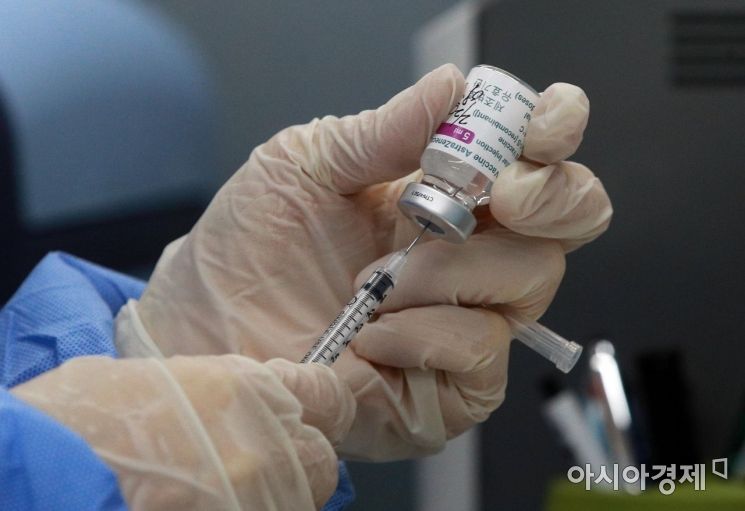 On the 26th, when COVID-19 vaccinations began in Korea, medical staff at Dobong-gu Public Health Center in Seoul were filling syringes with the AstraZeneca vaccine. Photo by Hyunmin Kim kimhyun81@
[Asia Economy Reporter Cho Hyun-ui] As South Korea began COVID-19 vaccinations on the 26th, becoming the 102nd country worldwide to do so, voices are emerging that Israel and the United Kingdom’s precedents should serve as lessons. There are concerns that the start of vaccinations could lead to complacency in quarantine measures, potentially worsening the COVID-19 situation.
According to ‘Our World in Data,’ an international statistics site operated by the University of Oxford in the UK, Israel, which has the fastest vaccination rate globally, had 53.1% of its population receive either the first or second dose as of the 24th. The UK, the first country to start COVID-19 vaccinations on December 8 last year, currently ranks third in vaccination rate after Israel and the United Arab Emirates (UAE). As of the 23rd, 26.9% of the population, or one in four citizens, had received at least one dose of the COVID-19 vaccine.
With vaccinations progressing smoothly as planned, Israel and the UK have introduced measures to ease lockdown restrictions. Since the 21st, Israel has opened commercial and public facilities such as shopping malls, markets, and libraries to all citizens. This marks a step closer to normalcy after ending lockdown measures that had been in place since late December, lasting about two months. Citizens who have completed their second dose receive a kind of certificate called the ‘Green Pass,’ which allows them to use gyms, swimming pools, and indoor and outdoor cultural performance venues.
The UK recently announced a gradual lockdown easing plan. With the number of vaccinated individuals surpassing 17 million, the first phase, focusing on reopening schools, is set to begin on the 8th of next month. Prime Minister Boris Johnson aims to fully lift lockdown measures by June.
However, there are warnings that such easing of quarantine measures should not be hastily applied, and the start of vaccinations should not signal complacency. Considering that it takes about two weeks for antibodies to form after vaccination, ironically, the number of confirmed cases per one million people in Israel increased more than 1.7 times from 4,174.8 on February 2, two weeks after the first vaccination day, to 6,974.7 on February 17. Compared to 1,950.5 cases the day before vaccinations began, this is about 3.6 times higher.
The UK shows a similar trend. The number of confirmed cases per one million people rose steadily from 3,287.47 on December 22, two weeks after the first vaccination day, to 6,169.27 on January 9, more than doubling over 18 days. While the spread of more transmissible variant viruses than the original strain is a factor, the loosening of adherence to quarantine rules as vaccination numbers increased is also significant.
Jung Eun-kyung, head of the Korea Disease Control and Prevention Agency (KDCA), said yesterday, "Vaccinations are starting, but that does not mean COVID-19 is overcome," adding, "Since a very long time is needed, for vaccinations to proceed as planned, the COVID-19 outbreak must be properly controlled."
Meanwhile, the global COVID-19 death toll surpassed 2.5 million on this day. According to the international statistics site ‘Worldometer,’ the death toll reached 2,518,216, with the United States accounting for 20% and Brazil 10% of the total.
© The Asia Business Daily(www.asiae.co.kr). All rights reserved.

















