Foreigners and Institutions Continue Selling... Only Individuals Net Buying
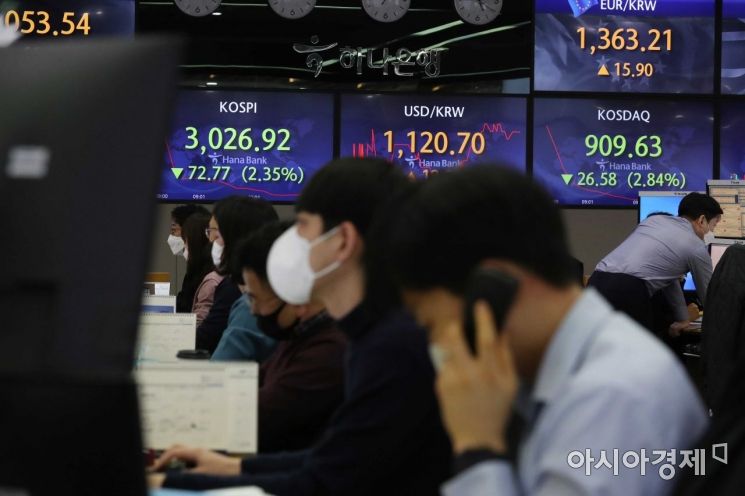 On the 26th, when the KOSPI index started with a sharp decline, dealers were working in the dealing room of Hana Bank in Euljiro, Seoul. On that day, the KOSPI opened at 3,089.49, down 10.20 points (-0.33%) from the previous trading day, showing a downward trend. Photo by Moon Honam munonam@
[Asia Economy Reporter Minwoo Lee] Both the KOSPI and KOSDAQ fell more than 2% in the early session. It is interpreted that the sluggish U.S. stock market due to the sharp rise in U.S. Treasury yields affected the domestic stock market.
On the 26th, the KOSPI opened at 3,089.49, down 0.33% (10.20 points) from the previous day. Afterwards, the decline rapidly widened, and as of 9:27 a.m., it plunged to 3,014.36, down 2.75% from the previous day.
It appears that selling pressure from foreigners and institutions pulled the index down. Foreigners sold a net 154.7 billion KRW, and institutions sold a net 364.4 billion KRW. Only individuals bought a net 517 billion KRW.
All sectors were in decline. The order was machinery (-4.22%), textiles and apparel (-4.11%), and electrical and electronics (-3.68%).
Among the top 10 market capitalization stocks, all fell except Kakao (0.5%). SK Hynix had the largest drop at -4.7%. Next were LG Chem (-4.2%), Samsung SDI (-3.8%), Samsung Electronics (-3.4%), Hyundai Motor (-2.6%), Samsung Biologics (-2.3%), NAVER (-2.2%), and Celltrion (-1.9%).
The KOSDAQ showed a similar trend. It started slightly down at 930.54, down 0.61% (5.71 points) from the previous day. Afterwards, the decline widened, falling to 910.29, down 2.77% from the previous day at the same time.
In the KOSDAQ market, institutional selling was prominent. Institutions sold a net 60.1 billion KRW. In contrast, foreigners and individuals bought net 16.9 billion KRW and 51.3 billion KRW, respectively.
Again, all sectors declined. The order was semiconductors (-3.91%), communication equipment (-3.87%), and general electrical and electronics (-3.91%).
All of the top 10 market capitalization stocks also declined. Alteogen had the largest drop at -5.1%. Next were EcoPro BM (-4.0%), SK Materials (-3.9%), Kakao Games (-3.3%), and Pearl Abyss (-3.2%). Only HL Biotech remained flat.
This decline is interpreted as a consequence of the sharp rise in U.S. Treasury yields. Generally, when U.S. interest rates rise, capital flows out to the U.S., which can be a negative factor for emerging market stock markets. On this day, the U.S. 10-year Treasury yield recorded 1.54%, a level similar to mid-February last year before the full spread of COVID-19. It even exceeded 1.6% at one point during the session. Sangyoung Seo, a researcher at Kiwoom Securities, explained, "The sharp rise in Treasury yields due to renewed inflation pressure issues in the U.S. stock market is a burden on the Korean stock market."
© The Asia Business Daily(www.asiae.co.kr). All rights reserved.
![Clutching a Stolen Dior Bag, Saying "I Hate Being Poor but Real"... The Grotesque Con of a "Human Knockoff" [Slate]](https://cwcontent.asiae.co.kr/asiaresize/183/2026021902243444107_1771435474.jpg)
















