[Asia Economy Reporter Jeong Hyunjin] The European Union (EU) has announced plans to legislate a 'sustainability compliance obligation' throughout the entire battery production and recycling process, which is expected to create a de facto non-tariff barrier. In response, claims have emerged that the Korean government and companies need a nationwide strategy, investment, and cooperation to build a sustainable battery value chain.
According to the 'EU Battery Industry Development Strategy and Implications' released on the 26th by the Brussels branch of the Korea International Trade Association (KITA), the EU is focusing on the battery industry as a future core industry for achieving the 'Green Deal' goals and economic recovery. The EU has launched the EU Battery Alliance and is making every effort to foster a green battery value chain.
The EU also announced a new battery regulation proposal, introducing specific environmental regulations across the entire battery value chain, including carbon emissions, ethical sourcing of raw materials, and the use ratio of recycled materials. The policy is preparing to allow only products that meet these standards to be distributed within the EU. KITA analyzed, "Ultimately, the EU plans to establish the EU battery standard as the international standard for the global battery industry and shape the battery market paradigm in a way favorable to EU companies."
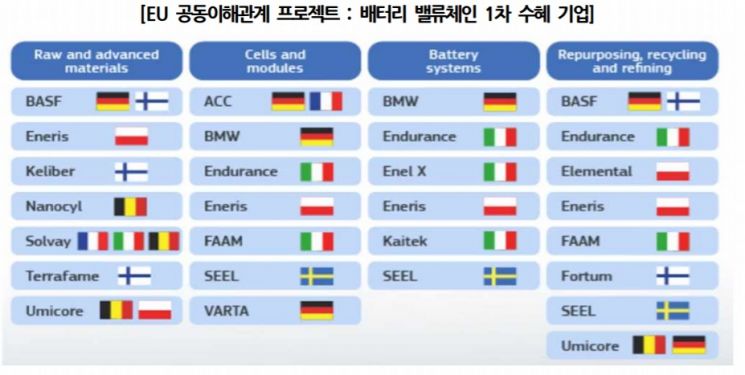
In particular, Sweden, through the government-led policy proposal organization Fossil Free Sweden, announced a 'Sustainable Battery Value Chain Strategy' and proposed it as a national industrial strategy, KITA reported. Sweden plans to apply the EU’s key agendas of the Green Deal and carbon neutrality to the entire battery value chain cycle, including raw material mining, battery production, distribution, and recycling, positioning itself as a core player in the EU battery industry and viewing this as an opportunity to strengthen national industrial competitiveness.
In response to these EU movements, companies participating in the battery value chain are focusing on the sustainability of the value chain to differentiate themselves from Asian companies with superior technology and price competitiveness. They are concentrating on building a green battery value chain through technological development, attracting investment using EU financial support, and cooperation among various fields, countries, and companies, KITA analyzed.
Kang Nokyung, deputy manager of KITA’s Brussels branch, said, "The EU’s new battery regulation proposal will act as a non-tariff barrier to non-EU companies entering the EU battery market. Like Sweden, Korea must prepare a national-level strategy covering the entire battery value chain and strengthen sustainability measures. Through technology, facility investment, and collaboration, we need to enhance the competitiveness of K-battery in the future battery market."
© The Asia Business Daily(www.asiae.co.kr). All rights reserved.
![Clutching a Stolen Dior Bag, Saying "I Hate Being Poor but Real"... The Grotesque Con of a "Human Knockoff" [Slate]](https://cwcontent.asiae.co.kr/asiaresize/183/2026021902243444107_1771435474.jpg)
















