Consumer Price Inflation Forecast Revised Up to 1.3%
Lee Ju-yeol: "No Need to Worry About Inflation"
Domestic Demand Slump and Continued Employment Shock
Employment Forecast Revised from 130,000 to 80,000... "Figures Reflect Government Public Jobs"
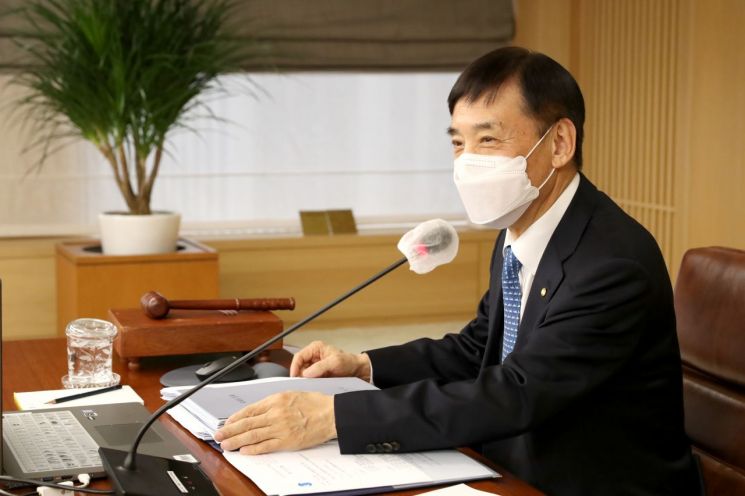 On the morning of the 25th, Lee Ju-yeol, Governor of the Bank of Korea, is speaking at a press conference on monetary policy direction held at the Bank of Korea in Jung-gu, Seoul.
[Asia Economy Reporter Kim Eun-byeol] The Bank of Korea maintained its forecast for this year's real Gross Domestic Product (GDP) growth rate at 3.0%. Although exports are recovering rapidly this year as well, uncertainties due to the COVID-19 pandemic persist, and the slow pace of domestic demand recovery means that a cautious approach is necessary. The slow recovery in domestic demand is expected to prolong employment shocks more than anticipated. Considering economic uncertainties, the base interest rate was kept at a record low of 0.50% per annum. However, the Bank of Korea raised its consumer price inflation forecast for this year to 1.3%, reflecting the global inflation trend driven by rising international oil prices.
On the 25th, the Bank of Korea announced in its 'February Economic Outlook' that it decided to maintain the growth rate forecast at 3.0% for this year. The growth rate forecast for next year was also maintained at 2.5%. The consumer price inflation forecast for this year was adjusted upward from 1.0% to 1.3%. The inflation forecast for next year was lowered from 1.5% to 1.4%.
Domestic Demand Slump Offsets Export Improvement Effect... Employment Forecast for This Year Revised from 130,000 to 80,000
The growth and inflation forecasts announced by the Bank of Korea indicate that uncertainties in the Korean economy are not easily resolved. While export recovery continues, domestic demand remains sluggish, and it is difficult to predict the impact on growth due to uncertainty about when COVID-19 vaccinations will be completed.
Initially, economic experts expected the Bank of Korea to slightly raise the growth forecast by around 0.1 percentage points, reflecting recent export improvements. In fact, the Bank of Korea raised its forecast for this year's merchandise export growth rate from 5.3% to 7.1%, an increase of 1.8 percentage points, in its economic outlook report. The merchandise import growth rate was also revised upward from 5.9% to 6.4%, a 0.5 percentage point increase, and the current account surplus forecast was raised from $60 billion to $64 billion. The forecast for facility investment growth (5.3%) was also 1.0 percentage point higher than the previous 4.3%.
However, domestic demand growth is expected to be sluggish. The forecast for private consumption growth this year was lowered by 1.1 percentage points from 3.1% to 2.0%. Due to the third wave of COVID-19 and strengthened social distancing measures, the sharply contracted consumption is seen as offsetting the export improvement, leading to no change in the overall economic growth forecast.
Bank of Korea Governor Lee Ju-yeol said at a press conference following the Monetary Policy Committee meeting, "Global trade conditions are expected to be favorable this year due to vaccine distribution in major countries and active fiscal stimulus measures. However, due to the prolonged COVID-19 pandemic, face-to-face service consumption has been severely contracted, and income conditions have not improved, especially for those working in that sector. In particular, the domestic COVID-19 spread this winter has been more severe than expected, so consumption is expected to be weaker than the previous forecast (November last year)," he said.
The Bank of Korea's employment recovery outlook has also darkened. In the November forecast last year, the Bank of Korea expected employment to increase by 130,000 this year, but the latest forecast reduced the increase to 80,000. Conversely, the unemployment rate forecast was raised from 3.8% to 4.0%. The increase in employment this year reflects the government's plan to create 800,000 to 1 million public jobs. Even though the government is increasing public jobs, due to social distancing measures, about 1 million jobs were lost early in the year, so the overall employment increase has decreased.
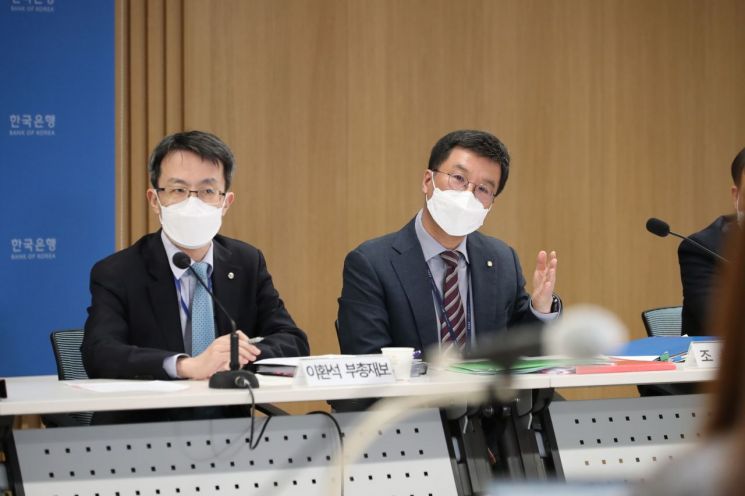 Lee Hwan-seok, Deputy Governor of the Bank of Korea (left), and Kim Woong, Director of the Bank of Korea's Research Department, are speaking at the economic outlook briefing held at the Bank of Korea in Jung-gu, Seoul, on the afternoon of the 25th.
Inflation Forecast Raised to 1.3%, Up 0.3 Percentage Points... Lee Ju-yeol: "Not a Level to Worry About Inflation"
The inflation forecast was raised by 0.3 percentage points from the previous 1.0% to 1.3%. This reflects economic recovery, recent rises in international oil, raw materials, and grain prices, as well as strong rents and lease prices. Kim Woong, head of the Bank of Korea's Research Department, explained at the economic outlook briefing, "The first reason for raising the inflation forecast is the rise in prices of agricultural products and food due to adverse weather conditions and avian influenza (AI), and the other is the rebound in international oil prices."
With the Bank of Korea raising its inflation forecast, attention is focused on the direction of inflation. Governor Lee said, "The general public's expected inflation rate has risen to around 2%, indicating that many people expect prices to rise in the future."
However, Governor Lee explained that the current inflation rate in the 1% range is not a level to be concerned about. He said, "Due to COVID-19, it will take time for demand to fully recover," but added, "It is necessary to be cautious about the possibility of inflation, and if economic activity restrictions are eased, suppressed consumption could be released in a short period." Regarding the rise in raw material prices, Governor Lee said, "While expectations for global economic recovery have increased, adverse weather causing poor harvests, some raw material mining disruptions, and production cuts by the Organization of the Petroleum Exporting Countries (OPEC) have also contributed to supply-side difficulties, and accommodative monetary policy has led to a preference for risk assets," adding that "it is necessary to monitor whether the rise in international raw material prices will continue."
Meanwhile, the Bank of Korea's forecast for next year's consumer price inflation was lowered from 1.5% to 1.4%. Since inflation this year is expected to rebound more than anticipated, the base effect led to a 0.1 percentage point downward revision of next year's inflation forecast.
The economic outlook released by the Bank of Korea assumes a 'base' scenario in which the COVID-19 spread gradually subsides in the mid to late part of this year. However, under a 'pessimistic' scenario where the global COVID-19 containment is delayed until early to mid-next year, growth rates for this year and next year are expected to fall to 2.4% and 1.9%, respectively. Conversely, under an 'optimistic' scenario where the COVID-19 spread is quickly controlled by early to mid-this year, the Bank of Korea's analysis shows growth rates of 3.8% for this year and 3.1% for next year.
© The Asia Business Daily(www.asiae.co.kr). All rights reserved.


















