More than 20 Chinese Provinces, Municipalities, and Autonomous Regions to Make Large-Scale Infrastructure Investments This Year
First Year of the 14th Five-Year Plan... Boosting Domestic Demand Through Infrastructure Investment
[Asia Economy Beijing=Special Correspondent Jo Young-shin] China will invest 25 trillion yuan (approximately 4,300 trillion KRW) in infrastructure sectors such as construction. This is interpreted as an intention to stimulate the economy through real investment rather than fiscal and monetary policies like tax cuts. The final decision on economic stimulus measures, including infrastructure investment, is expected to be made at the upcoming Lianghui (National People's Congress and Chinese People's Political Consultative Conference) starting on the 4th of next month.
According to the state-run People's Daily and others on the 25th, the scale of construction projects being prepared by more than 20 provinces and municipalities directly under the central government in China amounts to 25 trillion yuan.
Considering that China's GDP last year was 101.5989 trillion yuan, the 25 trillion yuan investment is literally a super economic stimulus package. During the global financial crisis, China used 4 trillion yuan, equivalent to 13% of GDP, for economic stimulus. Given the unprecedented COVID-19 pandemic situation, it appears that funds equivalent to 40% of GDP will be injected.
In particular, this is seen as an economic stimulus measure considering that this year is the first year of the 14th Five-Year Plan (2021?2025) and the dual circulation policy, as well as the heightened uncertainty due to US-China conflicts.
Wu Yaping, director of the Investment Research Institute at the China Macroeconomic Research Institute, said, "This year is the first year of the 14th Five-Year economic plan," and added, "Local governments in provinces, municipalities, and autonomous regions will focus on optimizing investment structures."
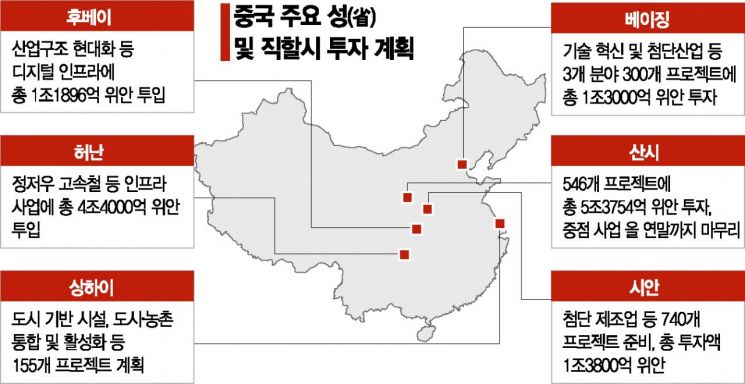
In fact, the capital Beijing plans to promote 300 projects across three major areas: key infrastructure, living environment improvement, and technological innovation and advanced industries. The funds to be invested amount to 1.3 trillion yuan, of which 278 billion yuan will be executed this year.
Shanxi Province, the forefront of China's semiconductor rise, will pour a total of 5.3754 trillion yuan divided between the province and cities. The Shanxi provincial government has also set detailed plans to complete construction by the end of this year, with key projects progressing over 50% in the first quarter and over 80% in the second quarter. The goal is to achieve an annual economic growth rate of over 7%.
In Xi'an, where Samsung Electronics' semiconductor factory is located, plans are in place to maintain a fixed asset investment growth rate of over 10%. The total investment amount in Xi'an is 1.38 trillion yuan, with 395 billion yuan to be executed this year alone.
Henan Province is preparing a total of 4.4 trillion yuan for infrastructure projects including high-speed rail extensions, with 1.1 trillion yuan to be invested this year.
Hubei Province, which faced difficulties due to COVID-19 last year, has allocated 1.18965 trillion yuan for strategic emerging industries, industrial structure modernization, transportation, public services, and digital infrastructure, with 281.06 billion yuan to be invested this year.
Jiang Jian, a researcher at the China Academy of Social Sciences' China Finance and Economics Strategy Research Institute, said, "Project investments such as infrastructure will be an important driver for expanding domestic demand," adding, "Investments by provinces, municipalities, and autonomous regions will promote economic growth and optimize urban and rural structures." He further emphasized, "It is necessary to pay close attention to ensuring that consumption grows alongside investment."
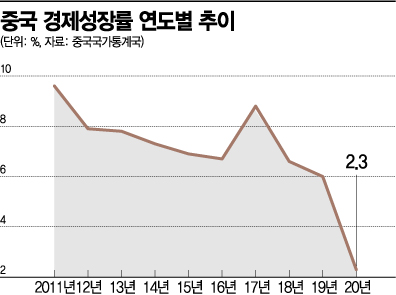
Such large-scale economic stimulus measures by major provinces, cities, and autonomous regions in China appear to be a desperate measure to boost economic growth rates. Ahead of the Lianghui starting on the 4th of next month, China's 31 provinces, cities, and autonomous regions have set economic growth targets of 6?10% for this year. It is widely agreed that achieving these targets through consumption by the 1.4 billion population alone will be difficult. The uncertainty caused by US-China conflicts remains a significant obstacle.
Some in China predict that the Chinese government is likely to focus on infrastructure investments during the 14th Five-Year Plan period in preparation for the global economic downturn caused by COVID-19 and the prolonged US-China conflicts.
© The Asia Business Daily(www.asiae.co.kr). All rights reserved.
![Clutching a Stolen Dior Bag, Saying "I Hate Being Poor but Real"... The Grotesque Con of a "Human Knockoff" [Slate]](https://cwcontent.asiae.co.kr/asiaresize/183/2026021902243444107_1771435474.jpg)

















