Minimum 12km to Enter Seoul Core Area... Challenges in Improving Poor Roads
Severe Traffic Congestion in Southwest Region and Lack of Transportation Infrastructure Worsen Accessibility
Only Severely Congested Major Arterial Roads from Gwangmyeong to Seoul Are Seobu Expressway and Route 1
Securing New Road Sites Difficult... Local Government Conflicts Over 2 Gyeongin Line Must Also Be Resolved
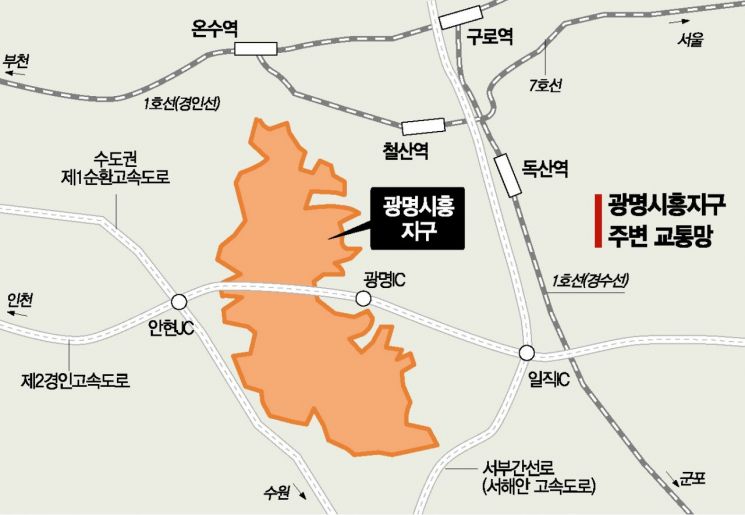
[Asia Economy Reporters Kangwook Cho, Hyemin Kim] "We selected a location sufficiently accessible by metropolitan transportation networks, railways, and roads, in an area not far from the city center." This is the evaluation of the Gwangmyeong-Siheung district given by Byeon Chang-heum, Minister of Land, Infrastructure and Transport, in an interview with the media on the 25th. Minister Byeon explained, "It has a scale and location that can give a feeling similar to being in the city center."
Despite Minister Byeon's assurance, there are forecasts that the 'metropolitan transportation network' will be a decisive factor in the success or failure of the Gwangmyeong-Siheung district, a 3rd phase new town with 70,000 households announced by the government the day before.
◇How to solve the worst traffic congestion= The government emphasizes that Gwangmyeong-Siheung is only 1 km away from Seoul. However, it is at least about 12 km away from Seoul's core areas such as Yeouido, where many office workers gather, and if the severe traffic congestion in the southwestern region is not resolved, the perceived distance is much farther. Experts point out that if a proper metropolitan transportation network is not established, it could lead to concentration in the outskirts of the metropolitan area without absorbing demand from Seoul.
In fact, the Gwangmyeong-Siheung district is the largest among the six 3rd phase new towns, covering 12.71 million square meters. The number of households is 70,000, similar to the 1st phase new town Ilsan (about 69,000 households). Without expansion of the transportation network, it could worsen the already weak accessibility to Seoul in the southwestern region.
The Ministry of Land, Infrastructure and Transport plans to build an urban railway running north-south through the Gwangmyeong-Siheung district to alleviate transportation demand, connecting it with existing subway Line 2 Sindorim Station, KTX Gwangmyeong Station, and Sinansan Line Hakon Station. The through railway is likely to be a light rail. According to the ministry, this would enable travel to Yeouido in Seoul in 20 minutes and to Gangnam Station in 45 minutes.
◇Road network offers no solution other than 'expansion' = According to the government's plan, the railway network is relatively favorable, but the problem lies with the 'road network.' Currently, the main north-south arterial roads connecting Gwangmyeong and Seoul are the Western Arterial Road connected to the Seohaean Expressway and National Route 1. Both roads are major axes connecting Anyang and Suwon to Seoul and are considered some of the most congested areas in the metropolitan area, reaching saturation. The east-west axis connecting to Gangnam is somewhat better due to the Gangnam Circular Expressway, but the Southern Circular Road is also notorious for habitual congestion. Nevertheless, the Ministry of Land, Infrastructure and Transport has not proposed any solution other than 'expanding existing roads' in its transportation measures announced the day before.
Another concern is the large-scale redevelopment and reconstruction in the Gwangmyeong area, involving more than 30,000 households. An industry insider pointed out, "Considering that more than 100,000 households will be built when combining existing maintenance projects and the Gwangmyeong-Siheung district, road expansion is essential in addition to the railway network." Gwangmyeong City has also demanded the government establish metropolitan transportation measures and complete projects before residents move in as prerequisites related to the new town designation.
The reality is that it is not easy to secure new road networks connecting to Seoul. A large urban area has already formed between the two regions, making it physically difficult to secure road land, and even if secured, the industry assesses that it would be hard to bear the high compensation costs.
◇The Second Gyeongin Line issue must also be resolved = Attention is also focused on whether the 'Second Gyeongin Line,' which has been a source of conflict due to the relocation of the vehicle depot, will gain momentum. The Second Gyeongin Line is a metropolitan railway connecting Cheonghak Station in Yeonsu-gu, Incheon, passing through the Gwangmyeong-Siheung district, to Noryangjin Station in Seoul. The total project cost is 1.1446 trillion KRW. The government planned to relocate the Guro vehicle depot to Noonsadong within the Gwangmyeong-Siheung district, but the project has effectively stalled due to opposition from Gwangmyeong City. The issue has become sensitive enough to cause regional conflicts, and the feasibility of relocating the Guro vehicle depot is currently being reconsidered.
The government reiterated its intention to relocate the Guro vehicle depot in the recent measures. Since the Gwangmyeong-Siheung district was designated as a 3rd phase new town and plans were announced to link the Second Gyeongin Line with an internal circular tram within the new town, it is expected that securing funds for undergrounding the vehicle depot will become possible.
Gwangmyeong City has clearly opposed relocating the vehicle depot to Noonsan-dong. A Gwangmyeong City official said, "We remain firmly opposed to relocating the Guro vehicle depot to its current location, which cuts through Gwangmyeong City's green axis," but added, "However, if the Second Gyeongin Line project is inevitable, we have conveyed the opinion that the relocation should be to a location that allows regional coexistence."
Kim Hak-ryeol, director of the Smart Tube Real Estate Research Institute, pointed out, "Solving transportation infrastructure is important," and emphasized, "For the success of development in the Gwangmyeong-Siheung area, we need to consider how to integrate the transportation network."
© The Asia Business Daily(www.asiae.co.kr). All rights reserved.
![Clutching a Stolen Dior Bag, Saying "I Hate Being Poor but Real"... The Grotesque Con of a "Human Knockoff" [Slate]](https://cwcontent.asiae.co.kr/asiaresize/183/2026021902243444107_1771435474.jpg)
















