Installation of CCTV in Operating Rooms Supported by 89% of Adults
National Assembly: "Install CCTV at Operating Room Entrances"
KMA: "Concerns Over Medical Staff Burden and Video Leakage"
Public Opinion and Victims' Families Oppose, Demand Internal Installation

[Asia Economy Reporter Kim Young-eun] Amid controversy over the mandatory installation of closed-circuit (CC) TV cameras in operating rooms, the National Assembly recently proposed an alternative to install CCTV not inside the operating rooms but at entrances or other external locations, drawing criticism. It is pointed out that the original purpose of installing CCTV inside operating rooms to prevent various illegal acts that might occur is effectively lost.
Previously, in 2016, a patient named Kwon Dae-hee died from excessive bleeding during orthognathic surgery at a plastic surgery clinic in Seoul. In 2018, a patient who underwent spinal surgery experienced sudden paralysis after the operation. Last year, a 5-year-old child died after undergoing a tonsillectomy at a hospital in Yangsan.
Earlier, in March of last year, a woman undergoing liposuction at a clinic in Seoul suffered respiratory distress during surgery but died due to inadequate response and neglect by the medical staff. As a result, public opinion has grown in favor of installing CCTV inside operating rooms to verify medical errors or illegal acts, supported not only by bereaved families but also by the general public.
The bill related to installing CCTV inside operating rooms includes provisions to mandate CCTV installation inside operating rooms and allow recording and preservation upon request by patients or guardians. The purpose is to prevent illegal medical acts such as proxy surgeries and sexual crimes, and to help patients secure evidence in disputes over medical accidents.
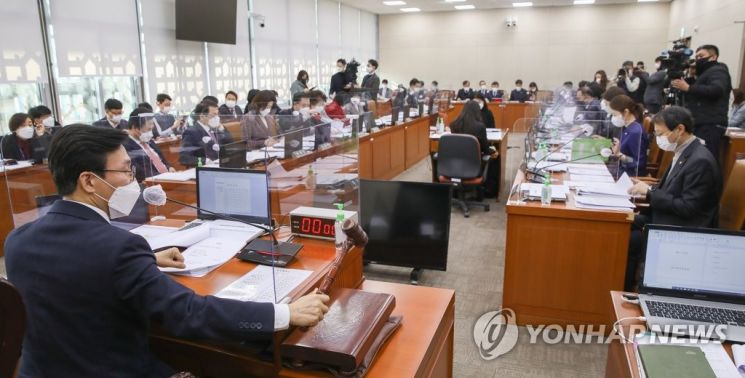 The Health and Welfare Committee plenary meeting held at the National Assembly on the 17th. Photo by Yonhap News
However, on the 18th, the National Assembly's Health and Welfare Committee concluded that it is premature to uniformly mandate CCTV installation in operating rooms across all hospitals and postponed the processing of the bill.
Moreover, many members of the first bill review subcommittee of the Health and Welfare Committee proposed an alternative to install CCTV 'outside the door' of operating rooms to monitor entry and exit, differing from the original bill. It was also suggested that hospitals voluntarily install CCTV inside operating rooms through incentives.
This has led to criticism that the National Assembly is ignoring public opinion. According to a telephone interview (CATI) survey conducted by polling firm Realmeter on behalf of the Health and Welfare Committee from March 3 to 8 with 1,000 adult men and women nationwide (95% confidence level, ±3.1% margin of error), 89% supported mandatory installation of CCTV in operating rooms.
In particular, the government's compromise proposal to install CCTV at the entrance of operating rooms has drawn greater criticism, even though many bereaved families of patients who died from medical accidents oppose it.
The mother of patient Kwon Dae-hee, who died from excessive bleeding during surgery, held a one-person protest in front of the National Assembly, pleading, "If CCTV is installed outside, a normal doctor can enter inside and create another door to exit behind it. CCTV inside the operating room is what should be called operating room CCTV, and installing it outside could become a harmful law."
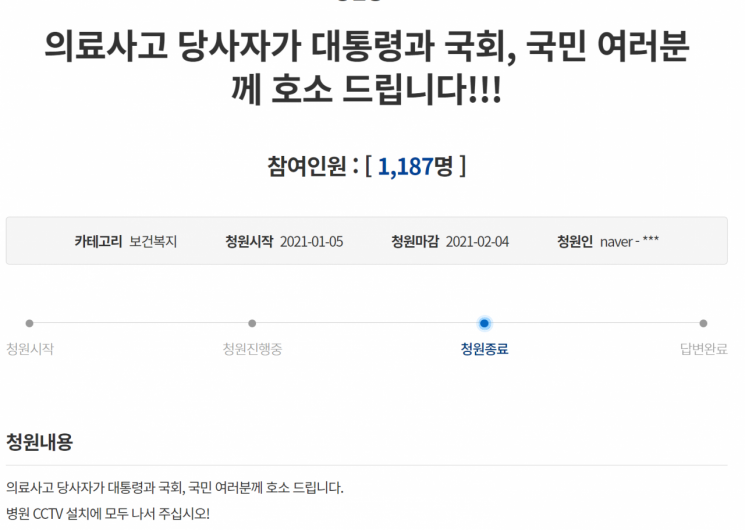
Last month, a petition urging the installation of CCTV inside operating rooms was posted on the Blue House's public petition board. In August last year, a national petition requesting CCTV installation in operating rooms was submitted by the bereaved family of a child who died during treatment after a tonsillectomy, gathering over 200,000 signatures. One netizen strongly urged, "This is a very important issue related to the life, safety, and human rights of citizens who do not know what harm they might suffer under anesthesia," adding, "CCTV must be installed inside the operating room, not just at the entrance."
As controversy grew over the possible failure to install CCTV, the National Assembly later announced it would continue to push the bill forward.
The Democratic Party of Korea stated at a party strategy meeting on the 23rd, "We are narrowing differences through various discussions," and added, "If there are differing opinions in the National Assembly, serious debate and long patience to reach consensus is in line with the spirit of democracy." The bill is expected to be actively discussed in the March session of the National Assembly, as opposition parties oppose it and internal coordination within the Democratic Party is needed. Attention is focused on whether the bill will be enacted into law.
Meanwhile, the Korean Medical Association opposes installing CCTV in operating rooms, citing concerns that it may inhibit medical professionals' treatment and infringe on human rights and privacy.
Kim Dae-ha, spokesperson for the Korean Medical Association, said on YTN Radio's "Hwang Bo-seon's Starting New Morning" on the 23rd, "(Installing CCTV in operating rooms) may be a means to alleviate patients' concerns, but on the other hand, medical professionals inevitably feel a great burden when it is installed."
He added, "There are serious issues regarding the security and storage of videos recorded by CCTV. If such videos are leaked or shared with malicious intent, it becomes very difficult to rectify the situation. Although the bill seems very favorable, it is a part that even foreign countries have not easily implemented. Considering this, our society must approach this matter cautiously," he argued.
© The Asia Business Daily(www.asiae.co.kr). All rights reserved.



















