2020 Year-End Settlement Shows Deficit of 640 Billion Won... Sharp Decrease of 1.4 Trillion Won Compared to Previous Year
Government Support Soars from 140 Billion Won to 5.8 Trillion Won in One Year
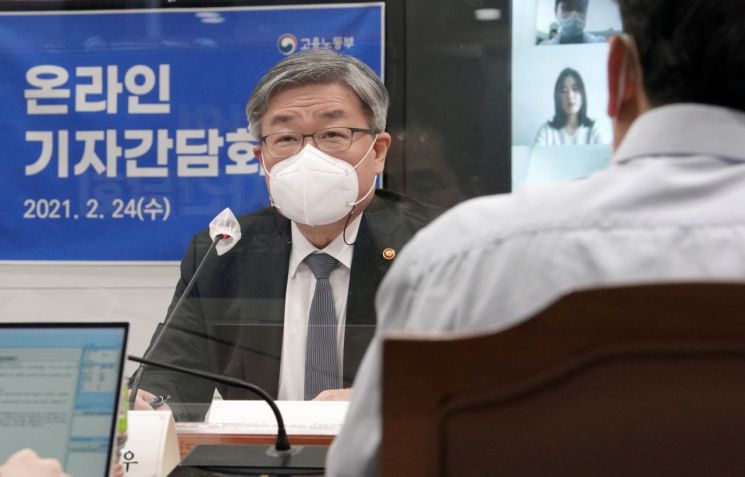 Minister of Employment and Labor Lee Jae-gap is explaining employment and labor issues at an online press briefing held at the Government Complex Sejong in Sejong City on the afternoon of the 24th. 2021.2.24 [Photo by Yonhap News]
[Sejong=Asia Economy Reporter Son Seon-hee] The deficit of the Employment Insurance Fund significantly decreased last year. After turning to a deficit in 2018 and recording a deficit of over 2 trillion won in 2019, the deficit shrank by more than 1 trillion won last year despite the ongoing COVID-19 crisis. This can be seen as a result of increased revenue and reduced expenditures, but it was revealed that the government filled the gap by injecting a large amount of taxpayers' money.
According to the 2020 Employment Insurance Fund financial statement (excluding the self-employed account) released by the Ministry of Employment and Labor on the 25th, the fund's financial balance showed a deficit of about 640 billion won last year, an improvement of 1.4 trillion won compared to the previous year. Considering the unprecedented surge in unemployment and employment contraction due to the COVID-19 crisis last year, the reduction in the deficit is not easy to understand. Employment insurance premiums decreased, but unemployment benefit expenditures increased significantly. In fact, fund expenditures surged by about 41% from the previous year to 13.888 trillion won.
This phenomenon was possible because of the government budget. According to the data on the "Trend of Government Budget Support for the Employment Insurance Fund and Future Support Estimates" submitted by the Ministry of Economy and Finance to the office of Joo Ho-young, a member of the People Power Party, the government injected 5.85 trillion won into the Employment Insurance Fund last year. Considering that the support amount was 140 billion won the previous year, this is an increase of more than 50 times.
Future government subsidies to be injected are also substantial. According to the outlook for future support included in the National Fiscal Management Plan, a total of 16.5 trillion won in government subsidies is expected to be provided by 2024, including 4 trillion won this year. The government plans to expand the coverage of employment insurance, such as applying it to 12 special types of workers (Specially Employed Workers, or SEWs) in July following artists in December last year, but realistically, it is virtually impossible to operate the fund independently.
The sustainability is questionable. To prevent further deterioration of the fund's financial situation, there is a prevailing perception that raising the employment insurance premium rate is inevitable. Minister of Employment and Labor Lee Jae-gap said at an online briefing yesterday, "In this situation where all classes are struggling due to the COVID-19 crisis, it is difficult to raise the rate," and added, "We will decide the timing of the rate increase while monitoring the economic situation." Although he did not deny the need for a premium increase, he seemed to suggest a pace adjustment regarding the timing. There is also a forecast that it will be postponed beyond this year. Minister Lee stated, "We will prepare a plan to stabilize the Employment Insurance Fund's finances, including institutional improvements, within the first half of the year."
© The Asia Business Daily(www.asiae.co.kr). All rights reserved.

















