[Asia Economy Reporter Byunghee Park] "If the European Union (EU) forces banks to move euro clearing transactions from London to the Eurozone, tensions between the UK and the EU will escalate sharply."
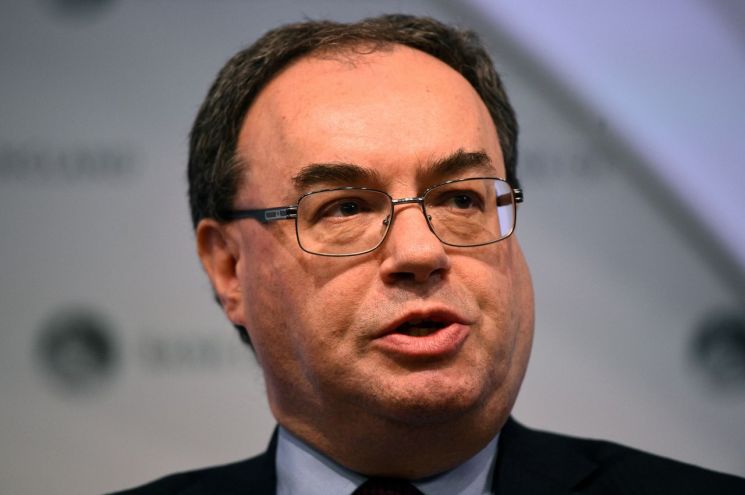
Andrew Bailey, Governor of the Bank of England (BoE), warned this at the European Parliament on the 24th (local time), according to the Financial Times (FT) report on the same day.
With Brexit officially formalized this year, there are forecasts that the UK will lose its status as a financial center in Europe. Governor Bailey’s remarks at the European Parliament are interpreted as expressing concerns about London’s status as a financial hub.
The EU appears to be aiming to build its own capital market within the Eurozone following the formalization of Brexit. In this process, it is naturally expected that dependence on London will decrease.
Governor Bailey has stepped in to put a brake on such EU moves. He particularly focused on clearing transactions. The FT explained that clearing transactions have become more important after the financial crisis because they help stabilize financial markets. Governor Bailey also said, "Undermining the stability of the clearing system would cause serious problems." London handles 90% of euro derivatives clearing transactions. Clearing transactions are mainly conducted through the London Clearing House (LCH) under the London Stock Exchange and the ICE Clearing House.
The EU is allowing banks to continue clearing derivatives in London even after Brexit to avoid financial market disruption. However, it is expected to gradually require banks to move transactions into the Eurozone. The European Commission already checked last month whether there could be technical issues in moving euro derivatives clearing transactions from European investment banks into the Eurozone. A related working group is scheduled to meet with investment bank representatives on the 26th to discuss this issue again.
Based on a UK Treasury survey, Governor Bailey said that one-quarter of the 83 trillion euro volume of euro derivatives transactions is expected to move to the Eurozone. He predicted that the remaining 75% would stay in London because London’s financial system is more efficient and cheaper. However, he expressed concern that the EU might impose mandatory provisions or penalties on banks to move even the remaining 75% of transactions. He added that if this happens, fierce disputes could arise between the UK and the EU.
The European Central Bank (ECB) had already attempted to move the euro clearing house into the Eurozone when Brexit first became visible in the UK. At that time, the ECB clashed with the UK government, arguing that the euro clearing house should be located within the Eurozone and be subject to ECB regulation. However, regarding this dispute, the European Court of Justice (ECJ) ruled in 2015 that it was acceptable for the euro clearing house to be located in London, siding with the UK.
Although Brexit has been formalized, the UK and the EU have yet to reach a proper agreement on financial services. The UK and the EU plan to sign a memorandum of understanding on financial services regulation by the end of March.
© The Asia Business Daily(www.asiae.co.kr). All rights reserved.

















