Health Authorities: "Nationwide Simultaneous Vaccination... Emphasis on 'First Day' Rather Than 'Patient Zero'"
Concerns Over Political Controversy of 'Patient Zero' Vaccination
Burden of Late Vaccination as 'World's 102nd'
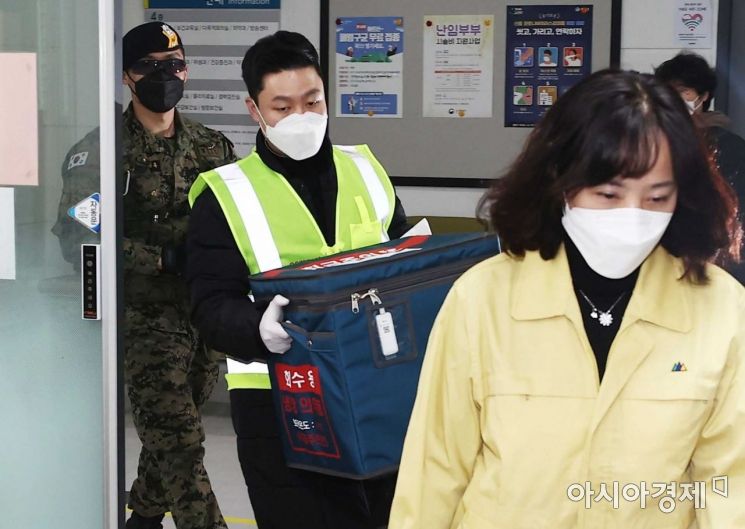 The AstraZeneca vaccine, which departed from the Gtree BNT Logistics Center in Icheon City, arrived on the 25th at the Jungnang-gu Public Health Center in Seoul, where officials are seen carrying the vaccine transport container. Photo by Jinhyung Kang aymsdream@
[Asia Economy Reporter Lee Chun-hee] Although COVID-19 vaccinations will begin on the 26th, the government has yet to confirm the ‘first domestic vaccine recipient,’ sparking curiosity. While health authorities emphasize that ‘everyone vaccinated on the first day is considered the first recipient,’ there is speculation that political controversy and the burden of delayed vaccinations may be factors.
Hong Jeong-ik, Team Leader of the COVID-19 Vaccine Prevention Vaccination Management Team, appeared on MBC Radio’s ‘Kim Jong-bae’s Focus’ on the 25th and said, "Everyone receiving the vaccine at 9 a.m. on the 26th in each region can be considered the first recipient," adding, "Rather than placing significance on the ‘first recipient’ itself, the emphasis is on the fact that it is the first day vaccinations are starting." Jeong Eun-kyeong, Director of the Korea Disease Control and Prevention Agency, also mentioned the day before, "The first recipient situation means that all facility workers and residents are the first vaccination targets."
Health authorities will begin administering the AstraZeneca COVID-19 vaccine from 9 a.m. on the 26th to approximately 289,000 inpatients, residents, and workers under 65 years old at nursing hospitals and facilities nationwide. While each city and province is announcing their first recipients, such as hospital directors (Gwangju) and doctors and nurses (Chungnam), the nationwide first recipient has not yet been confirmed. This differs from overseas cases where messages of overcoming COVID-19 were delivered through first recipients such as a grandmother in her 90s (UK) or a nurse (USA).
There is speculation that this is due to concerns over political controversy. When the conservative opposition party raised safety concerns about the AstraZeneca vaccine and demanded that President Moon Jae-in be the first recipient, Democratic Party lawmaker Jeong Cheong-rae retorted, "Is the head of state a test subject?" escalating the controversy. Ahn Cheol-soo, leader of the People’s Party, also stated, "I am willing to be vaccinated first at any time."
Overseas, there have been cases where leaders such as Israeli Prime Minister Benjamin Netanyahu and Czech Prime Minister Andrej Babi? were the first recipients. However, the government explains that these countries had extremely high vaccine distrust, unlike South Korea, where the vaccination consent rate reaches 93%. Earlier, President Moon stated, "If anxiety rises to the point where people avoid vaccines and leading by example becomes necessary, I will not avoid it."
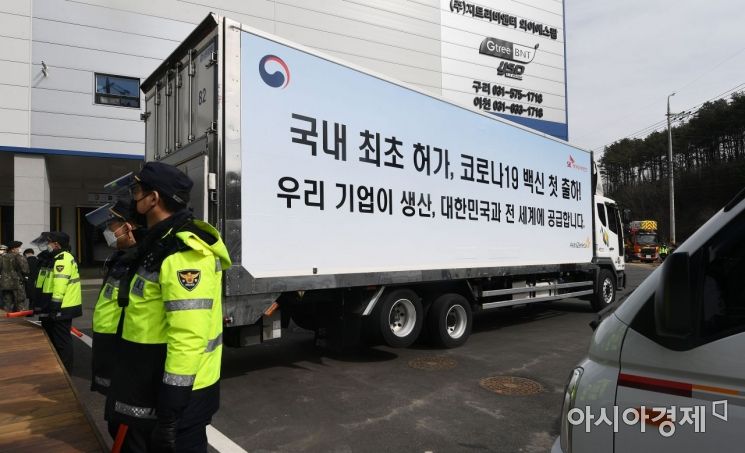 On the 24th, the day the first shipment of AstraZeneca COVID-19 vaccines was made in Korea, the AstraZeneca vaccine transport vehicle arrived at the Gtree BNT logistics center in Icheon, Gyeonggi Province, after being shipped from the SK Bioscience factory in Andong, Gyeongbuk. /Photo by Joint Press Corps
The vaccines that arrived at the logistics center that day were 150,000 doses, part of the 750,000 doses contracted by the government, and were scheduled to be sequentially transported to public health centers and nursing hospitals nationwide starting from the 25th. 2021.2.24 Photo by Joint Press Corps
The late introduction of vaccines is also analyzed as a factor contributing to the government’s lukewarm attitude. According to the international statistics site ‘Our World in Data’ from Oxford University in the UK, as of the 23rd, out of 196 countries worldwide (based on the United Nations), a total of 101 countries have started COVID-19 vaccinations.
When vaccinations begin domestically on the 26th, South Korea will become the 102nd country in the world to start vaccinations, two and a half months after the first general COVID-19 vaccination began in the UK on December 8 last year. For a government that has promoted ‘K-Quarantine’ and boasted of its quarantine achievements, it is an awkward situation to assign special significance to the first recipient.
© The Asia Business Daily(www.asiae.co.kr). All rights reserved.


















