Gwangmyeong New Town and Cheolsan Reconstruction Continue with KTX Station Area Development
70,000 New Homes Added in Gwangmyeong-Siheung
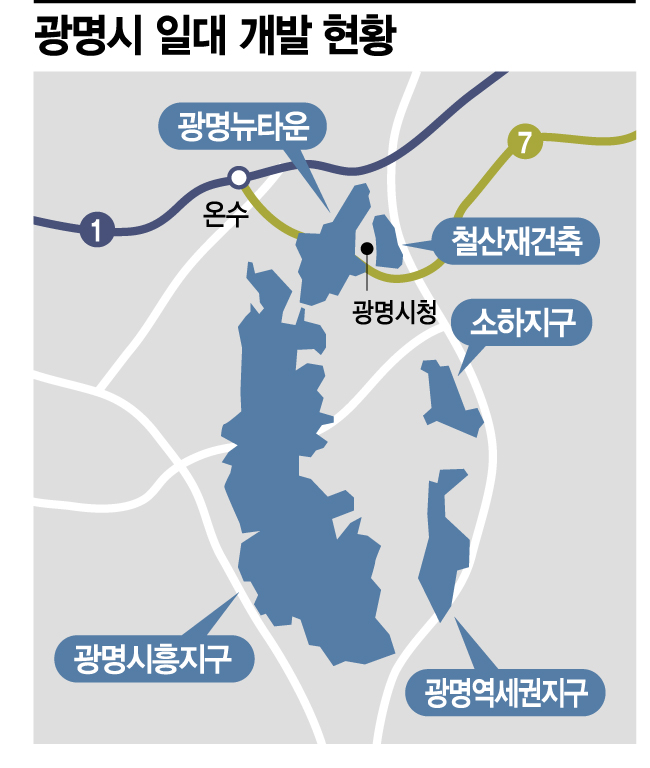
[Asia Economy Reporter Onyu Lim] As the government announced the plan for the Gwangmyeong-Siheung district, one of the 3rd phase new towns with an area 4.3 times that of Yeouido, Gwangmyeong is attracting attention as a hot place in the real estate market. Since the early 2000s, low-rise apartment reconstruction in the Cheolsan-dong area has been in full swing, and with the redevelopment of the old town's New Town area followed by the development of a new town with 70,000 households, large-scale development is effectively taking place throughout the entire city.
◇Aged residential area transformed into a mini new town with 25,000 households= According to the Ministry of Land, Infrastructure and Transport and related industries on the 25th, with the confirmation of the 70,000-household Gwangmyeong-Siheung new town development, more than 100,000 newly built apartments will be supplied in Gwangmyeong by 2030. Even before the new town plan announcement, Gwangmyeong was an area with active development due to major maintenance issues in Gwangmyeong-dong and Cheolsan-dong, which border Seoul’s Geumcheon and Guro districts.
In particular, Gwangmyeong New Town is the largest redevelopment project in the Gyeonggi area. When the redevelopment, which is being promoted by dividing the 1.14 million square meter residential area around Cheolsan Station and Gwangmyeong Sageori Station on Subway Line 7 into 11 districts, is completed, it will form a mini new town-scale apartment complex with about 25,000 households. District 16 moved in last November, and districts 14 and 15 have completed general sales. The remaining districts have either received project implementation approval or are undergoing relocation and demolition.
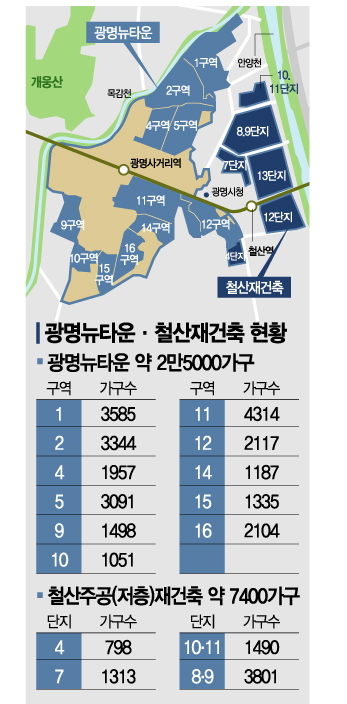
◇Reconstruction in Cheolsan-dong area also in full swing= In the area around Gwangmyeong New Town, the reconstruction of Jugong Apartments in Cheolsan-dong, including complexes 4, 7, 8, 9, 10, and 11, is underway. When the project is completed, about 7,400 new households will be established. Complex 4 will start moving in next month, and complex 7 is scheduled for completion in March next year. Mid-rise apartments in complexes 12 and 13 are currently undergoing detailed safety inspections.
The development of the KTX Gwangmyeong Station area, which leads Gwangmyeong’s housing prices, is also not finished yet. Construction of residential-commercial complex apartments is underway centered around the station. Furthermore, with the government announcing that it will supply 70,000 houses, the largest among the 3rd phase new towns, in the Gwangmyeong-Siheung district, the possibility of Gwangmyeong transforming into a hub city leading the development of the southwestern metropolitan area has increased.
◇Transportation and industrial complex benefits overlap= There are abundant transportation benefits as well. Gwangmyeong is a representative beneficiary area of the Sinansan Line and Wolpan Line construction. When the 44.7 km-long Sinansan Line connecting Ansan and Siheung in Gyeonggi Province with Yeouido in Seoul opens in 2024, access to Yeouido will be possible within 10 minutes. The Wolpan Line is a metropolitan subway line connecting Wolgot Station on the Suin-Bundang Line in Siheung, Gyeonggi Province, passing through Gwangmyeong, Anyang, Gwacheon, and reaching Pangyo Station on the Gyeonggang Line in Bundang-gu, Seongnam City. It is targeted to open by the end of 2025, and the Siheung City Hall to Gwangmyeong section shares the route with the Sinansan Line. Additionally, with the metropolitan transportation network resulting from the Gwangmyeong-Siheung district development, accessibility to Seoul is expected to improve further.
The ‘Gwangmyeong-Siheung Techno Valley,’ covering 2.45 million square meters in Gahak-dong, Gwangmyeong, and Mujinae-dong, Siheung, scheduled to start construction within this year, is also a point of interest. The Techno Valley, targeted for completion in 2024, will involve a total investment of 2.4 trillion won and will consist of △general industrial complex △public housing district △distribution complex △high-tech industrial complex.
Yang Ji-young, director of Yang Ji-young R&C Research Institute, said, "If Gwangmyeong combines large-scale residential development with expanded transportation networks and advanced industrial functions, it has the potential to establish itself as a self-sufficient hub city in the southwestern metropolitan area."
© The Asia Business Daily(www.asiae.co.kr). All rights reserved.


















