Gwangmyeong-Siheung District Can Absorb Gangnam Demand
'Metropolitan Network' Connecting 6 Railways to Be Established
No Plan Yet to Lift Seoul Greenbelt
Contract Canceled After Record-High Transaction, Seoul 37%
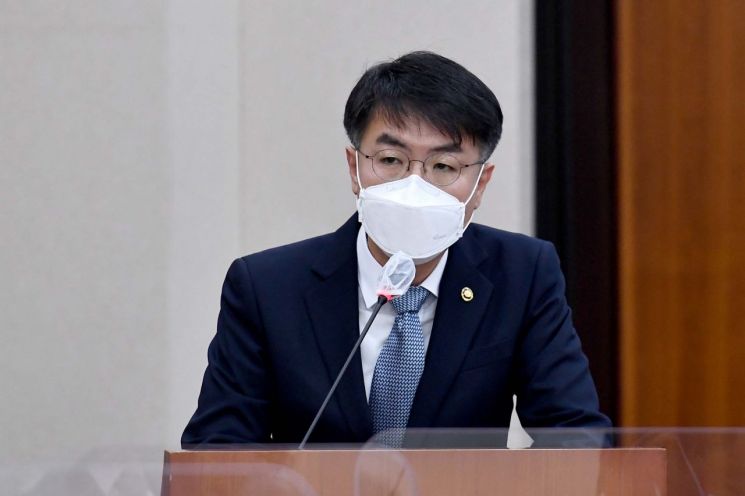
[Asia Economy Reporter Moon Jiwon] Yoon Sung-won, the First Vice Minister of the Ministry of Land, Infrastructure and Transport, explained that if a metropolitan transportation network connecting six railway lines is established in the Gwangmyeong-Siheung district, which was announced as the sixth 3rd phase new town the day before, it can sufficiently absorb housing demand from Seoul's Gangnam area.
Vice Minister Yoon appeared on KBS1 radio on the 25th and said, "The Gwangmyeong-Siheung district will be connected to six railway lines including Subway Lines 1, 2, and 7, the Sinansan Line, the 2nd Gyeongin Line, and GTX-B," adding, "We plan to organize a comprehensive metropolitan transportation network to enable transfers, so the current traffic demand concentrated on roads will be dispersed to the railway network."
The government announced three first-phase new public land sites that were previewed in the 2.4 housing supply plan the day before. In the metropolitan area, a 12.71 million square meter site around Gwangmyeong and Siheung in Gyeonggi Province was included. This area will be developed as the sixth 3rd phase new town and a southwestern hub, with the number of housing units supplied reaching 70,000.
Vice Minister Yoon said, "The average distance of 3rd phase new towns from the Seoul boundary is 1.3 km, while the 1st phase new towns like Bundang or Ilsan are about 4.4 km away, and the 2nd phase new towns such as Gimpo are about 10.3 km away," adding, "The Gwangmyeong-Siheung district is adjacent to Seoul's Guro-gu and will have a metropolitan railway network connecting six railway lines, so I believe it can absorb demand from areas like Gangnam."
He explained that there are no plans to lift the greenbelt in the Gangnam area. Vice Minister Yoon said, "When the 8.4 plan was prepared last year, there were various opinions about lifting the greenbelt in Seoul's Gangnam area, and it was a controversial issue in the political sphere," adding, "At that time, it was agreed that land should be preserved within Seoul for the future, so there are currently no plans to additionally lift the greenbelt in Seoul."
Regarding concerns that existing homeowners might strongly oppose the new town in Gwangmyeong due to fears of falling house prices, Vice Minister Yoon predicted 'little impact.' He explained, "In Gwangmyeong, redevelopment projects are underway in 11 locations and reconstruction in 4 locations, which will all be completed by next year," adding, "The Gwangmyeong-Siheung district will begin sales in 2025 after most private projects are settled, so the impact on prices of ongoing projects is not significant."
On concerns about conflicts over land compensation or house price stimulation during the project progress, he said, "Recently, landowners do not prefer to receive cash. They want land," adding, "In land-for-land compensation, instead of cash, land is given, and some landowners gather to build commercial or neighborhood facilities or row houses to self-sell, which can generate more income. Therefore, land-for-land compensation is a major trend in the 3rd phase new towns as well."
Vice Minister Yoon also addressed the practice of inflating house prices by signing real estate sales contracts at record prices and then canceling the contracts. He said, "Due to recent controversies, the Ministry of Land, Infrastructure and Transport revised the law in February last year to require reporting of canceled contracts as well," adding, "So far, there have been 39,000 canceled contracts, among which 17,000 were due to errors or mistakes in the contract, and 22,000 were simply canceled after signing."
He continued, "Among the 22,000 canceled contracts, about 3,700 involved updating the record price. In Seoul, a remarkable 37% of canceled contracts were signed at record prices, and in Sejong, it was 30%."
© The Asia Business Daily(www.asiae.co.kr). All rights reserved.

















