One Year Since the Enforcement of the 'Workplace Harassment Prohibition Act'... 'Workplace Power Abuse' Persists
Workers Not Covered by the Law Face 'Light Punishments'
Experts Say "Urgent Revision Needed Due to Limitations in Current Law Application"
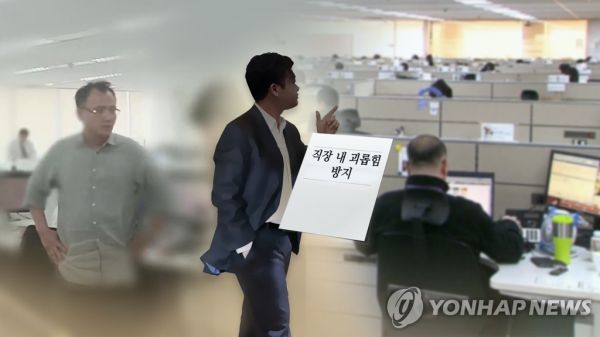
[Asia Economy reporters Seunggon Han and Jumi Lee] Although the Workplace Harassment Prohibition Act has been in effect for over a year and a half, some workers are still suffering from power harassment. There are not only lenient punishments for perpetrators but also workers who are completely excluded from the protection of this law. Experts emphasize that expanding the application of the law is crucial to reduce the number of workers suffering as much as possible.
Criticism of 'half-baked law' due to lenient punishments... Expert says "Law application must be expanded"
Park, who worked as a social worker at a social welfare center, endured verbal abuse, insults, and exclusion from work by the center director for some time. Even when applying for annual leave, it was treated as unauthorized absence, and Park was forced to write a written apology. Park recorded conversations with the center director and sought help from the Ministry of Employment and Labor, the National Petition Office, and the county office, but only received responses stating that "businesses with fewer than five employees are not covered by the law." Eventually, Park was able to receive a decision recognizing workplace harassment only after filing a complaint with the Human Rights Center.
As in Park’s case, workers at businesses with fewer than five employees have not felt the effects of the Workplace Harassment Prohibition Act even after its enforcement. According to a survey released last year by Workplace Power Harassment 119, when asked "Do you think harassment has decreased since the law was enacted?" 49% of workers at businesses with fewer than five employees answered "It has not decreased." This means that one in two workers is excluded from the law’s protection and suffers.
A similar case involved Bae, a worker in his 20s who worked as a caddy at a golf course in 2019. He claimed to have been continuously harassed by his superior, the "captain," and tragically took his own life in September last year. The bereaved family protested the company, demanding justice for their daughter and raising awareness about workplace harassment.
According to media reports, the captain publicly insulted and reprimanded Bae, and Bae was effectively dismissed after protesting.
The Ministry of Employment and Labor acknowledged that some of the captain’s actions toward Bae constituted "workplace harassment." However, it judged that directly applying workplace harassment regulations was difficult. This is because Bae, a golf course caddy, was a special employment worker who did not have a written labor contract. Furthermore, the accused superior denies the allegations of workplace harassment against Bae.
Victims of workplace power harassment can file complaints with the Ministry of Employment and Labor under related laws (Article 76-2 and 3 of the Labor Standards Act). However, there are no legal penalties, and the law only applies to workers and employers at businesses with five or more employees, which limits its scope.
For example, apartment security guards who suffer power harassment from residents, freelance salespeople who are effectively supervised by their bosses, and subcontractor employees working under the instructions of primary contractors find it difficult to be covered by the Workplace Harassment Prohibition Act. Harassment by third parties such as family members of primary contractors or customers is also excluded.
Special related parties are not in direct labor contracts but indirectly influence employment, so victimized workers suffer harassment without being able to respond. Even if employees of primary contractors use their dominant position to harass subcontractor or partner company employees, victims find it difficult to receive relief.
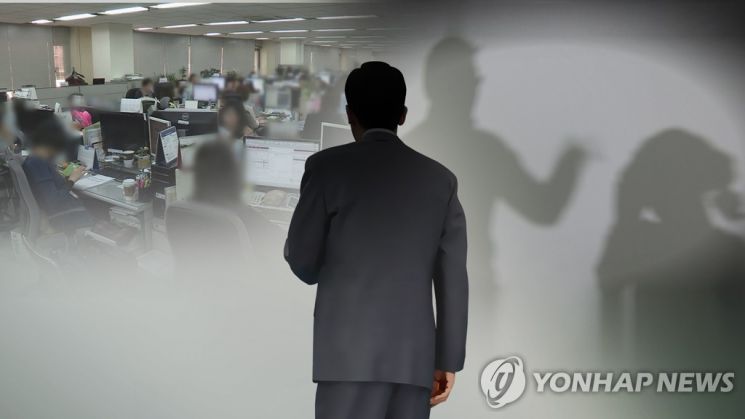 There are criticisms calling for the expansion of the application of the current Workplace Harassment Prevention Act. Photo by Yonhap News
Legal blind spots... Workers suffer without even being able to properly protest
According to a survey, some workers who suffer harassment at work cannot protest or simply endure it. According to the civic group Workplace Power Harassment 119, Kim, who works for a public institution’s service contractor, complained that a supervisor made him do unrelated tasks such as carrying chairs and flowerpots. Kim also said the supervisor took contractor employees to personal errands just because he was bored. However, the contractor is afraid of not having employment succession after the contract period ends and thus cannot respond.
Cases of power harassment by special related parties are not uncommon. According to a survey released by Workplace Power Harassment 119 in January, 9.3% of harassment perpetrators were special related parties in dominant positions, including customers, complainants, and client employees (4.4%), employer relatives (2.6%), and primary contractor managers and employees (2.3%). One in ten workers suffered harassment but had no proper way to seek relief.
There are more blind spots in the power harassment prevention law. It does not apply to businesses with "fewer than five employees." Under the current law, which applies only to businesses with five or more employees, workers at businesses with four or fewer employees cannot even report power harassment.
As a result, workplace harassment continues to increase. According to data released by Basic Income Party lawmaker Yong Hye-in on the 2nd, there were a total of 5,823 workplace harassment cases reported to the Ministry of Employment and Labor in 2020. This is an increase of 3,693 cases compared to 2,130 cases reported in the six months after the law’s enforcement in July 2019.
The average monthly number of workplace harassment reports in 2020 also reached 485, a 37% increase compared to 355 in 2019. In particular, punishments for perpetrators have not been properly enforced. Of the total 7,953 cases received from the law’s enforcement date to 2020, only 1.2% (94 cases) were forwarded to prosecution. The indictment rate was only 0.36% (29 cases) of all cases.
Looking at the situation after complaints, prosecution referrals, which are procedures for sending cases to trial, were also few. Among 7,941 cases closed by December 2020 (99.85%), 42.50% (3,375 cases) were withdrawn, 39.84% (3,164 cases) were categorized as others, 16.47% (1,308 cases) received improvement guidance, and only 1.18% (94 cases) were forwarded to prosecution.
By type of harassment, verbal abuse was the most common at 45.18% (3,571 cases), followed by unfair personnel actions and ostracism/gossip at 21.19% (1,675 cases) and 14.97% (1,183 cases), respectively. Others included discrimination 4.14% (327 cases), withholding work 3.61% (285 cases), assault 2.94% (232 cases), surveillance 2.11% (167 cases), personal errands 2.04% (161 cases), coercion 2.02% (160 cases), and others 1.81% (143 cases).
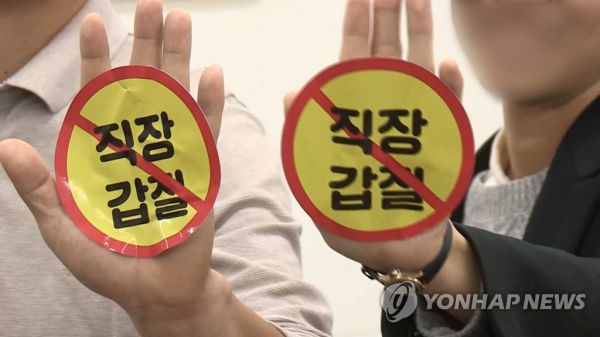
According to Statistics Korea, workers at businesses with fewer than five employees, a legal blind spot for power harassment, accounted for 26.5% (about 5.87 million people) as of 2018. This means that one in four workers in Korean society is excluded from the "Workplace Harassment Prohibition Act." This is why the law is criticized as a half-baked law with no real effectiveness.
Experts urge the expansion of the Workplace Harassment Prohibition Act. Oh Jin-ho, executive director of Workplace Power Harassment 119, told Asia Economy in a phone interview, "Especially in businesses with fewer than five employees, where employers and workers often have close relationships, it is important to resolve issues through legal systems," and emphasized, "It is urgent to amend the current law, which has limitations in its application."
© The Asia Business Daily(www.asiae.co.kr). All rights reserved.
!["The Woman Who Threw Herself into the Water Clutching a Stolen Dior Bag"...A Grotesque Success Story That Shakes the Korean Psyche [Slate]](https://cwcontent.asiae.co.kr/asiaresize/183/2026021902243444107_1771435474.jpg)


















