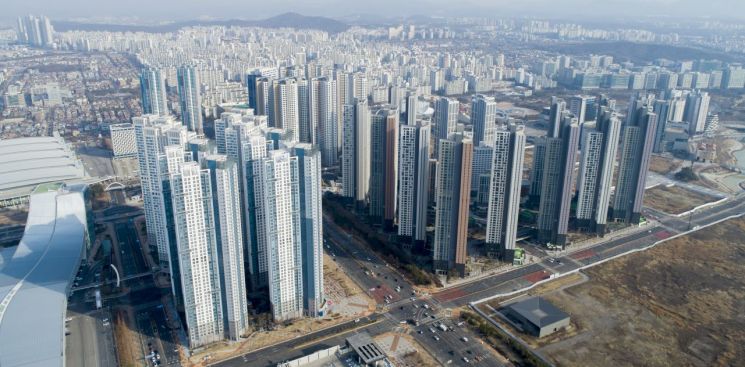
 The Bundang Hansol Village Jugong Complex 5, which marks its 30th year since completion this year, has become the first apartment complex among the first-generation new towns in the Seoul metropolitan area to receive approval for a remodeling project plan. Construction will begin at the end of this year, and three years later, it will be transformed into a new apartment complex with 115 additional units. This is also the first case of a large-scale remodeling project involving more than 1,000 households. The photo shows an apartment complex in the Kintex area of Ilsan, Goyang City, Gyeonggi Province, a first-generation new town.
 There is growing anticipation that remodeling of the first-generation new towns will gain momentum following the approval of the remodeling of Hansol Jugong Complex 5 in Bundang, but the government's passive stance remains an obstacle. This is because the feasibility of remodeling hinges on whether 'vertical extension' and the 'allowance of load-bearing wall demolition' between units are permitted, both of which remain uncertain. The government applies stringent regulations to vertical extensions and has yet to release research results on the allowance of load-bearing wall demolition even after five years.
The government first allowed vertical extension remodeling in April 2014. However, the only project to have received approval so far is Seongji Apartment in Songpa-dong, Songpa-gu, Seoul, which obtained business plan approval in February last year. The 3rd and 4th complexes of Nutimaeul Public Officials Village in Bundang-gu, Seongnam, which had been pursuing vertical extension remodeling since 2014, passed the first safety inspection but were ultimately deemed 'unsuitable' in the second safety review last month.
The government is concerned about potential housing price increases triggered by remodeling and the decline in residential quality. Chang-Hum Byun, Minister of Land, Infrastructure and Transport, described vertical extension as a "risky housing policy" at a forum hosted by the Democratic Policy Institute (now the Democratic Research Institute) in 2013. The decision of Hansol Jugong Complex 5 to switch to horizontal extension appears to stem from the judgment that the project could no longer be delayed while waiting for the uncertain approval of vertical extension.
Another key factor for revitalizing remodeling is the allowance of load-bearing wall demolition. If demolition of load-bearing walls, which support the building's weight, is not permitted, flexible floor plan design is impossible. Most mid-rise apartments over 15 years old are constructed with a wall-type structure (without separate columns) and feature a 2-bay floor plan (arranged with one room and one living room facing the apartment front). Maintaining the load-bearing walls as is makes it difficult to expand to the popular 4-bay layout.
The government announced at the end of 2015 that partial demolition of load-bearing walls between apartment units would be allowed during vertical extension remodeling, but reversed its position in August the following year, citing safety concerns and promising to reconsider. It had declared it would decide on the allowance by March 2019, but the announcement has been delayed. The Korea Institute of Civil Engineering and Building Technology, which conducted the research, submitted a report last year indicating that partial demolition is possible, but the government has yet to make an official statement.
© The Asia Business Daily(www.asiae.co.kr). All rights reserved.

![Clutching a Stolen Dior Bag, Saying "I Hate Being Poor but Real"... The Grotesque Con of a "Human Knockoff" [Slate]](https://cwcontent.asiae.co.kr/asiaresize/183/2026021902243444107_1771435474.jpg)















