Design, Price, and Performance Significantly Superior to Existing Electric Vehicles
Vehicle Semiconductor Supply Shortage Identified as a Challenge to Overcome
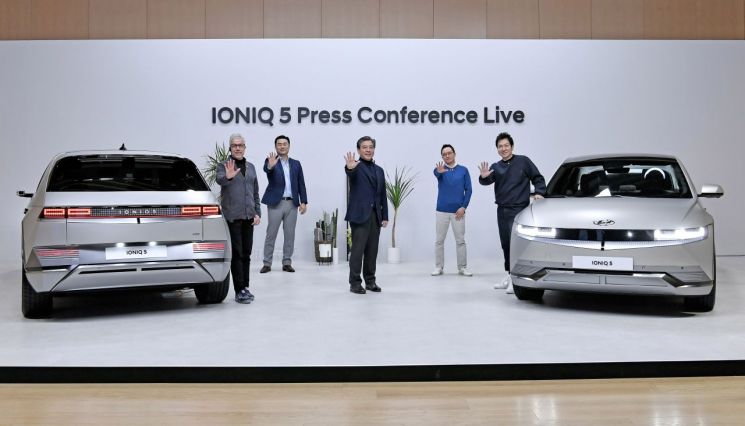 At the press conference held online on the 23rd, Hyundai Motor officials are taking commemorative photos with the Ioniq 5. (From left) Faiyez Raman, Executive Vice President of Vehicle Architecture Development Center; Kim Heung-su, Head of Product Division; Jang Jae-hoon, President; Ji Sung-won, Head of Creative Works Office; Lee Sang-yup, Executive Vice President in charge of Hyundai Design.
[Asia Economy Reporter Changhwan Lee] Hyundai Motor Company unveiled its first dedicated electric vehicle, the Ioniq 5, marking its entry into the global electric vehicle market. Industry experts expect the Ioniq 5 to gain significant popularity in the EV market considering its performance, design, and price. However, the recent severe shortage of automotive semiconductors is seen as a variable that could affect the success of the Ioniq 5.
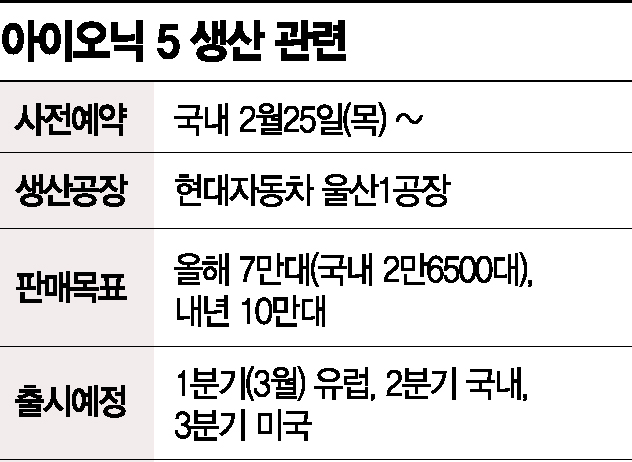
Hyundai announced on the 24th that it plans to sell 70,000 units of the Ioniq 5, the first model to apply the dedicated electric vehicle platform E-GMP (Electric-Global Modular Platform), in the global market this year.
Jang Jae-hoon, President of Hyundai Motor Company, said, "The total sales target for the Ioniq 5 this year is 70,000 units, and from next year onwards, we plan to increase it to 100,000 units. We aim to establish ourselves as a top-tier brand leading the electrification era in the global electric vehicle market."
The market views the 70,000-unit target as achievable. The global electric vehicle market has been explosively growing recently, and popular models like Tesla Model 3 and Renault Zoe already sell hundreds of thousands of units annually.
Kim Gui-yeon, a researcher at Heungkuk Securities, explained, "Considering that Hyundai’s existing representative electric vehicle model, Kona EV, sold 85,000 units globally last year and the continued expansion of the electric vehicle markets in Europe and Korea, the 70,000-unit target is a level that can be comfortably achieved."
There is also analysis that Hyundai’s future depends on the success of the Ioniq 5. Hyundai plans to launch 23 electric vehicle models by 2025 using the E-GMP platform, aiming for annual sales exceeding one million units.
Song Seon-jae, a researcher at Hana Financial Investment, said, "The success of the Ioniq 5 will serve as a clue to evaluate the product competitiveness of E-GMP and predict Hyundai’s position in the electric vehicle market. Moreover, based on the competitiveness of the hardware platform, adding software and service technology capabilities could also serve as a gauge of Hyundai’s ability to expand into the mobility market."
However, the recent shortage of automotive semiconductors, which has hit the automotive industry, is considered a challenge that the Ioniq 5 must overcome to succeed. Due to the shortage of automotive semiconductor supply, many global automakers such as GM, Ford, Volkswagen, and Toyota have recently reduced production volumes. Hyundai is also experiencing difficulties in securing some semiconductors and is adjusting vehicle production volumes in response.
The electric vehicle Ioniq 5 is understood to require more semiconductors than conventional internal combustion engine vehicles. While conventional vehicles contain about 200 to 300 automotive semiconductors, electric vehicles are known to have roughly over 1,000 semiconductors depending on the model. Accordingly, it is expected that Hyundai will prioritize supplying automotive semiconductors to the Ioniq 5.
A Hyundai official said, "We are continuing operations through adjustments to vehicle production plans and negotiations with semiconductor makers, but some semiconductor parts are not being supplied smoothly. To secure quantities, we check inventory on a weekly basis and conduct direct negotiations with semiconductor makers."
© The Asia Business Daily(www.asiae.co.kr). All rights reserved.


















