Demand for Route Diversion or Undergrounding Project to Outskirts of the City Center
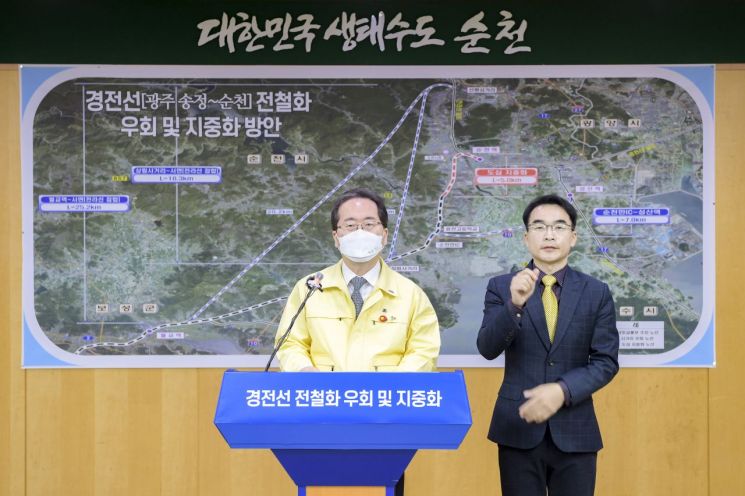
[Asia Economy Honam Reporting Headquarters Reporter Lee Hyung-kwon] On the morning of the 24th, Heo Seok, mayor of Suncheon, announced his position on the Gyeongjeon Line electrification project through a video briefing.
Mayor Heo said, “Once the Gyeongjeon Line high-speed electrification project and the Namhae Coast railway between Suncheon and Mokpo are opened, new tourism demand will be created in Busan, Gwangju, and other areas, and Suncheon will truly become the central city of the Namhae Coast region.”
However, he added, “Every matter has its pros and cons,” and said, “If the project proceeds exactly as the government currently plans, an increase in train operation frequency and the installation of high-voltage electrification structures are expected to cause considerable damage to the lives of citizens within the railway network’s influence, so we must gather the will of the citizens and respond wisely.”
If the Gyeongjeon Line electrification project proceeds according to the government’s plan, 46 trains will pass through 10 level crossings in Suncheon city daily, meaning more than one high-speed train will pass through the downtown area every 30 minutes.
As a result, residents near the railway will suffer from noise and dust damage, and the risks of traffic congestion and traffic accidents will increase.
Additionally, the installation of 7-meter-high high-voltage structures will damage the cityscape and seriously impact Suncheon’s brand image, which promotes itself as an ecological city.
In response, Mayor Heo proposed two alternatives.
One is to change the railway route to the outskirts of the city, and the other is to underground the downtown section.
He argued that by rerouting the line from Beolgyo Station to the outskirts of Suncheon and connecting it to the Jeolla Line at Seomyeon, and by undergrounding the downtown section, various inconveniences can be resolved, and the existing railway line can be utilized as urban infrastructure such as parks, roads, and parking lots.
Mayor Heo said, “Even if it requires a large budget, the route should be decided from a long-term perspective that aligns with the future development of Suncheon as an ecological capital,” and added, “For the development of Suncheon and the improvement of citizens’ living areas, we will gather the consensus of the citizens and make recommendations to the government.”
Meanwhile, the Gyeongjeon Line electrification project is a project to electrify the Gwangju-Suncheon section of the Gyeongjeon Line, which connects Gwangju Station to Busan Bujeon Station and has not been upgraded since its construction in 1930. This will reduce the travel time between Gwangju and Busan, which previously took more than five hours, to about two hours.
The government passed the preliminary feasibility re-investigation of the Gyeongjeon Line electrification project in 2019 without consulting Suncheon city’s opinion, deciding to use the existing line for the Suncheon section due to economic reasons, which is the background for this statement.
© The Asia Business Daily(www.asiae.co.kr). All rights reserved.

![Clutching a Stolen Dior Bag, Saying "I Hate Being Poor but Real"... The Grotesque Con of a "Human Knockoff" [Slate]](https://cwcontent.asiae.co.kr/asiaresize/183/2026021902243444107_1771435474.jpg)















