11cm Longer Wheelbase than Model Y... Spacious Interior
Ioniq 5 Has Lower Battery Capacity than Model Y but Significantly Faster Charging Speed
After Excise Tax Cut and EV Subsidy, Price in the High 30 Million Won Range
[Asia Economy Reporter Ki-min Lee] Hyundai Motor Company unveiled the Ioniq 5, which features an electric vehicle-exclusive platform, on the 23rd, drawing attention as a rival to Tesla's Model Y. Comparing the two vehicles, the Ioniq 5 appears to have an advantage in 'cost-effectiveness (performance relative to price)'.
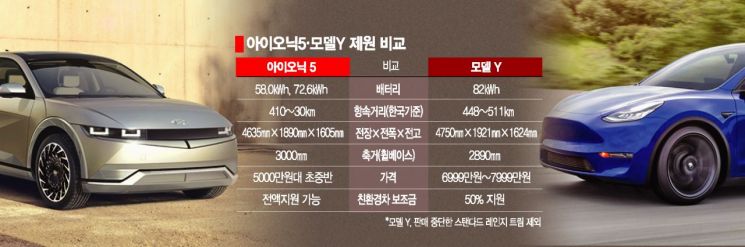
The Model Y is larger in body size than the Ioniq 5. According to Hyundai, the Ioniq 5 measures 4635 mm in length, 1890 mm in width, and 1605 mm in height. In comparison, the Model Y measures 4750 mm in length, 1921 mm in width, and 1624 mm in height. However, the interior space is more spacious in the Ioniq 5. The wheelbase, which is the distance between the centers of the front and rear wheels and is crucial for creating interior space, is 3000 mm in the Ioniq 5, which is 110 mm longer than the Model Y's 2890 mm. It is also about 360 mm longer than Hyundai's compact SUV Tucson, which gained popularity last year amid the 'car camping' trend. To optimize the use of interior space, Hyundai equipped the Ioniq 5 with a movable console called the 'Universal Island' and designed the second-row seats to move forward by 135 mm.
In terms of driving range, the Model Y, with a battery capacity of 82 kWh, surpasses the Ioniq 5, which has a capacity ranging from 58.0 kWh to 72.6 kWh. The Model Y's driving range is between 448 km and 511 km, while the Ioniq 5's range is somewhat shorter at 410 km to 430 km. There is also a power gap. The Model Y delivers 384 horsepower (based on the Long Range version), whereas the Ioniq 5 produces 225 horsepower (based on the all-wheel-drive Prestige version). The zero to 100 km/h acceleration time is 5.2 seconds for the Ioniq 5, while the Model Y is slightly faster at 4.2 seconds.
Most notably, the battery charging speed, which is vital for electric vehicles, is where the Ioniq 5 outperforms the Model Y. The Ioniq 5 supports 800V fast charging, allowing it to charge up to 80% in just 18 minutes and to drive 100 km after only 5 minutes of charging. In contrast, the Model Y takes over an hour to fully charge.
It is difficult to determine superiority in autonomous driving technology due to differences in operating methods. The Model Y is equipped with cameras and ultrasonic sensors similar to other Tesla vehicles, while the Ioniq 5 combines LiDAR and radar sensors. Both vehicles are evaluated to have autonomous driving capabilities at level 2.5, which corresponds to partial automation.
The strengths of the two vehicles are distinctly different. The Ioniq 5 is equipped with a V2L (Vehicle To Load) function that allows the vehicle's electricity to be used externally, and an intelligent air flow controller (AAF) that can extend driving range. On the other hand, the Model Y features an Autopilot function that enables the car to move autonomously once a destination is set.
As the pros and cons of the Ioniq 5 and Model Y diverge, price competitiveness is also expected to be a factor in purchasing decisions. The domestic launch price of the Model Y Standard Range trim was 59.99 million KRW, making it eligible for full electric vehicle subsidies, but sales are currently suspended. Meanwhile, the pre-tax price of the Ioniq 5 Long Range Exclusive model is in the low 50 million KRW range, and the Prestige trim is in the mid-50 million KRW range. After subsidies (1.2 million KRW based on Seoul city standards) and a 3.5% reduction in individual consumption tax are applied, the Exclusive trim can be purchased for the high 30 million KRW range.
© The Asia Business Daily(www.asiae.co.kr). All rights reserved.

















