Statistics Korea Announces '2020 Birth and Death Statistics (Provisional)'... South Korea's Fertility Rate Remains OECD's Unchallenged Last Place
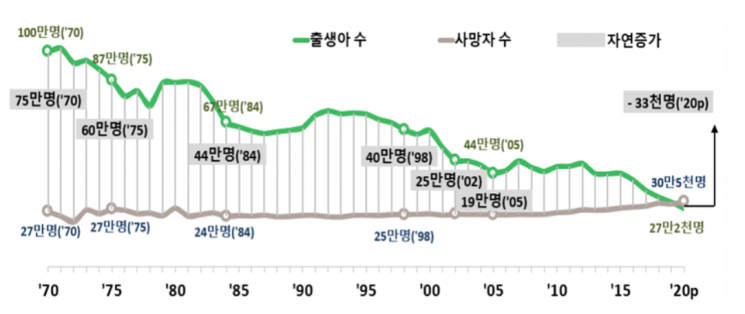
[Sejong=Asia Economy Reporter Son Sun-hee] Last year, South Korea's population declined for the first time in history, marking the beginning of a full-fledged 'population shrinkage era.' The annual number of births, which had been setting 'all-time lows' every year, finally fell below the number of deaths, resulting in a natural decrease in the total population. This is the first time such an event has occurred since related statistics began being compiled in 1970.
According to the '2020 Birth and Death Statistics (Preliminary)' released by Statistics Korea on the 23rd, the natural population increase (births minus deaths) last year was -33,000, a decrease of 40,000 from the previous year's 7,600, marking the first negative figure. The natural increase rate, which indicates natural increase per 1,000 people, also recorded -0.6, down 0.7 from the previous year.
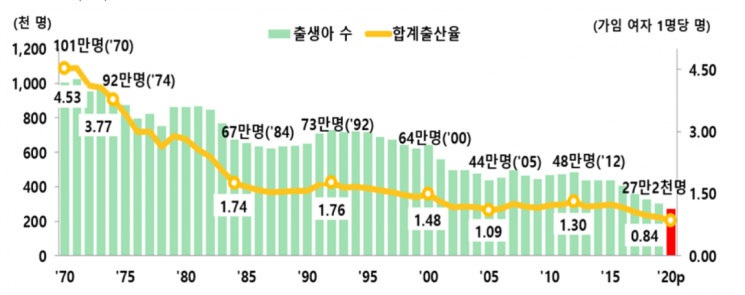
This is the result of a steady decline in the number of births. The annual number of births last year was 272,400, a 10% decrease compared to the previous year. It is also the first time the annual number of births has fallen below 300,000. The rate of decline has also widened compared to the previous year (-7.4%).
The total fertility rate (the average number of children a woman is expected to have in her lifetime) was 0.84, down 0.08 from 0.92 the previous year. The crude birth rate, which indicates the number of births per 1,000 people, was 5.3, down 0.6 from the previous year.
This fertility rate in South Korea ranks the lowest among the 37 OECD countries. South Korea is the only OECD country with a fertility rate below 1.
By age group, fertility rates (number of births per 1,000 women in the respective age group) declined in all age groups except for those in their 40s. The highest fertility rate was among women in their early 30s (30-34 years) at 79, followed by late 30s (35-39) at 42.3, and late 20s (25-29) at 30.6. However, fertility rates in these most active childbearing age groups dropped significantly. The fertility rate for women in their early 30s decreased by 7.2 compared to the previous year, 5.1 for late 20s, and 2.7 for late 30s. The average age of childbirth rose by 0.1 years to 33.1 years.
By month, the number of births decreased every month last year compared to the previous year. The number of births declined in all cities and provinces nationwide, with Daegu (-15.3%), Incheon (-13.3%), and Gyeongnam (-12.5%) showing the largest decreases. The absolute number of births was highest in Gyeonggi Province at 78,000, followed by Seoul at 47,000.
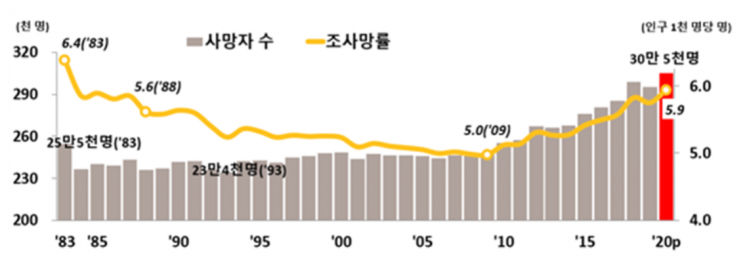
In contrast to the record low number of births, the annual number of deaths last year was 305,100, an increase of 3.4% (10,000) compared to the previous year. The crude death rate, which indicates the number of deaths per 1,000 people, was 5.9, up 3.4% (0.2) from the previous year. The number of deaths increased among people in their 20s and those aged 60 and above compared to the previous year. For both men and women, the highest number of deaths was among those in their 80s. Marking the 'population dead cross,' where deaths outnumber births, this trend is expected to continue for the foreseeable future.
© The Asia Business Daily(www.asiae.co.kr). All rights reserved.
![Clutching a Stolen Dior Bag, Saying "I Hate Being Poor but Real"... The Grotesque Con of a "Human Knockoff" [Slate]](https://cwcontent.asiae.co.kr/asiaresize/183/2026021902243444107_1771435474.jpg)













