Causes of Declining School-Age Population
2021 Admissions: Regular Admission Quota > Number of Applicants
Reality of Admissions Population Cliff... Significant Impact on Regional Universities
Experts Say "Reduction of Enrollment Quotas Needed"
 There is growing interest in cases where students who received low grades on the 2021 College Scholastic Ability Test (CSAT) managed to gain final admission to top-tier universities through so-called "bbangku (holes)." The photo is unrelated to specific expressions in the article. / Photo by Yonhap News
[Asia Economy Reporter Lim Ju-hyung] A controversy has arisen as a story about a student who was admitted to a top-tier university despite receiving low grades on the 2021 College Scholastic Ability Test (CSAT) has come to light. This phenomenon is known as a so-called 'bbangku (hole)'. It refers to cases where the number of applicants for a specific university department falls short of the admission quota, allowing students with relatively low scores to be admitted.
The problem is that this hole phenomenon has begun to occur even in prestigious top-tier universities that previously had high competition rates. In particular, the phenomenon appears to be intensifying in local universities hit hard by factors such as concentration in the metropolitan area and a declining school-age population. Some test-takers and university students have expressed frustration, pointing out that university admissions are effectively turning into a 'game of wits' rather than a merit-based process.
◆"I study like crazy to get into a good university," test-takers express frustration
Earlier on the 21st, a post titled "The situation of the math department at XX University where students with CSAT grades 7, 8, 5, 7, 7 were admitted" was uploaded on an online community related to the CSAT.
According to the post, Mr. A, who received a grade 7 in Korean, grade 8 in Math (Type A), and grade 5 in English on this year's 2021 CSAT, was admitted to the math department of a four-year local flagship national university (Jigeoguk).
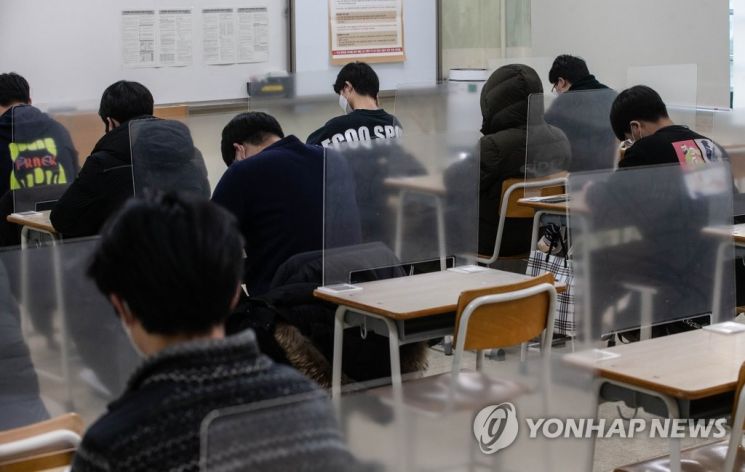 On the morning of December 3, 2020, when the 2021 College Scholastic Ability Test was held, examinees were preparing for the exam at Yongsan High School in Yongsan-gu, Seoul. / Photo by Yonhap News
According to Mr. A, the math department at this university recruited 19 students in the regular admissions this year, with a total of 49 applicants, resulting in a competition rate of only 2.58. Consequently, if the initially admitted students defer enrollment, Mr. A, who has a significantly low CSAT grade but holds a waiting list number, has a high chance of final admission.
Some university students and test-takers who saw Mr. A's score report and final admission notice expressed frustration. They pointed out that university admissions have effectively turned into a game of wits targeting departments with low competition rates.
One netizen wrote on a CSAT-related internet community, "I study like crazy to get into a good university, but some people get into Jigeoguk by choosing departments with holes," adding, "Of course, since this is a rare stroke of luck, I try not to be conscious of it, but I can't help feeling empty."
There were also reactions expressing surprise at the poor situation of local universities. University student B (26) said, "This is something unimaginable just a few years ago. I heard that Jigeoguk is not inferior to most universities in Seoul," adding, "Although it is said that local universities are closing down 'in the order of cherry blossoms blooming,' I didn't expect it to be this bad."
◆Number of regular admissions > Number of applicants... Reality of the school-age population cliff
This hole phenomenon is not new. In the past, there have been occasional cases where students with relatively low CSAT grades were finally admitted due to fewer applicants than the admission quota in some departments of top-tier universities, resulting in lower competition rates. However, such cases are very rare and seem to occur when newly established departments lack sufficient promotion, leading to fewer applicants.
Another problem is that the hole phenomenon currently occurring in some local universities stems from structural issues. Due to concentration in the metropolitan area and a declining school-age population, the number of applicants to local universities is falling short of the regular admission quota, a so-called 'under-enrollment' phenomenon, and concerns are rising that this effect is spreading even to Jigeoguk.
In particular, under-enrollment was realized in this year's CSAT. According to the Korea Council for University Education (KCUE) on the 22nd, the number of additional admissions for regular recruitment at 162 four-year universities this year was 26,129, nearly three times the 9,830 in the previous year. Additional admissions are a system where universities that fail to fill their admission quotas select additional successful candidates.
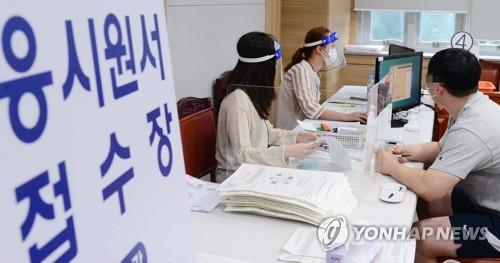
Especially, the under-enrollment problem appears to be worsening in local areas. By region, the number of additional admissions was highest in Gyeongbuk (4,331), followed by Busan (3,883) and Jeonbuk (2,566).
The under-enrollment phenomenon occurs because the school-age population itself is decreasing. This year, the total number of CSAT applicants was 493,433, down by more than 50,000 from the previous year (548,734). Meanwhile, the university admission quota this year is 555,774.
This means that the number of CSAT applicants is more than 60,000 short of the number of students universities plan to admit. Ultimately, local universities far from the metropolitan area are bound to be hit first.
◆Experts: Both metropolitan and local universities need to reduce quotas
Given this situation, voices are emerging expressing concern about the 'collapse of local universities' due to financial difficulties and other issues caused by failure to fill admission quotas. If the collapse of local universities becomes a reality, not only the local economy dependent on university-adjacent commercial districts but also regional industries cooperating with various research institutes established by universities could suffer significant damage.
Experts suggest that to resolve the crisis of local university collapse, a balanced reduction of admission quotas across universities nationwide and government support policies to mitigate expected financial damage to universities are necessary.
A representative from the University Education Research Institute told Asia Economy in a phone interview, "The biggest crisis currently facing Korean universities is the decline in the school-age population itself, and the crisis for local universities caused by this is growing," adding, "By 2024, among 220 local universities outside Seoul, Incheon, and Gyeonggi, 85 schools will fail to fill 70% of their freshman quotas."
He continued, "In particular, local universities heavily rely on tuition for revenue and have a significant impact on local commercial districts, so the crisis of local universities greatly affects local communities," emphasizing, "To prevent this crisis, a balanced reduction of university admission quotas including both metropolitan and local universities is necessary."
He also advised, "Due to quota reductions, universities will inevitably face short-term financial damage, so policies to alleviate this through active government financial support will be necessary."
© The Asia Business Daily(www.asiae.co.kr). All rights reserved.
![Clutching a Stolen Dior Bag, Saying "I Hate Being Poor but Real"... The Grotesque Con of a "Human Knockoff" [Slate]](https://cwcontent.asiae.co.kr/asiaresize/183/2026021902243444107_1771435474.jpg)


















