[Asia Economy Reporter Eunbyeol Kim] The Bank of Korea has clearly expressed its intention to actively participate in National Assembly discussions regarding the expansion of the Bank’s role, including the addition of a ‘responsibility for employment stability.’
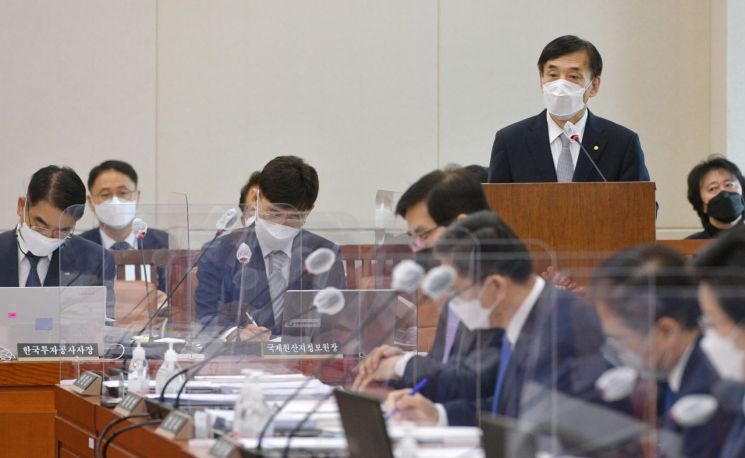
On the 23rd, Bank of Korea Governor Lee Ju-yeol stated during a briefing to the National Assembly’s Planning and Finance Committee, “We will thoroughly review the addition of the responsibility for employment stability and actively participate in related discussions in the National Assembly.” Although the necessity of adding this responsibility was mentioned in this year’s monetary and credit policy directions and New Year’s address, this statement conveyed a stronger tone of commitment to actively engage in the National Assembly’s discussions. Accordingly, the pace of deliberations on the amendment to the Bank of Korea Act in the National Assembly is expected to accelerate.
Due to the significant employment shock caused by COVID-19 and growing public opinion that the Bank’s role should be expanded, several amendment bills reflecting the ‘employment stability’ goal in Article 1 of the Bank of Korea Act have been consecutively proposed in the National Assembly. However, concerns have been raised regarding potential conflicts with the Bank’s existing objectives such as price stability and financial stability, and uncertainty about how effective monetary policy would be in improving employment conditions. Governor Lee said, “We will comprehensively gather opinions from external experts and others.”
In today’s report, the Bank of Korea assessed that while expectations for global economic recovery are rising, uncertainties remain high. Governor Lee stated, “There are views that economic recovery will not be easy for the time being due to the continued high uncertainty related to the spread of infectious diseases.” He added that monetary policy will be operated in a accommodative manner to support the domestic economic recovery.
Regarding the recent concentration of funds into asset markets such as stocks and real estate, Governor Lee said, “We will pay closer attention to changes in financial stability risks, including capital flows into asset markets and the increase in household debt.”
The Bank of Korea announced it will proceed with purchasing government bonds amid the recent rise in government bond yields. However, in response to a question from Ryu Seong-geol, a member of the People Power Party, about direct purchases of government bonds, Governor Lee maintained a negative stance, saying, “Our position that it is undesirable for the Bank of Korea to directly underwrite government-issued bonds has not changed.”
© The Asia Business Daily(www.asiae.co.kr). All rights reserved.

















