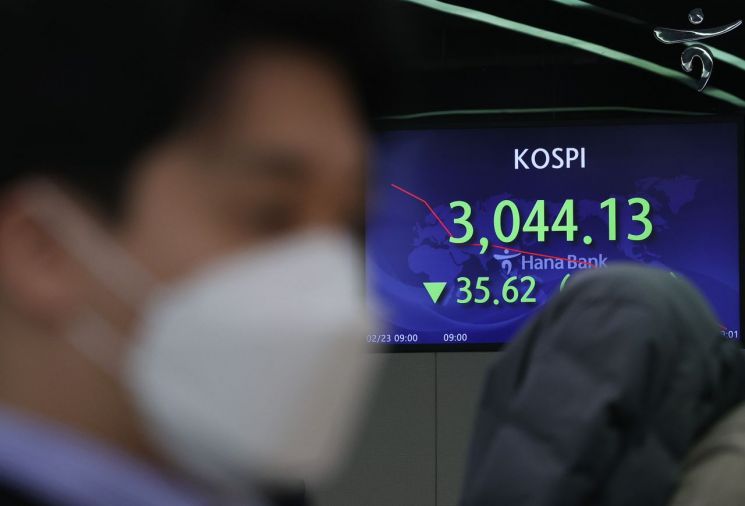
[Asia Economy Reporter Lee Seon-ae] On the 23rd, the domestic stock market, which started lower, is showing signs of instability as the decline widens. Foreigners and institutions are leading the index drop with a dominant 'sell' stance, while only individuals are struggling to defend with 'buy' orders.
As of 10:15 AM on the 23rd, the KOSPI is at 3036.15, down 1.42% from the previous day. The KOSDAQ is at 934.35, down 2.09%. Both KOSPI and KOSDAQ started the day down by 0.34% and 0.22%, respectively, with the losses increasing as time passes.
Seosangyoung, a researcher at Kiwoom Securities, said, "The U.S. stock market's weakness due to increased Bitcoin volatility, rising interest rates, and Treasury Secretary Janet Yellen's remarks on taxes is expected to act as a factor dampening investor sentiment in our market as well. In particular, the significant drop in the Philadelphia Semiconductor Index will also be a burden."
There is widespread fear of a market correction due to rising interest rates and inflation. Especially, foreigners, who hold the key to the direction of the domestic market, are pouring out sell orders, driving the market down.
As of 10:20 AM, foreigners are net selling about 203.5 billion KRW in the KOSPI market. In the KOSDAQ market, they are net selling 14.2 billion KRW. Institutions are also selling in both markets, with net sales of about 18.6 billion KRW in KOSPI and 13.5 billion KRW in KOSDAQ. Only individuals are net buyers, engaging in a tough battle. Individuals are net buying about 231.9 billion KRW in KOSPI and 46.6 billion KRW in KOSDAQ. This is interpreted as a belief that despite rising interest rates, the domestic market will trend upward, prompting buying activity.
Park Sang-hyun, a researcher at Hi Investment & Securities, said, "Although concerns about rising interest rates are emerging, looking at the trends of stock prices and economic indicators during U.S. 10-year Treasury yield increases since 1990, there has been only one instance where stock prices fell during a rising interest rate phase." He explained, "With strong economic stimulus measures and expanded vaccine distribution as tailwinds, there is a high possibility of a strong rebound in the global economy including the U.S. Although interest rates may rise faster than expected, solid economic fundamentals are expected to absorb much of the shock from rising rates."
Currently, investors are closely watching for remarks from Federal Reserve Chair Jerome Powell this evening. Researcher Seo said, "Investors are anticipating Powell's remarks tonight, so the possibility of continued investor sentiment deterioration is limited. Since it is expected that he will maintain his stance, there is high anticipation for a rebound buying wave. Considering this, the Korean market is expected to show changes following the People's Bank of China's announcement after 10 AM and then seek a rebound ahead of the market close in anticipation of Powell's remarks."
© The Asia Business Daily(www.asiae.co.kr). All rights reserved.

















