[Asia Economy Reporter Choi Dong-hyun] The participation rate of people with disabilities in recreational sports has decreased due to the impact of COVID-19.
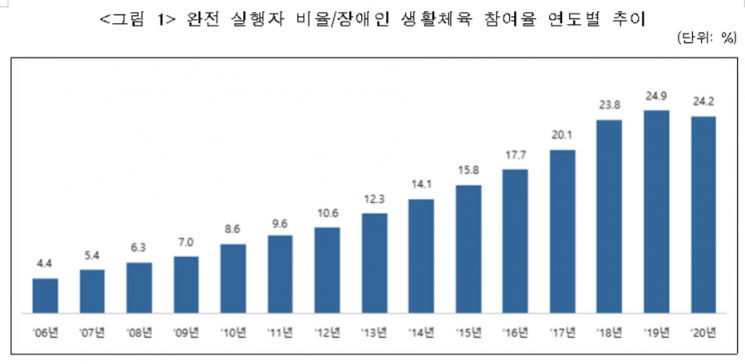
The Ministry of Culture, Sports and Tourism announced on the 23rd that the participation rate in recreational sports among people with disabilities in Korea was 24.2% last year, based on the results of the "2020 Disabled Recreational Sports" survey conducted on 10,000 registered people with disabilities nationwide in collaboration with the Korea Paralympic Committee.
According to the survey, the proportion of "fully active participants in disabled recreational sports," who exercise at least twice a week, decreased by 0.7% compared to 2019. After showing an increasing trend every year since the 2006 survey, the participation rate of people with disabilities in recreational sports declined for the first time last year.
The most common places where people with disabilities exercised were outdoor hiking trails or parks, accounting for 31.8%. This was followed by sports facilities (12.9%) and homes (8.2%). The rate of those not using sports facilities increased by 5.6 percentage points from the previous year to 87.1%.
COVID-19 also affected the types of sports participated in. The most common exercise among recreational sports participants was walking and light jogging (58.4%). This was followed by strength training (9.2%) and calisthenics without equipment (7.3%), indicating a high proportion of solo exercises.
The primary purpose of exercise for people with disabilities was "health and fitness management," at 82.9%. This was followed by rehabilitation exercise (11.0%) and leisure activities (5.9%).
Regarding companions during exercise, "alone" was the most common response at 68.7%, an increase of 5% from the previous year. This was followed by family and relatives (15.6%) and friends (4.2%).
As for the most important areas for improvement during exercise, cost support was chosen the most at 47.6%, continuing from last year. Other areas identified for improvement included disabled recreational sports programs (12%), exercise equipment and gear for people with disabilities (11%), and accessibility facilities for people with disabilities at sports facilities (9.8%).
A policy official from the Ministry of Culture, Sports and Tourism stated, "Despite the prolonged COVID-19 pandemic, it is fortunate that the participation rate only slightly decreased due to the regular exercise efforts of people with disabilities to maintain their health and fitness." He added, "Since barriers to exercise participation remain high for people with disabilities, we plan to create an environment where they can participate in exercise anytime and anywhere."
© The Asia Business Daily(www.asiae.co.kr). All rights reserved.
![Clutching a Stolen Dior Bag, Saying "I Hate Being Poor but Real"... The Grotesque Con of a "Human Knockoff" [Slate]](https://cwcontent.asiae.co.kr/asiaresize/183/2026021902243444107_1771435474.jpg)
















